


Follow us
Add us as a preferred source on Google
Subscribe to our newsletter
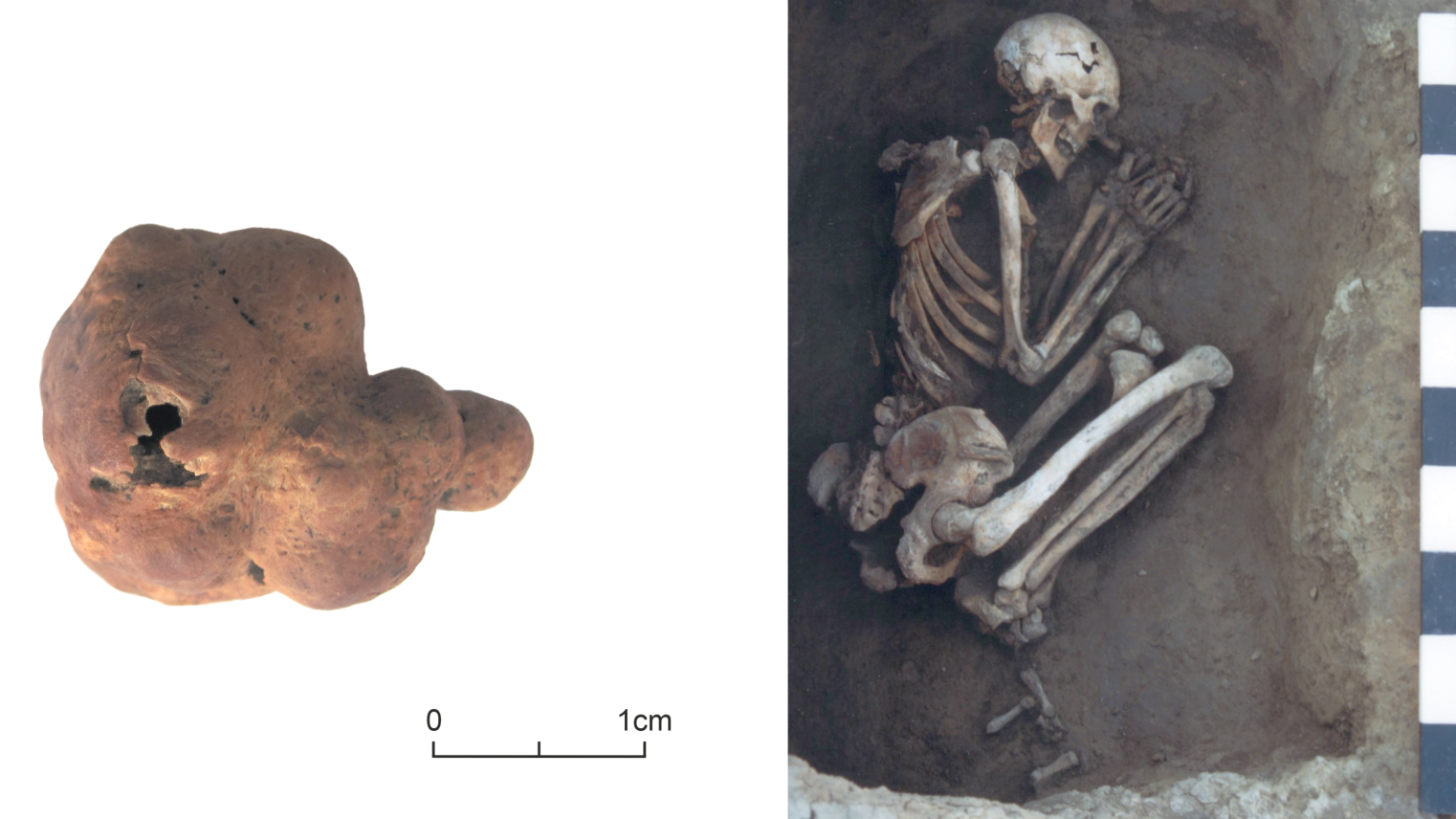
A Bronze Age man buried in a monumental tomb near the Black Sea may have died from complications of a urinary tract infection (UTI) more than five millennia ago, according to a new study. Archaeologists identified a grape-size object consistent with a kidney or bladder stone in the man’s burial.
“He lived with a chronic urogenital infection,” study lead author Natalia Berezina, an anthropologist at Lomonosov Moscow State University in Russia, told Live Science in an email.
“It was not a brief episode,” she said. “His last years were probably marked by considerable and more or less constant pain.”
Latest Videos FromLive Science
Berezina and colleagues investigated a small, stone-like object found in an Early Bronze Age burial in the Stavropol Upland region of southwestern Russia. They published their findings Sept. 30 in the journal Archaeological and Anthropological Sciences.
The burial was part of a kurgan cemetery, an ancient steppe funeral tradition that involved constructing a large mound of dirt over a grave. Archaeologists discovered a catacomb when they excavated the mound, and inside was the skeleton of a man who was in his 40s when he died around 5,300 years ago. The researchers found a flint arrowhead near the man’s pelvis.
But during a laboratory analysis after the skeleton was excavated, researchers noticed an odd stone-like object in the collection of hand bones. The brownish object was round with several protrusions and measured about 0.8 inches (2.1 centimeters) in diameter, or roughly the size of a grape. A small crack in the object showed a crystal-like structure inside.
To learn more, the researchers used several analytical methods to determine what the tiny object was made of. First, X-ray fluorescence analysis revealed that the main components of the object were calcium and phosphorus. Then, they used X-ray powder diffraction analysis to identify the crystal structures.
Get the world’s most fascinating discoveries delivered straight to your inbox.
In addition to common minerals, the researchers discovered the presence of whitlockite, a rare calcium salt that is known to occur in kidney, bladder and prostate stones. These “stones,” collectively called calculi, are hard masses of minerals, such as calcium-containing salts. They differ in terms of the organ they form within, the exact mechanism of how they form, and their chemical makeup, although kidney and bladder stones tend to contain very similar compounds.
Whitlockite is strongly associated with bacterial infections in the human body, which suggests that the Bronze Age man had a chronic infection that resulted in the stone, the scientists concluded.
“On the balance of the available evidence, we regard a renal [kidney] stone secondary to chronic upper urinary tract infection as the most probable origin,” the researchers wrote. That is, the man dealt with chronic or recurrent UTIs, which led to the formation of the stone and likely caused him considerable discomfort. UTIs can contribute to the formation of kidney stones by altering the acidity of urine and making minerals more likely to accumulate.
The researchers aren’t sure why the man had urinary tract issues or whether it contributed to his death.
Notably, kidney stones can sometimes travel to the bladder, so it’s unclear exactly where the stone was in the man’s body when he died. If the stone had obstructed the man’s ureter — one of the two long tubes that connect the kidneys to the bladder — it may have caused kidney swelling, a secondary infection or sepsis. These conditions were frequently fatal prior to the invention of antibiotics.
Other possibilities for what caused the stone include a bacterial infection of the man’s prostate gland or even a sexually transmitted infection.
The man was likely on the move frequently within this Early Bronze Age steppe society, and other injuries to his skeleton suggested he had a physically demanding life, the researchers wrote. His bones showed that he was well muscled but was also dealing with degenerative joint disease in his spine, shoulders, hips, hands and feet. He had a series of healed fractures in his right shoulder, ribs and forearm.
“These were people who worked with cattle and heavy wagons on the open steppe,” Berezina said, “and the injuries that follow from that are the injuries we find.” In a previous study at a nearby cemetery, Berezina and colleagues found the skeleton of a man who was injured when a wagon ran over him, several years before his death. “Against that background, four healed fractures in our man look unremarkable,” she said.
But the urinary tract stone would have made the man’s life difficult, the researchers noted. “This individual suffered from a painful and debilitating chronic urogenital infection, a condition that would have significantly impacted his quality of life,” they wrote.
Berezina, N. Ya., Statkus, M. A., Kalmykov, A. A., Abdrashitova, I. V., Kolesnik, I. V., Platonov, V. B., Shashurin, D. A., Garmay, A. V., Korobkova, V. V., Ryleeva, V. S., & Gresky, J. (2026). Urolithiasis in the Early Bronze Age of the North Caucasus: A paleopathological case study and insights into ancient lifeways. Archaeological and Anthropological Sciences, 18(10), 209. https://doi.org/10.1007/s12520-026-02574-7
What do you know about the bones in your body? Test your knowledge with our human skeleton quiz.