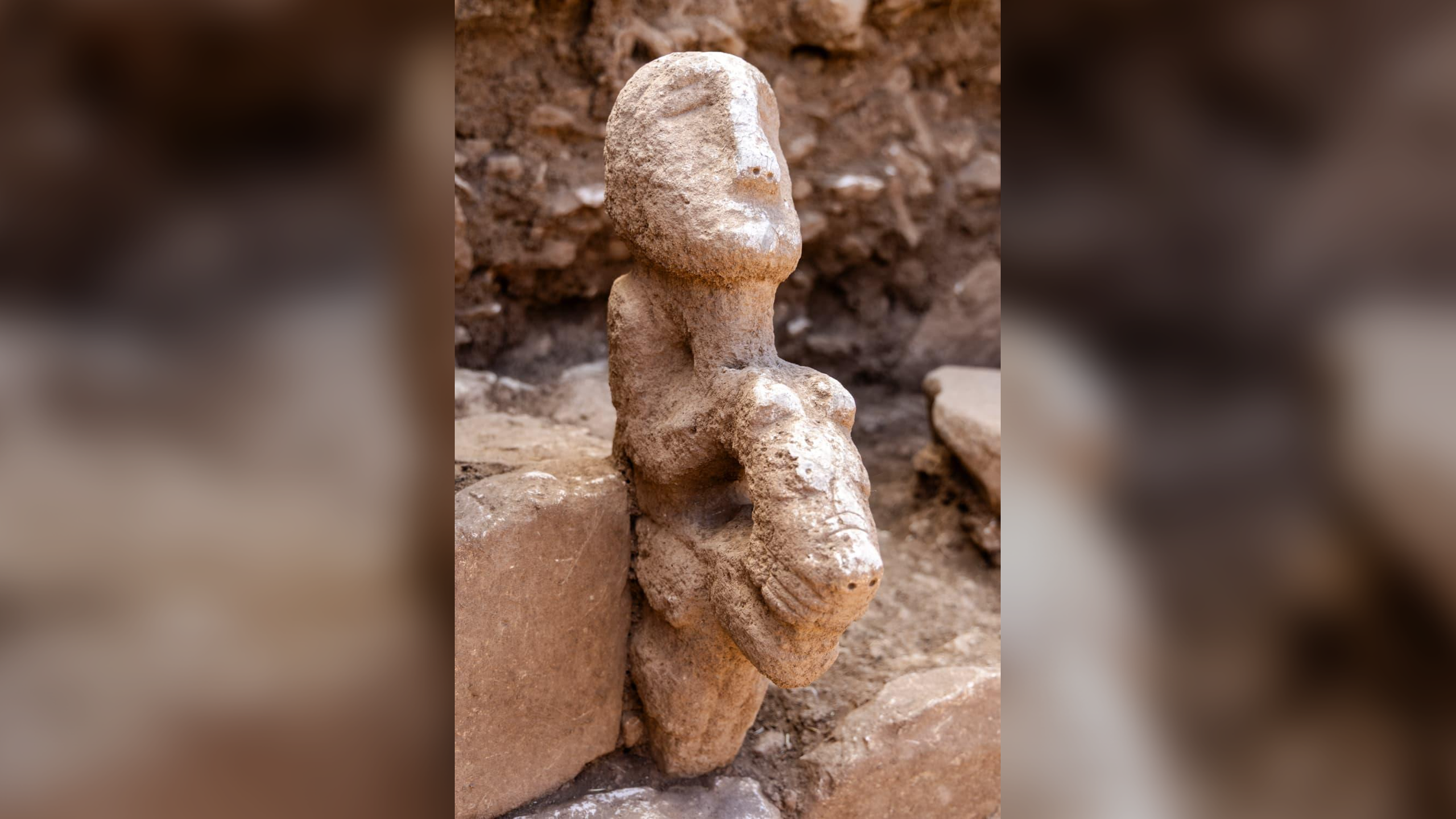


Never-before-seen fossils of newly hatched crocodile-like creatures are shining new light on how our aquatic ancestors conquered land.
Early four-limbed vertebrates (tetrapods), which would eventually give rise to humans, took their first steps on land in the Devonian period, some 419 million to 359 million years ago, marking one of the most important periods in the evolutionary history of animals.
Now, a new study published Thursday (June 18) in the journal Science has revealed that these early tetrapods were less like amphibians and more like us. Rather than having a tadpole phase in their development, as many amphibians do today, new evidence suggests that they were direct developers — growing from smaller to bigger versions of themselves, like their ancestors, humans and many other animals.
The study is an important contribution to our understanding of early tetrapods’ reproductive developmental biology, said Tim Smithson, a visiting academic at the University of Cambridge who specializes in early tetrapods but was not involved in the study.
It suggests that the “earliest tetrapods that took those first steps on to land were able to rely on the successful reproductive and developmental strategies of their forebears,” Smithson told Live Science in an email. “Direct development made life easier — one less thing to worry about!”
The new research was based partly on fossils from early land-dwelling predators called embolomeres. These animals looked like a cross between a crocodile and an eel and ruled river, lake and swamp habitats 350 million to 280 million years ago, during the Carboniferous and Permian periods. While these creatures could grow to more than 10 feet (3 meters) long as adults, the study unveils rare fossils from Mazon Creek, near Chicago, that preserved embolomeres as hatchlings that were days to a couple of weeks old.
“These are intimate details of the first moments of these animals’ lives, and we’ve never seen that before for this entire part of the evolutionary tree,” study co-author Jason Pardo, a postdoctoral fellow of evolutionary biology at Vilnius University in Lithuania and a research associate at the Field Museum in Chicago, told Live Science.
Get the world’s most fascinating discoveries delivered straight to your inbox.
Researchers studied exceptionally well-preserved fossils from Mazon Creek, Illinois.
(Image credit: Arjan Mann)
These fossils didn’t show evidence of external gills and other tadpole-like features that the researchers would have expected from an early land dweller. The researchers then checked other fossils from before and during the “fin-to-limb transition” but found no evidence of an amphibian-like life cycle in those, either.
“For as long as we’ve understood evolution, we’ve assumed this story of how we made that transition from water to land,” Pardo said. “We in fact have a completely different story.”
Science upended?
A statement released by the Field Museum claimed that the study upends scientists’ understanding of how animals conquered the land. However, the experts Live Science spoke to disagreed with this assertion.
“The Mazon Creek material is wonderful, the study is interesting and the interpretation of the fossils is sound, but I don’t think the results are terribly surprising,” Per Ahlberg, a professor of evolutionary organismal biology at Uppsala University in Sweden, told Live Science in an email.
Ahlberg, who was not involved in the new study, specializes in the early evolution of tetrapods. He noted that scientists knew some early tetrapods had a larval stage similar to that of modern salamanders — namely, those belonging to the group Temnospondyli, which he described as the ancestral stock of modern amphibians. However, he contends that this didn’t mean scientists assumed every early tetrapod was the same.
“Nobody has been arguing in recent years that ALL early tetrapods had such a larval stage or that this was essential for enabling the transition to land,” Ahlberg said. “I mean, I have been working right at the core of this research field for 40 years and I have never given it any thought.”
In response, Pardo agreed that specialists in the field recognized that the data didn’t support that early tetrapods had an amphibian-like development. However, he argued that even among specialists, assumptions were still made about metamorphosis — a major developmental transition, like a tadpole transforming into a frog — and amphibian-like bodies.

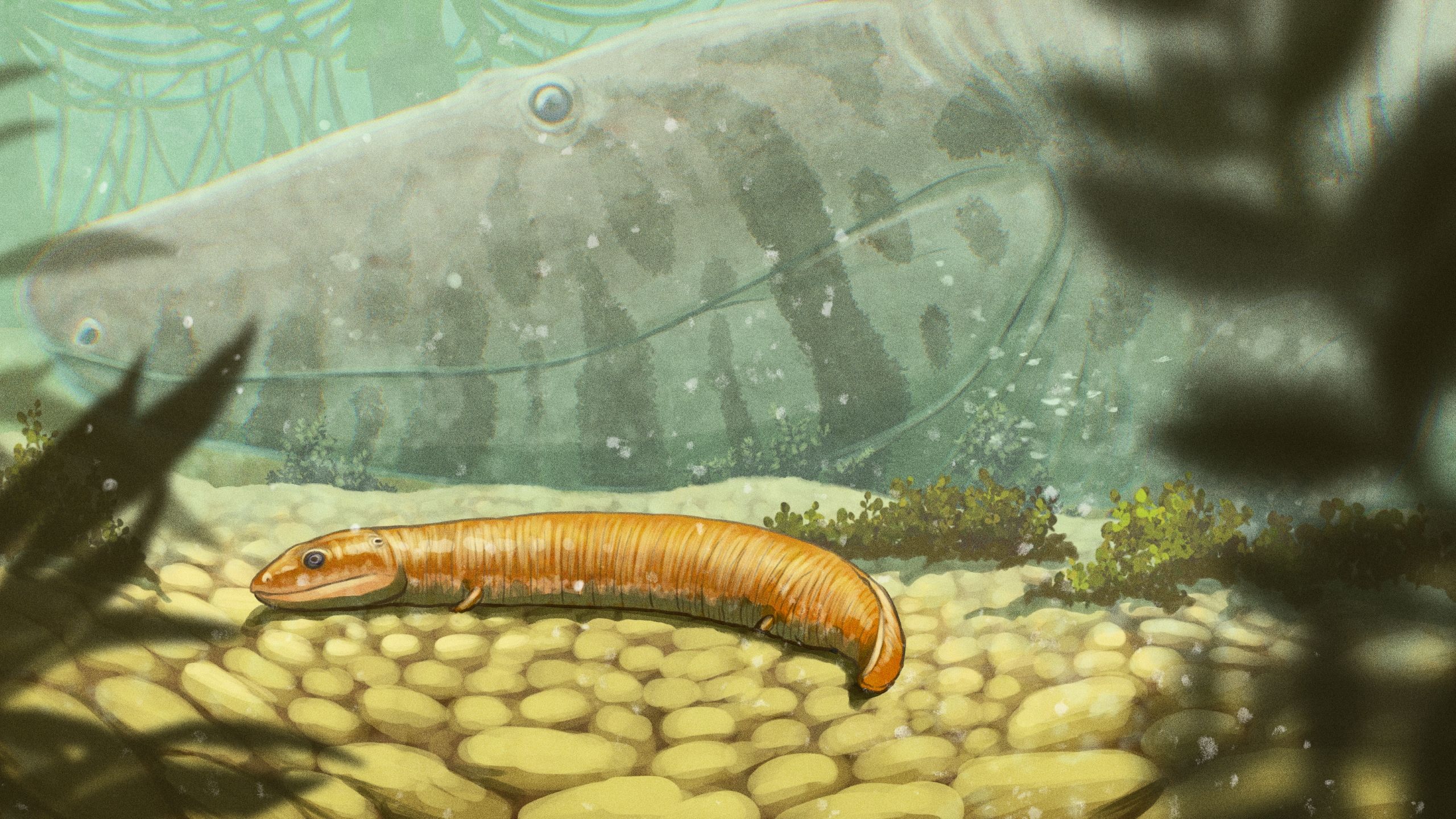
Young embolomeres, illustrated here, suggest that early tetrapods didn’t undergo an amphibian-like metamorphosis.
(Image credit: Berit Godring)
“Onto something big”
Study co-author Arjan Mann, an assistant curator of early tetrapods at the Field Museum, first saw the study’s first baby embolomere fossil during a 2016 trip to the Field Museum while working on his doctorate. At the time, the fossil was a mystery.
Mann and Pardo mused over the fossil’s identity for years before high-resolution scans with scanning electron microscopy at the Canadian Museum of Nature confirmed that the ancient creature was an embolomere, according to the museum’s statement.
“I think Jason and I both knew we were onto something big, since fossils of this kind of animal and from this phase, and developmental state in early tetrapod evolution have never been found or studied before,” Mann told Live Science in an email.
Along with the embolomeres, the researchers looked at megalichthyid fish from before the land transition and limbless, snake-like creatures known as aistopods from during the land transition. All showed signs of direct development, they said.
“I think the take home message of this study is that we should always challenge conventional wisdom in science, especially when these older ideas do not have substantial backing,” Mann said.