Over the past 5,000 years, East Africa has dried out. Now, new research finds that this change may be making the continent pull apart faster.
Faults in the East African Rift Zone have sped up since the levels of large lakes have dropped, according to research published in November in the journal Scientific Reports.
“Usually it is something we think about the other way around: Mountains build, and that changes the local or regional climate,” Scholz told Live Science. “But it can work the other way around too.”
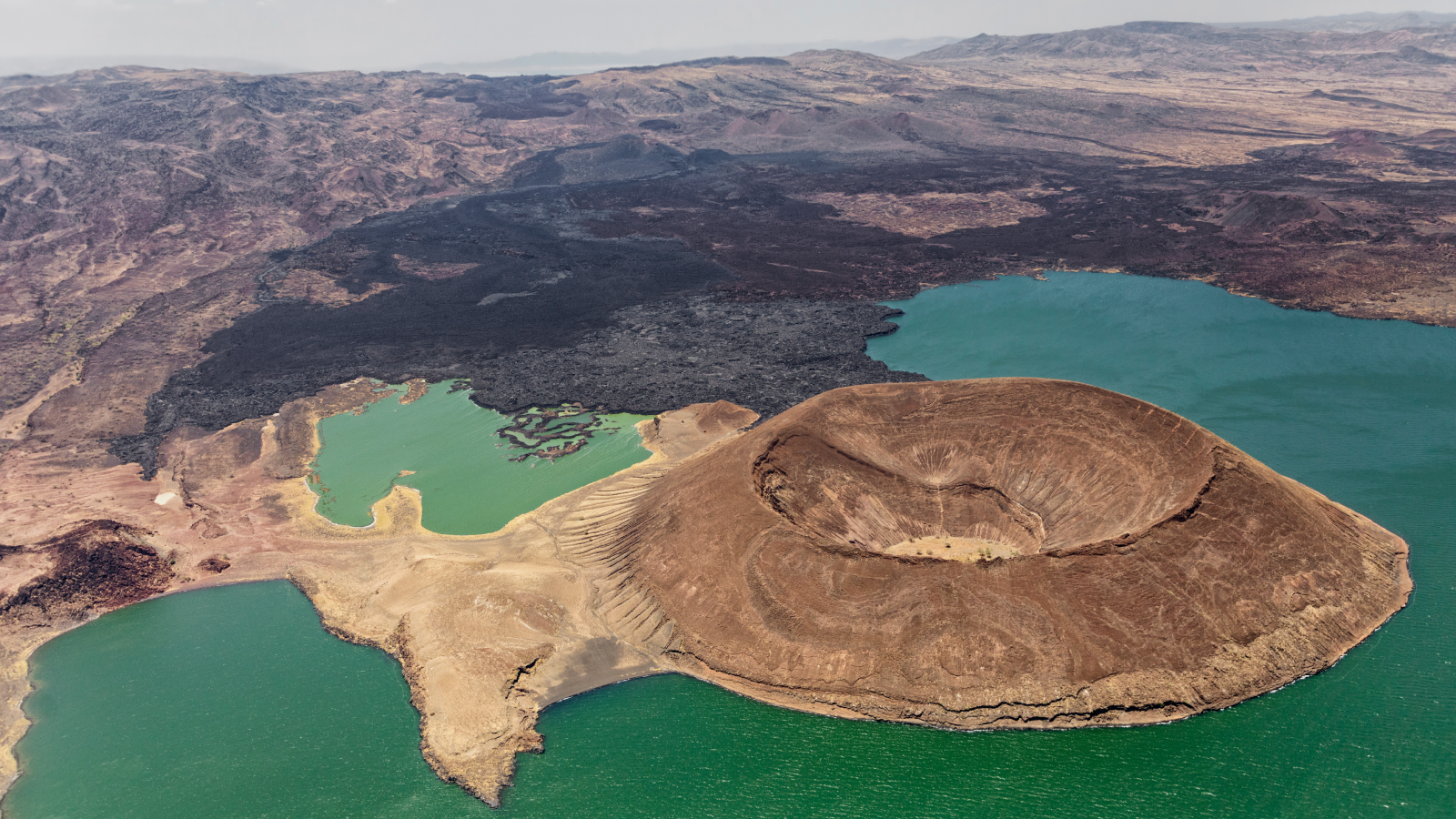
Scholz and his colleagues conducted their research at Lake Turkana in Kenya, which is 155 miles (250 kilometers) long, 19 miles (30 km) wide, and up to 400 feet (120 meters) deep in places. That’s nothing, however, compared with the level more than 5,000 years ago, when the lake was up to 500 feet (150 m) deeper.
That was during the African Humid Period, when much of Africa was wetter than it is today. In East Africa, this period persisted from about 9,600 years ago to 5,300 years ago, with drier conditions prevailing over the past 5,300 years. The researchers studied lake-bed sediments to determine ancient water levels and sediment flows into Lake Turkana. In the process, they noticed many small faults and the fingerprints of long-ago earthquakes in the sediments.
The tectonic plate that underlies Africa is pulling apart in eastern Africa and may one day split into two plates with an ocean between them. The deep, narrow lakes in the region — including Lake Turkana and nearby waterways, such as Lake Malawi in Tanzania and Mozambique —, are the result of this rifting process, which is creating a deep valley in the region.
Scholz and his team wanted to know if the changes in the lakes themselves were influencing this rifting process. Water matters to tectonics: When glaciers retreat, for example, the lifting of their weight actually causes the land beneath to spring up like rising bread — a process called isostatic rebound. Large amounts of water similarly press down on the crust beneath, potentially affecting processes like earthquakes.
The researchers found that after the end of the African Humid Period, the faults in Lake Turkana began to move faster, at an average rate of 0.007 inches (0.17 millimeters) of extra movement per year. In general, Africa is rifting apart at 0.25 inches (6.35 millimeters) per year.
Using computer simulations, the researchers figured out that this seismic speedup likely has two causes. One is that with less water pressing down on the crust, the faults have more freedom to move: Imagine a vise loosening around two slabs of wood. The other cause is more indirect. On an island in the south side of Lake Turkana is a volcano with an active magma chamber. The removal of water from the African Humid Period decompresses the mantle under this volcano, leading to more melting. That melt, in turn, moves into the volcano’s magma chamber, inflating it and leading to more tectonic activity on nearby fault lines.
“We see enhanced faulting during this time interval, so more pronounced earthquakes are presumably prevalent in this broader region now compared to 8,000 years ago,” Scholz said.
The researchers are now working on a project at Lake Malawi looking at water level changes going back 1.4 million years, hoping to get a better sense of how the climate affects the separation of continents.
“This information about these huge changes in water volumes in these lakes is a really important part of the story,” Scholz said.
Muirhead, J. D., Xue, L., Moucha, R., Paciga, M. K., Judd, E. J., & Scholz, C. A. (2025). Accelerated rifting in response to regional climate change in the East African Rift System. Scientific Reports, 15(1), 38833. https://doi.org/10.1038/s41598-025-23264-9