About 1,500 years ago, early Christian monks and adherents of the Persian religion Zoroastrianism lived together without conflict in northern Iraq, according to a new study.
This wasn’t the only place where Zoroastrians mingled with people of other faiths; a 2,000-year-old sanctuary discovered in modern Georgia reveals a mixture of Zoroastrian beliefs and those of other religions, another study reports.
Taken together, the finds are more evidence that Zoroastrianism — the official religion of the royal dynasties that governed the Persian empires for more than 1,000 years — often coexisted peacefully with other religions.
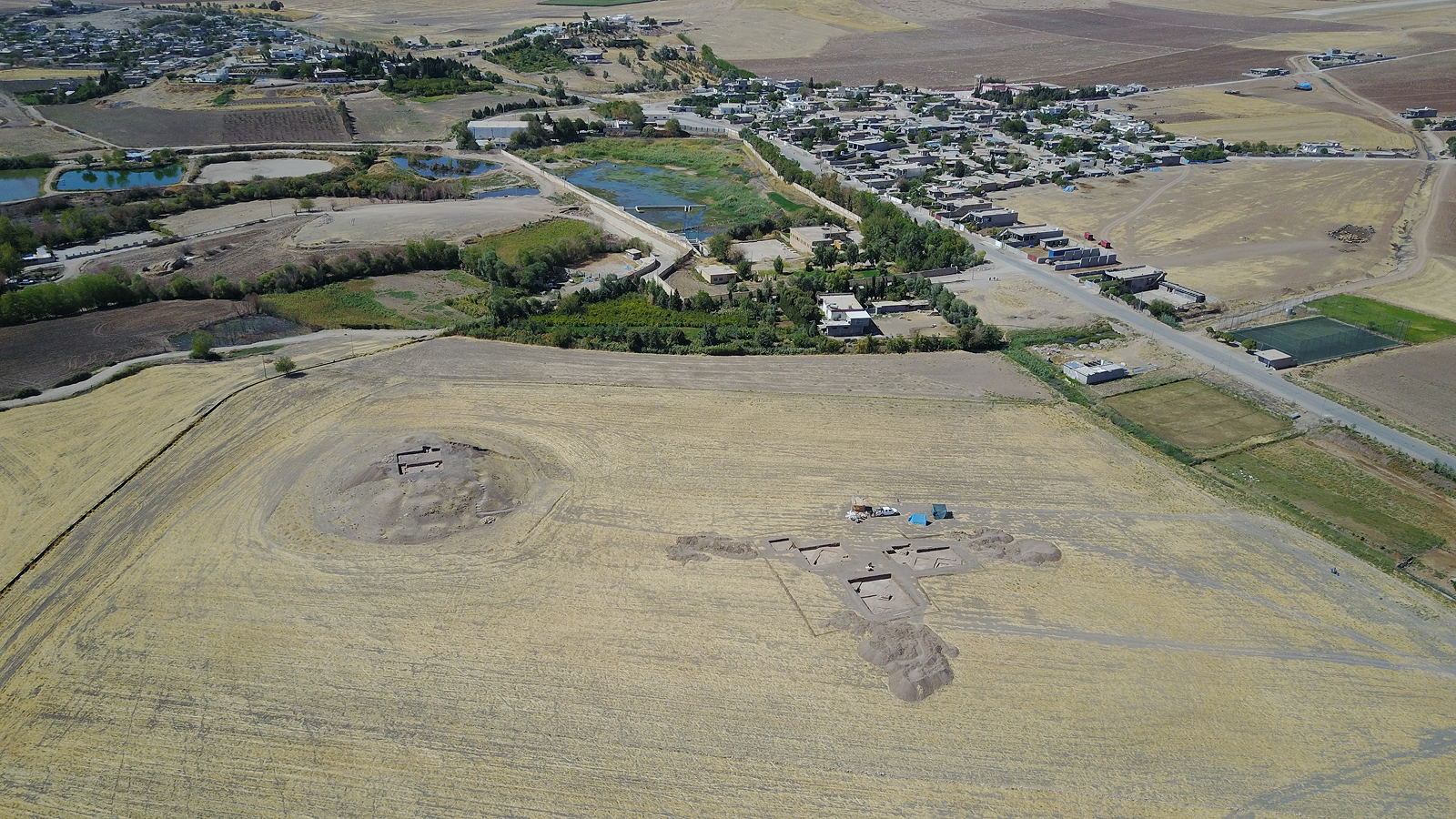
In the Iraq finding, a team led by archaeologists Alexander Tamm, of the Friedrich-Alexander University of Erlangen-Nuremberg, and Dirk Wicke, of Goethe University Frankfurt, examined the ruins of a building complex at the Gird-î Kazhaw site in the Kurdistan region of the country, according to a statement from Goethe University Frankfurt.
They found buried stone pillars and other architectural evidence that the building complex had been a church at the center of a Christian monastery, which was originally discovered in 2015. The monastery was built in about A.D. 500 — “a huge surprise” because it was the first Christian structure ever found there, according to the statement.
The team also unearthed buried fragments of a large jug decorated with an early Christian cross. (Crosses were rarely used as Christian symbols until the Roman Empire legalized Christianity in the fourth century.)
And yet the newly investigated Christian monastery lies only a few yards from a Sasanian Persian fortification where Zoroastrianism was practiced. The two structures’ proximity indicates that Christians and Zoroastrians were living peacefully side by side at this location, the statement said.
Rival empires
The archaeological team noted that in that era, Christianity was spreading beyond the borders of the Roman Empire, where it had been the official religion since the Edict of Thessalonica by Emperor Theodosius in 380.
The Romans — and, later, the Byzantines — were usually rivals of the Persians, and sometimes allies. The new religion of Christianity, however, was spreading even among the Persians. “The early dating for a church building into the fifth to sixth century AD is not unusual in the region,” the statement said. “There are comparable structures in northern Syria and northern Mesopotamia.”
“Grandiose” temple in Georgia
The finds in northern Iraq come amid new details of a roughly 2,000-year-old sanctuary within a “grandiose” temple complex at Dedoplis Gora in Georgia, less than 400 miles (600 kilometers) north of Gird-î Kazhaw in Iraq.
Dedoplis Gora was under the independent Kartli kingdom at that time. However, the region was heavily influenced by the Achaemenid Persian Empire, and there is extensive evidence that Zoroastrianism was practiced there.
According to a study in the January 2026 issue of the American Journal of Archaeology by David Gagoshidze, an archaeologist at the University of Georgia in Tbilisi, “the kings of Kartli worshiped Iranian (Zoroastrian) gods merged with local Georgian astral deities.” The study looks at three sanctuary rooms in the Dedoplis Gora palace that had different religious traditions.

In one sanctuary, the rites of Zoroastrainism were practiced at an altar where “permanent residents of the palace of Dedoplis Gora offered daily sacrifices and prayed.” In another room, it appears the “noble owners of the palace” worshipped the Greek cult of Apollo, “based on the statuettes found there,” according to the study.
Finally, in a third room, in what seems to have been a “syncretic” ceremony (that is, a ceremony that combines more than one religious tradition), rituals were likely carried out for a local cult related to “fertility, agriculture and harvest.”
History of Zoroastrianism
The studies indicate the official Persian religion of Zoroastrianism was generally tolerant of other beliefs, although there were times during the late Sasanian Persian Empire when followers of rival religions like Christianity or Manicheism (a now-extinct Persian religion centered on the prophet Mani) were persecuted.
Zoroastrianism is named after the Persian prophet Zarathustra (Zoroaster in Greek), who is thought to have lived about 3,500 years ago, and it is centered on the worship of the “Wise Lord” Ahura Mazda, whose primary symbol is fire. (The phrase “Thus spake Zarathustra” is the title of a book by the 19th-century German philosopher Friedrich Nietzsche, who wasn’t Zoroastrian but used Zarathustra as a fictional mouthpiece for his ideas.)
Zoroastrianism sharply declined in Persia (now Iran) after the Islamic conquest of the Sasanian Empire in the seventh century, and now there are only about 120,000 practicing Zoroastrians worldwide.