Astronomers have spotted a supermassive black hole whipping up cosmic winds at record speeds.
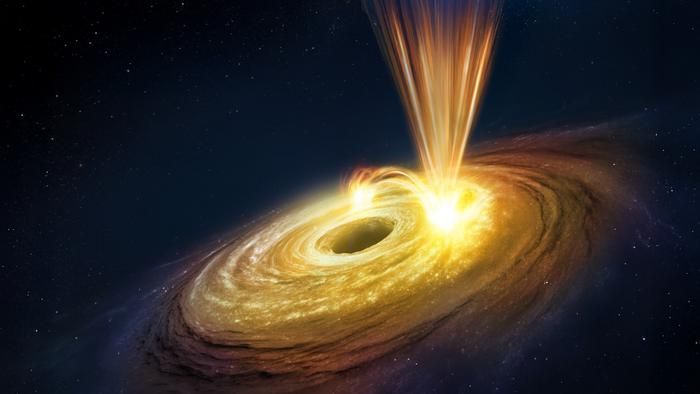
The black hole, located 135 million light-years from Earth in the center of the NGC 3783 spiral galaxy, caught researchers’ attention after emitting a huge X-ray flare. As the burst died down, it left winds of more than 37,000 miles per second (60,000 kilometers per second) — one-fifth the speed of light — howling in its wake.
“We’ve not watched a black hole create winds this speedily before,” Liyi Gu, an astronomer at Space Research Organisation Netherlands who led the research, said in a statement.
Gu and his colleagues were studying NGC 3783’s active galactic nucleus (AGN), the bright, busy region surrounding a galaxy’s feeding supermassive black hole. These areas are known to suddenly flare and belch jets of material and wind into space. The researchers think the intense X-ray burst and subsequent gale they observed was powered by the black hole’s tangled magnetic field, which suddenly “untwisted.”
The team likened the process to how Earth’s sun releases enormous eruptions of plasma called coronal mass ejections shortly after our star’s magnetic field lines tangle and snap. However, in this case, the supermassive black hole has the mass of 30 million suns, which puts its flares and ejections “on a scale almost too big to imagine,” Matteo Guainazzi, a team member and European Space Agency (ESA) astronomer, said in the statement. (For reference, the winds from a recent coronal mass ejection clocked in at a paltry 930 miles, or 1,500 km, per second.)
The discovery was made using ESA’s XMM-Newton and XRISM X-ray space telescopes. Gu’s team used the two telescopes in tandem, tracking the initial flare with XMM-Newton’s Optical Monitor, and analyzing the resultant winds with XRISM’s Resolve instrument. The researchers hope to take a similar collaborative approach to investigate other flaring AGNs.
They also think studying AGNs and the intense flares they produce could help further our understanding of how galaxies evolve.
“Because they’re so influential, knowing more about the magnetism of AGNs, and how they whip up winds such as these, is key to understanding the history of galaxies,” Camille Diez, an astrophysicist and ESA fellow who was part of the research, said in the statement.
The scientists detailed their discovery in a paper published Dec. 9 in the journal Astronomy & Astrophysics.