Beyond familiar particles such as electrons and protons, scientists have discovered a zoo of “quasiparticles” with exotic names, such as magnons, angulons, dropletons and polaritons. But what are quasiparticles, exactly? And given the “quasi” in their name, are they considered real particles?
One way to understand quasiparticles is to explore what a particle is. The standard mental picture of a particle “is of a discrete object, like a ball,” Douglas Natelson, a condensed matter physicist at Rice University in Houston, told Live Science. However, this classic image of particles changed with the advent of quantum physics, which revealed that the universe becomes fuzzy at its smallest levels. For example, in 1924, French physicist Louis de Broglie showed that particles such as electrons could also behave as waves — a discovery that earned him a Nobel Prize.
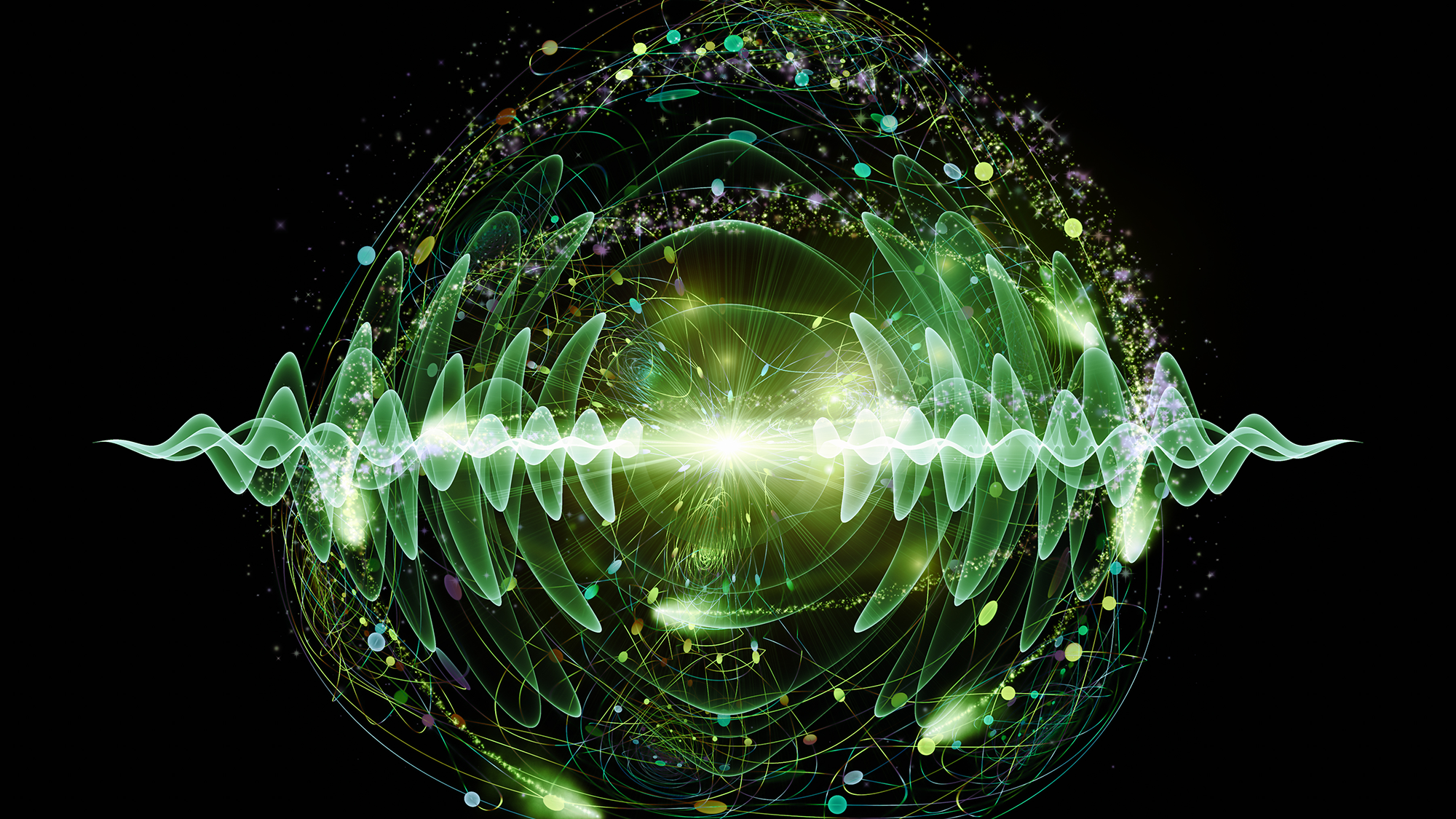
Modern physics suggests that particles are excitations in fields that permeate the entire universe, a bit like a ripple in a pond, Ross McKenzie, a theoretical condensed matter physicist and professor emeritus at the University of Queensland in Australia, told Live Science. Each type of particle has its own corresponding field. For instance, photons of light are ripples of the electromagnetic field, McKenzie noted.
Latest Videos FromLive Science
The quantum nature of particles means they can not only fly through an empty vacuum but also ripple through matter. For instance, photons can zip through transparent and translucent materials, and electrons can flow inside wires.
Sign up for our newsletter
(Image credit: Marilyn Perkins / Future)
Sign up for our weekly Life’s Little Mysteries newsletter to get the latest mysteries before they appear online.
If you can picture a standard particle, such as an electron, as a ripple traveling within a material, you can also envision other kinds of excitations within matter. These other types of ripples are quasiparticles.
For example, think of “the wave” done at a sporting event. “You can watch it propagate around a football stadium; it has a location and a speed,” Natelson said. “It only exists within the stadium, though, and it’s made up of the collective response of all the interacting fans.”
In much the same way, “quasiparticles can only exist within some medium or material, because they are built up from the response of that material’s constituents or building blocks,” Natelson said; in contrast, particles such as electrons and protons “can exist in free space.”
Electrons have a negative charge and orbit around the nucleus of an atom.
(Image credit: agung fatria viaGetty Images)
In other words, quasiparticles can’t exist in a vacuum and they can’t exist on their own. They’re reliant on particles acting together and being in a material where they can emerge, just as a wave carried out in a stadium can only exist when there is a group of people there who can perform it.
A philosophical question concerning quasiparticles is whether they are real, McKenzie noted. After all, “quasi” in Latin means “almost.”
“Fundamental particles can exist in isolation in a vacuum, and quasiparticles need many interacting particles to exist,” McKenzie said. “Still, I would say quasiparticles are, for all intents and purposes, just as real as particles, in how you can detect them and manipulate them.”
A zoo of quasiparticles
The concept of quasiparticles originated with theoretical physicist Lev Landau in the 1950s, McKenzie said, and the idea ultimately helped Landau win the Nobel Prize in physics in 1962. Scientists have now proposed the existence of dozens of quasiparticle types, including the following:
The phonon, which is a quasiparticle of sound — it is the smallest packet of vibrational energy that makes up sound in matter, McKenzie said.
The electron hole, often simply called a hole, is the positively charged vacancy left behind once an electron has left its original place, McKenzie noted.
The electron quasiparticle, which essentially consists of an electron and its interactions with its surrounding environment. This combined package means the electron quasiparticle requires more force to move, so it effectively has more mass than a regular electron, McKenzie explained.
The exciton, a quasiparticle made of an electron and a hole orbiting each other.
The anyon, a kind of quasiparticle so far only seen in two-dimensional systems, which may carry only a fraction of an electric charge.
“How many kinds of quasiparticles are there?” McKenzie said. “Just like there are an infinite number of possible states of matter, I would say that, in principle, there are an infinite number of types of quasiparticles.”
Scientists describe activity in material as quasiparticles “because it simplifies everything dramatically,” McKenzie said. In the same vein, Natelson said that “very often the math behind physical phenomena in solids is described well by quasiparticles.”
Quasiparticles are not simply useful for bookkeeping. For instance, researchers typically describe the behavior of electricity in electronic devices in forms of quasiparticles such as holes and excitons, Natelson said.
All in all, the answer to the question of whether quasiparticles are real is a matter of interpretation. If the question is whether or not a quasiparticle is an elementary particle such as an electron, the answer is no — they cannot exist on their own, and they depend on the materials in which they manifest.
However, if the question is whether or not quasiparticles are real phenomena, the answer is yes — they are things that scientists can measure that can behave like particles and effectively have many of the same properties that other particles do.