Refresh
Fast fill, again
Patrick Pester
Why use hydrogen fuel?
That’s because as the smallest molecule, hydrogen can readily pass through solid metals such as steel, nickel and titanium by diffusing through their atomic lattices.
And with a boiling point of minus 423 degrees Fahrenheit (minus 253 Celsius, or 20 kelvins), it must be stored at extremely cold temperatures, which can easily freeze seals beyond safe limits.
Despite these drawbacks, hydrogen still provides the highest specific impulse of any chemical propellant, and also burns without producing any harmful byproducts, making it NASA’s fuel of choice since the Apollo program.

Ben Turner
Filling speeds

Patrick Pester
Artemis II’s fuelling stages

The day has just begun and we’ve already hit some jargon.
Fuelling a 322-foot (100 meter) tall moon rocket is no easy task. But the steps for doing so can be broken down into four stages:
Chilldown: This initial stage cools the fuel lines down in order to reduce thermal shock across them. As we’ve already seen, it’s the quickest phase.
Slow fill: This slowly loads Artemis II’s extremely cold liquid hydrogen fuel into the rocket, doing so gradually to condition the rocket’s plumbing and tanks from room temperature to -253°C (-423.4°F) temperatures the liquid hydrogen is kept at. More on that in a minute.
Fast fill: Once temperatures inside the tank stabilize, the system moves to fast fill, pumping 8,000 gallons of liquid hydrogen and 1,300 gallons of liquid oxygen into the rocket’s tanks.
Topping/replenish: Once all the propellant is inside the rocket, engineers closely monitor the rocket for leaks while slowly topping it up to account for some of the fuel boiling off into gas.
Ben Turner
Fast fill
Propellant loading officially underway
The SLS core stage has a big ol’ tank that will be filled with 700,000 gallons of super-cold liquid oxygen and liquid hydrogen.
Slow fill
Why won’t Artemis II land on the moon?

While we’re waiting, wanna know why this mission is just a lunar flyby?
Artemis II’s four-person crew will break all kinds of records and achieve several historic firsts if this mission is a success, but they won’t step foot on the moon.
That’s because Artemis II was always meant to be a test flight. It’s a very expensive and exciting test flight, but a test flight nonetheless.
After sending an uncrewed Orion spacecraft around the moon in 2022 with Artemis I, NASA is now doing the same again with people on board. Artemis II’s Orion spacecraft wasn’t designed to land on the moon. The mission is all about testing systems and building capacity ahead of planned lunar surface missions in the years ahead.
NASA’s first moon landing missions are scheduled for 2028, although it’s worth keeping in mind that the Artemis program has been fraught with delays, and NASA originally planned to have astronauts back on the moon by now.
In 2019, NASA was targeting a moon landing by 2024, and yet here we are in 2026, and NASA still hasn’t launched its first crewed lunar flyby mission. Fingers crossed today is the day!
Never been one for appetizers
This is very much the appetizer before the main course of NASA’s launch coverage, which is scheduled to begin at 12:50 p.m. EDT.
“Favorable and acceptable weather”
Jaramillo notes that there are some clouds, but they don’t seem to be a threat. The Artemis launch weather officer told the launch team that they have “favorable and acceptable weather” for today’s countdown, according to Jaramillo.
Things are looking good!
Chilldown
Official “go” for tanking
Patrick Pester
And we’re live
Watch On
Artemis at no risk from exploded satellite

Good weather — check. No solar flares or coronal mass ejections — check. No debris from one of the more than 10,000 Starlink satellites in orbit — errrrrr.
On Sunday (March 29) and for the second time since December of last year, SpaceX lost contact with a Starlink satellite that suffered an “anomaly” that caused it to shatter into multiple fragments while in orbit.
The mishap is the latest event to litter Earth’s skies with yet more space junk.
Thankfully, however, SpaceX has said it will not impact today’s launch.
“Latest analysis shows the event poses no new risk to the @Space_Station, its crew, or to the upcoming launch of NASA’s Artemis II mission,” SpaceX representatives wrote on X on Monday (March 31). “We will continue to monitor the satellite along with any trackable debris and coordinate with @NASA and the @USSpaceForce.”
Moon quiz
The weather stays favorable
If the storm does arrive, The National Oceanic and Atmospheric Administration (NOAA) has forecast it will have a moderate G1 to G2 strength, meaning it won’t be strong enough to interfere with the Artemis II mission’s electronics.
Why launch windows matter
Well, launch windows are a bit like waiting for the stars to align. Or, in this case, the Earth and the moon. NASA plans launches for when the moon is as close as possible (at perigee) to Earth during its 28-day cycle.
That gives them the best target for what follows: a cislunar downtown shot that whips the Orion capsule around Earth to send it precisely where the moon will be in six days time.
Precision being the key word here: Orion will travel around 245,000 miles (394,000 kilometers) or the equivalent of ten trips around Earth’s equator before it arrives at the moon. Flight dynamics officers have calculated the launch and Earth’s gravity assist such that Orion flies a few thousand miles above the moon’s surface, slingshotting around it and (with the help of a well-timed translunar burn) returning safely home.
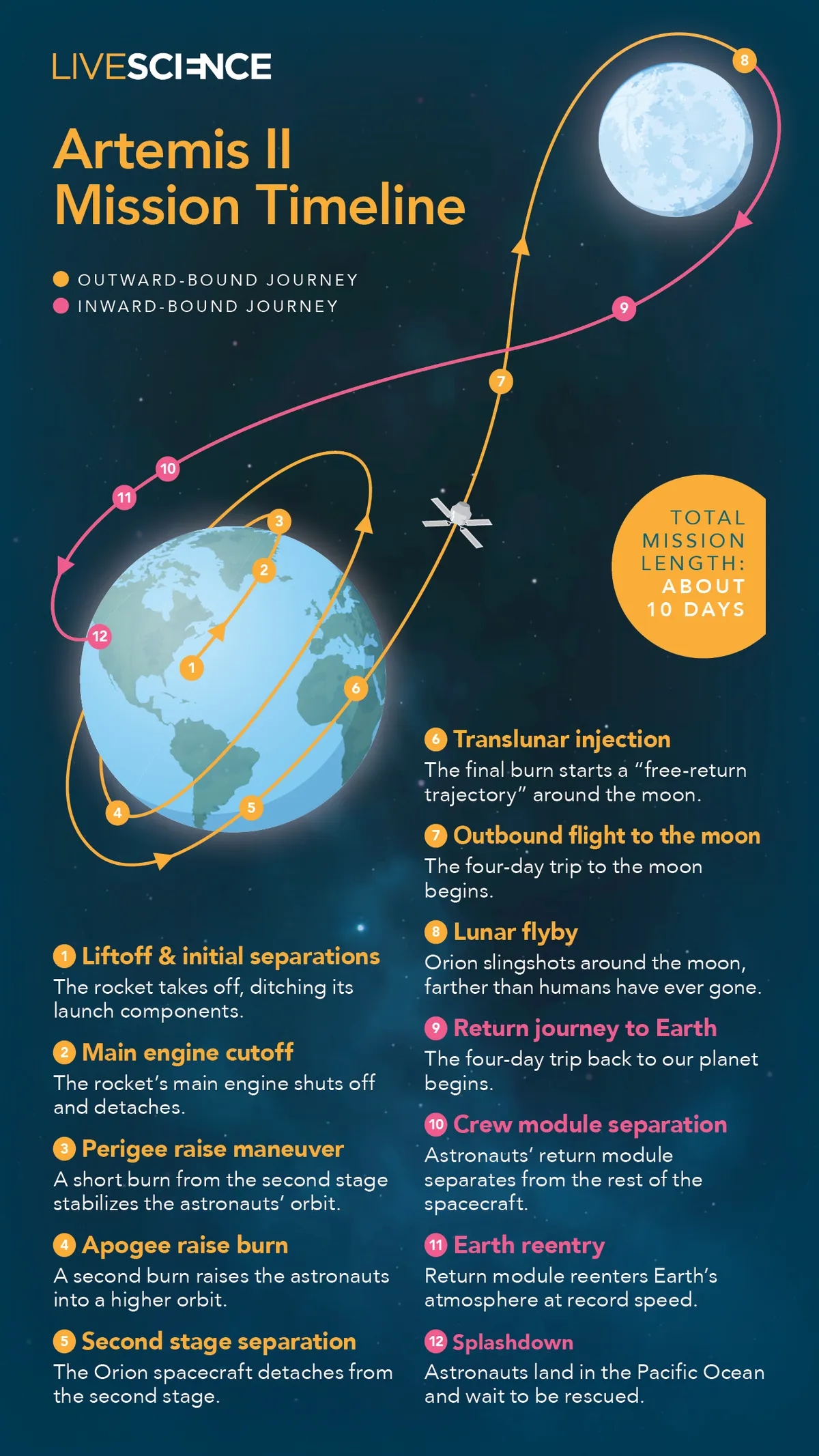
For a more granular look on the mission’s timeline, you can check out the full story here.
Ben Turner
“It’s a stepping stone for going to Mars”

Jim Gavio, director of the Yahn Planetarium at Penn State Behrend, has given a preview of what we can expect to see from the Artemis II mission, highlighting that if all goes to plan, NASA’s flight controllers will begin to look beyond the moon.
“It’s a stepping stone for going to Mars,” Gavio said in a statement released yesterday by Penn State (The Pennsylvania State University). “What we learn from going to our relatively close neighbor — the moon — we will use to actually get us to Mars someday.”
The Artemis program is meant to advance technologies and develop infrastructure that will be necessary for sending astronauts to Mars in the future. Establishing NASA’s recently announced $20 billion moon base could be a key part of this.
But let’s not get too far ahead of ourselves — NASA needs to show that it’s still capable of travelling to the moon first.
How to watch the launch

Morning, science fans! We’ve just published a launch watch guide that tells you where you can tune in to see Artemis II (hopefully) take off later today.
NASA is streaming the launch for free across lots of different platforms, so it will be very easy to find. Of course, you really should just stick around here. We’ll have a feed on the live blog, as well as moment-by-moment coverage of the launch
NASA’s launch coverage is scheduled to begin at 12:50 p.m. EDT on YouTube, X, Facebook and Twitch. The live coverage will also be available on NASA’s free streaming service, NASA+, as well as a variety of third-party streaming services, including Netflix and Amazon Prime.
We can’t say exactly what time the launch will be, but if it goes ahead, then expect the rocket to take off sometime between 6:24 p.m. and 8:24 p.m EDT.
Patrick Pester
Once in a pink moon

Welcome back, science fans. Are you ready to witness humanity fly to the moon for the first time in more than 50 years? Today is set to be the day. And no, this is not an April Fools’ joke.
After months of delays, NASA’s Artemis II rocket is ready to blast off on a 10-day slingshot trip around April’s Pink Moon and back, testing key systems for later lunar landings that the agency hopes will enable them to establish a permanent base on our celestial neighbor’s surface.
This lunar base, NASA claims, will soon become a stepping stone to Mars.
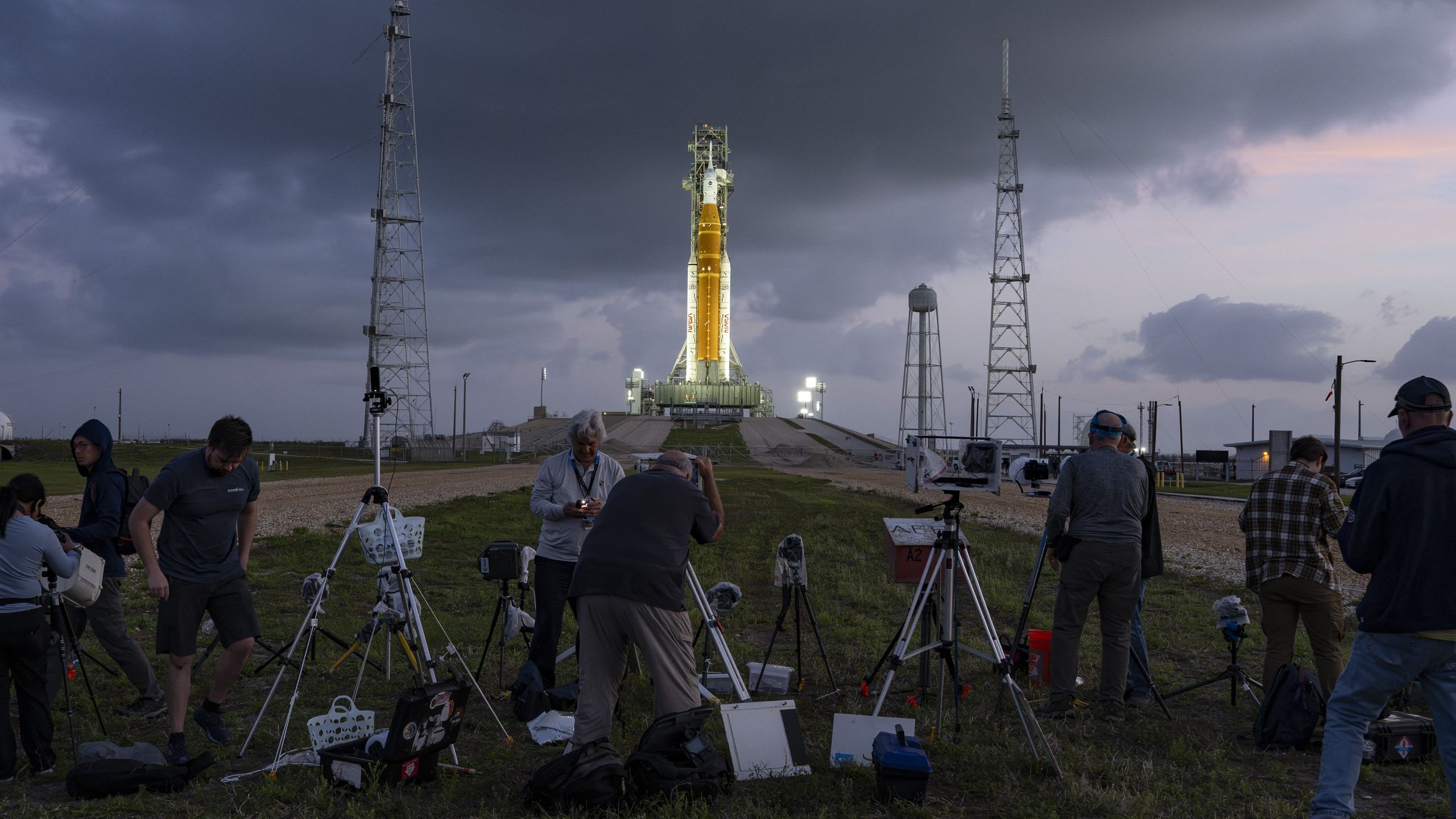
As NASA’s launch team works through the thousands of highly choreographed steps to bring the Artemis rocket roaring to life, weather conditions surrounding the launchpad at Kennedy Space Center in Cape Canaveral, Florida, remain favorable.
NASA says its coverage of tanking operations will begin at 7:45 a.m. EST (11:45 a.m. GMT). If all goes to plan, Artemis II and its crew will finally lift off sometime between 6:24 p.m. to 8:24 p.m. EST (10:24 p.m. to 12:24 a.m. GMT).
If favorable weather conditions persist; there are no major solar flares to interfere with the rocket’s electronics; and the spacecraft’s tanks evade the leaks that scrubbed a previous launch attempt in February, we will witness a historic launch.
Stick with Live Science for moment-by-moment updates, commentary, expert insight and exclusive coverage from the historic launch.
Ben Turner
What do astronauts do the night before a big launch?

It’s common to be nervous before a big event. In the case of NASA’s Artemis II mission, the stakes have never been higher as the agency attempts to return humans to the moon system for the first time in over 50 years.
So how do astronauts cope with the pressure of a big launch?
The night before a launch is usually far less glamorous than people imagine. Historically, astronauts have spent it doing last minute checks of their vital signs and getting themselves ready for the day ahead. For the Artemis II crew, their last night before the launch will be at the Kennedy beach house, a favorite spot for astronauts.
The beach house is located on Merritt Island, near Kennedy Space Center. Since being built in 1962, the beach house has been reserved for astronaut use; it became a quiet place where Apollo-era crews, and more recently ISS and SpaceX astronauts, have gathered with their families before launch day. The beach house’s large balcony gives crewmembers a chance to decompress and be with loved ones while looking out onto the Atlantic Ocean.
Keeping with tradition, the Artemis II crew spent Tuesday (March 31) with their families, according to agency administrators. Tomorrow, they’ll head to the launch pad for their first shot at the moon.

Kenna Hughes-Castleberry
Full moonshot

If the Artemis II mission lifts off on schedule around 6:24 p.m. tomorrow, NASA’s giant Space Launch System rocket will rise into the evening sky precisely as April’s full moon starts to creep over the horizon.
April’s full moon is nicknamed the Pink Moon, for obvious springtime reasons. It’s this year’s first full moon of spring in the Northern Hemisphere, and determines the start of the Passover and Easter holidays. The moon will also look bright and full on Monday (March 31) and Thursday (April 2).
You don’t need any special skywatching equipment to enjoy the full moon, but grabbing a good backyard telescope or strong pair of binoculars could help you zoom in on lunar features that the Artemis II crew will soon see rushing toward them — including famous craters, and even Apollo landing sites.
Someday, the Artemis IV mission — planned to launch in 2028 and return humans to the moon’s surface for the first time since 1972 — may become another lunar landmark that generations of skywatchers can attempt to spot from Earth. But for now, the Artemis II crew will only be passing by, shooting just past the moon and using its gravity to swing back toward Earth for the fastest reentry in history.
You can try to spot the moonbound capsule soar through our atmosphere several hours after launch, courtesy of the Virtual Telescope project‘s live stream.

Brandon Specktor
Who are the two backup crewmembers for Artemis II?

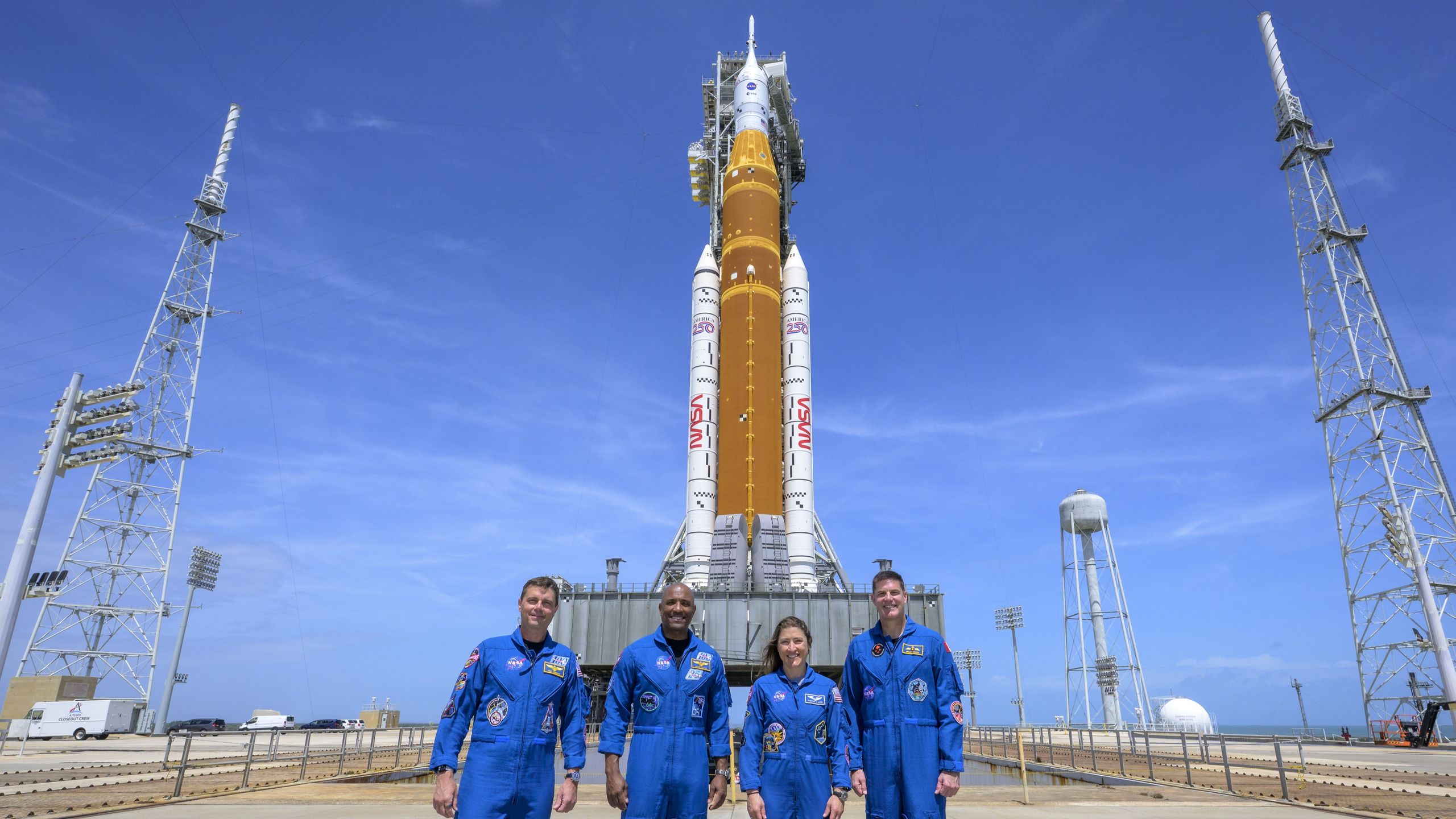
In the photo above, all six Artemis II crewmembers stand ready for action in Florida.
You read that right: Besides the Artemis II mission’s primary four-person crew, NASA has picked two alternate crewmembers as backups. These two astronauts have participated in astronaut training along with the main crewmembers and will take part in the closeout activities before the launch. But who are they?
The first alternate is NASA astronaut Andre Douglas. Douglas served in the U.S. Coast Guard as a naval architect, damage control assistant, salvage engineer and deck officer. When Douglas was selected as an astronaut, he was working at the Johns Hopkins University Applied Physics Lab, where he researched space exploration and planetary defense, including NASA’s Double Asteroid Redirection Test (DART) mission. Douglas also helped develop various spacecraft equipment, including a gamma-ray and neutron detector, MEGANE, which will help study Mars’ moons Phobos and Deimos.
As an alternate, Douglas runs through the same training for the upcoming Artemis II mission as its selected astronauts.

While Douglas studies engineering to ensure mechanical systems are working properly, the mission’s other backup crewmember, Jenni Gibbons of the Canadian Space Agency (CSA), looks at the exact opposite: how they explode. With a background in combustion science, Gibbons worked as an assistant professor at the University of Cambridge in 2016. In 2017, Gibbons was recruited by CSA as an astronaut candidate, graduated from astronaut training in 2020, and then led the Mission Control Capcom Console as International Space Station (ISS) lead capcom during Expedition 63 in 2020.
In the years that followed, Gibbons supported other space exploration endeavors, such as being a ground communicator for spacewalks that helped update the ISS’ solar panels and mentoring the 2021 astronaut candidate class in their spacewalk training.

In 2023, CSA announced Gibbons as a backup member for astronaut Jeremy Hanson on the Artemis II mission.
Gibbons or Douglas will step in if, for any reason, one of the primary Artemis II crewmembers is unable to participate in the upcoming launch.
Post-prelaunch conference: All conditions look good
Kenna Hughes-Castleberry
Would you go to the moon?

Artemis II’s crew are bound for a historic flight to the moon as soon as tomorrow — but would you swap places with them? Let us know in the poll below.
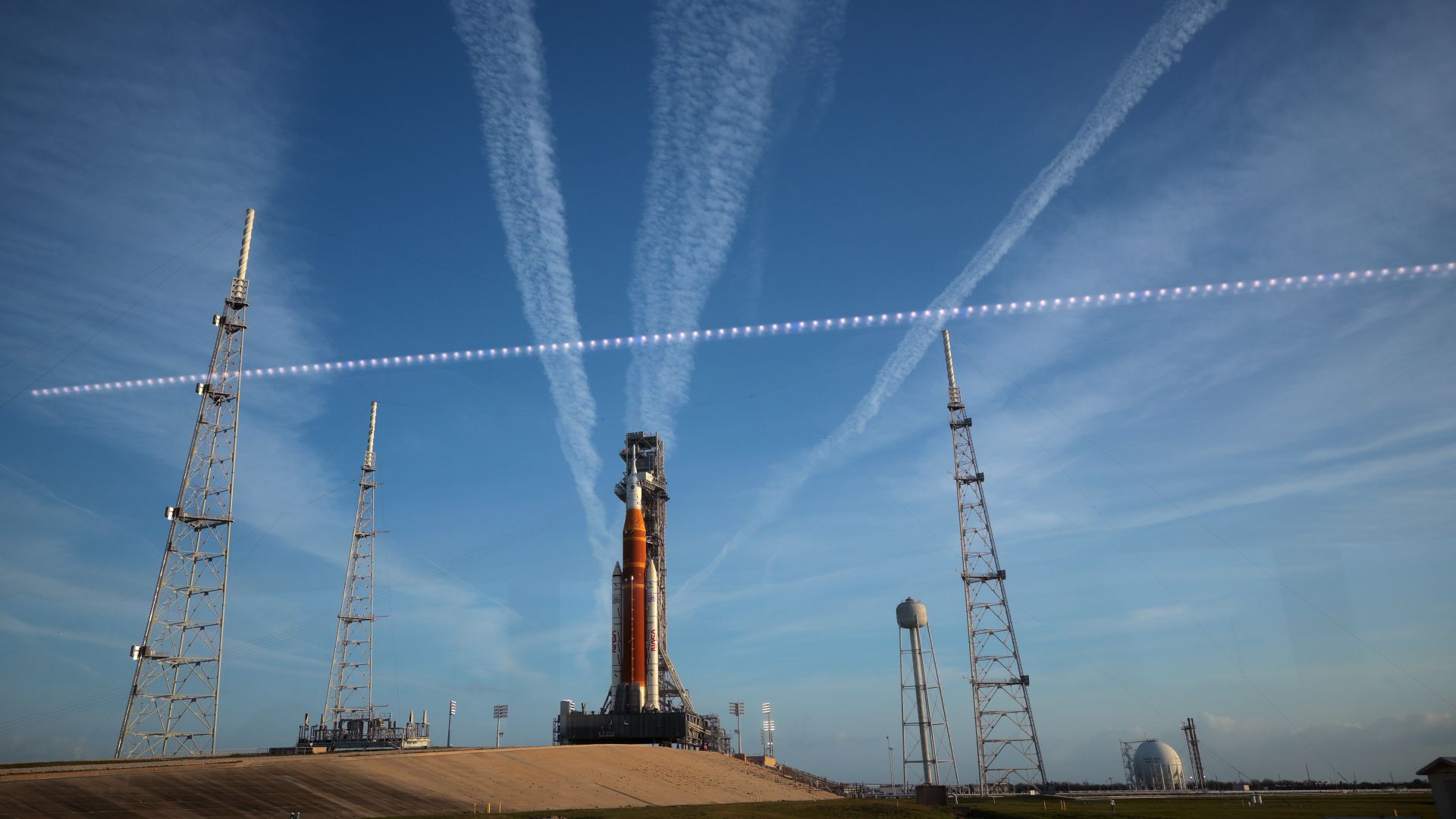
Like watching a rocket stand still
Cloudy with a chance of solar flares

Ben Turner
Watch live: Artemis II prelaunch news conference starts now
Watch On
Hey there, science fans. Live Science’s space and physics editor Brandon Specktor here.
With fewer than 30 hours to go before the Artemis II mission’s planned launch window opens, NASA officials are hosting a prelaunch news conference to share some final status updates. Watch it live right now.
Brandon Specktor
Watch NASA’s prelaunch coverage today at 1 pm EDT
The conference will run through the launch’s timeline and any final preparations NASA will make before ignition. We’ll be sure to keep you up to date on all the announcements as they’re made.
Artemis II is scheduled to launch Wednesday, April 1, with a two-hour window starting at 6:24 p.m. EDT.
Kenna Hughes-Castleberry
Meet the Artemis II crew

NASA’s Victor Glover, the mission’s pilot, a California-native and former U.S. Navy captain, he has worked both as a test pilot and has flown combat missions in aircraft that include the F/A-18 Hornet.
Glover is the first Black astronaut to be assigned to a lunar mission. Glover caused a stir in 2023 when he revealed that he listened to Gil Scott-Heron’s spoken-word poem “Whitey on the Moon” every Monday on his way to work.
“It’s funny, because that Space Symposium caused me a lot of grief in the next months because people tried to quote me out of context,” Glover told Space.com, Live Science’s sister site. “And it ain’t about racism. It’s about the human condition.”

NASA’s Christina Koch, Artemis II’s mission specialist, comes from Grand Rapids, Michigan. She holds several NASA records, including the longest single spaceflight by a woman (328 days). She also took part in the first all-female spacewalk with fellow astronaut Jessica Meir.
Koch’s specialization is in designing and operating tools that can survive in extreme environments, and she has spent a winter season in Antarctica at the Amundsen-Scott South pole station.

The Canadian Space Agency’s (CSA’s) Jeremy Hansen, another mission specialist and former fighter pilot in the Royal Canadian Air Force, Hansen’s seat on the mission is part of a partnership between the CSA and NASA.
This will be Hansen’s first ever spaceflight, but he has played critical roles in mission control for previous missions.

Who else walked on the moon?
When were Americans last on the moon?

The last person to step foot on the moon was Gene Cernan, the commander of NASA’s Apollo 17 mission. Cernan, the last of 12 humans to walk on the moon, left humanity’s final bootprint on the lunar surface on December 14, 1972.
And while Artemis II does mark NASA’s return to the moon, the mission more closely takes after Dec. 21, 1968’s Apollo 8 mission, which sent three NASA astronauts on a six-day trip around the moon. Much like Artemis II, Apollo 8 was a key step in testing flight systems and trajectories before attempting a lunar landing.
Ben Turner
So why return to the moon, anyway?

This is the first time in more than 50 years that NASA is sending humans to the moon, having famously taken 12 astronauts to the lunar surface as part of the Apollo missions that ran between 1969 and 1972.
But that doesn’t mean redoing something it achieved decades ago is straightforward. Space travel is a difficult endeavour that comes with substantial risks, and the moon remains a hard target even in 2026.
So why bother going back?
Artemis II is scheduled as a lunar flyby, so the astronauts aboard the Orion spacecraft won’t actually land on the lunar surface. However, if this 10-day flight around the moon and back to Earth is successful, then NASA will have tested systems ahead of the Artemis IV and Artemis V lunar surface mission planned for 2028, when NASA wants boots on the moon.
NASA aims to establish a sustained presence on the lunar surface and pave the way for future missions to Mars. That means Artemis II may end up being a key step on the road to humanity colonizing another planet.
Want to know more? You can read my analysis story here.
Patrick Pester
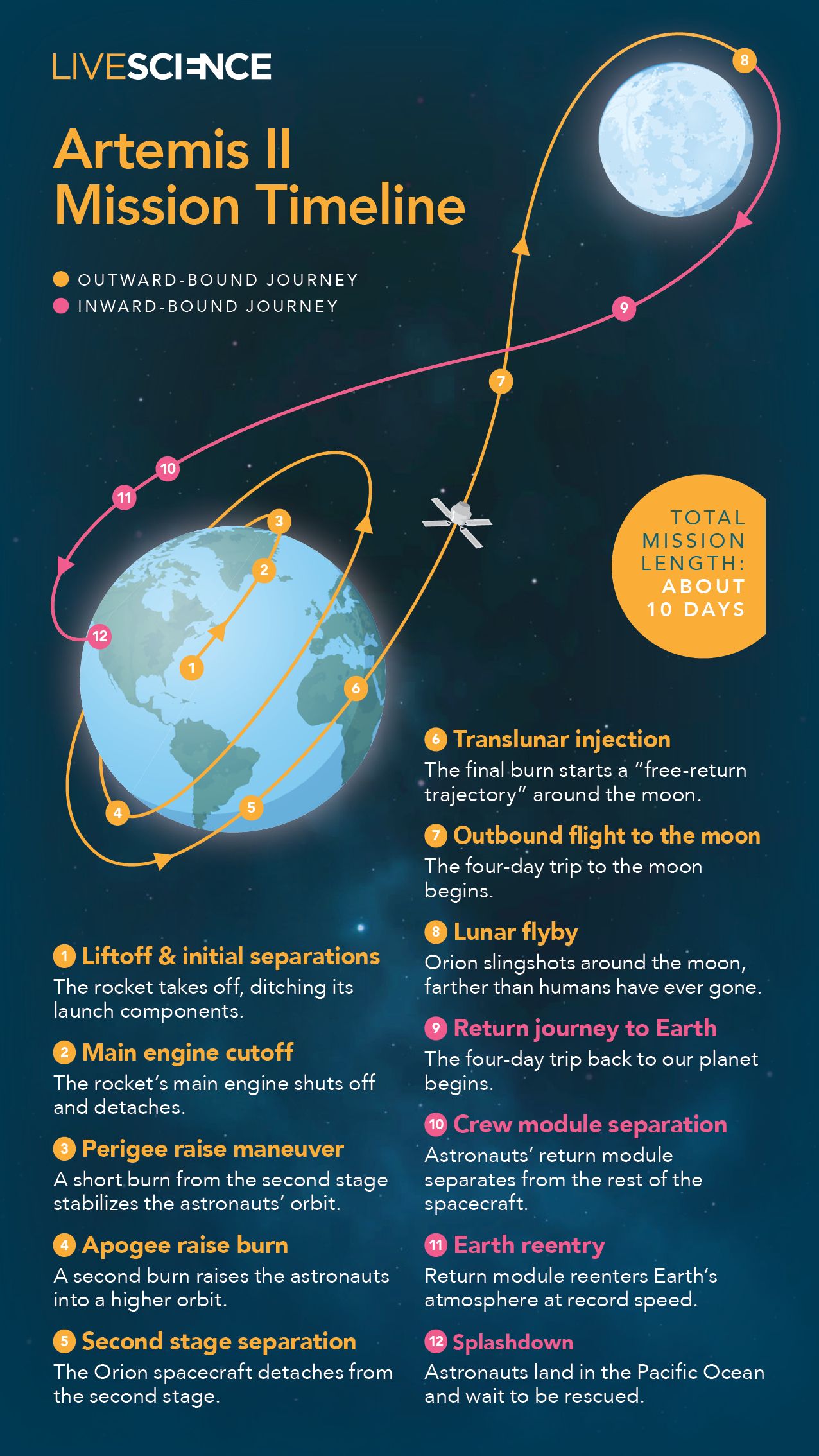
The mission timeline
Hello, fellow Artemis enthusiasts! Senior staff writer Harry Baker here to tell you a little bit about the timeline for NASA’s historic return trip to the moon (and back).
As soon as operators gave the green light for launch, the Artemis II mission officially began, and the launch team is already hard at work completing the long list of initial preflight checks. The quarantined astronauts are also making their final preparations before heading to the launch pad at Florida’s Kennedy Space Center tomorrow (April 1).
We’ve broken down the 10-day mission into 12 key steps, covering everything from liftoff and low Earth orbit maneuvers to the lunar slingshot, record-breaking reentry to Earth’s atmosphere and eventual splashdown in the Pacific Ocean.
My personal favorite stage is “prox opps.” This comes around 3.5 hours after launch and will see Artemis II’s pilot Victor Glover briefly take control of the Orion spacecraft to test out its manual thrusters and maneuverability, providing crucial data for the upcoming Artemis III and Artemis IV missions.
You can read my full story here.
And be sure to bookmark this page so you can come back to it at any point over the next few weeks!

Harry Baker
A record-breaking return

It took a while to get here, but after repeated delays, NASA says the Artemis II mission is finally ready to launch. Besides being NASA’s first step to a long-awaited return to the moon’s surface, the mission is set to achieve a number of firsts: Its crew contains the first Black astronaut, the first woman, and the first non-American to visit the moon.
The crew will smash several longstanding records too. For example, they will return to Earth as the fastest humans in history, splashing down in the Pacific Ocean after reentering our planet’s atmosphere at slightly over 25,000 mph (40,200 km/h), which would beat the 1969 reentry record currently held by the Apollo 10 astronauts.
And that’s not all that’s new or record-breaking about this flight. For more details, senior staff writer Harry Baker has the full story here.
To the moon and back

Good morning, science fans. For the first time since 1972, the countdown clock at NASA’s Kennedy Space Center in Florida is now running down the hours, minutes and seconds until the liftoff of a crewed mission beyond low Earth orbit.
With a little more than a day remaining until NASA’s Artemis II launch, the mission’s four-astronaut crew said they’re ready for their 685,000-mile (1.1 million kilometers) 10-day journey around the moon and back. They will be sent into space by a colossal, 322-foot-tall (98 meters) rocket stack — taller than the Statue of Liberty — which will provide over 8.8 million pounds (4 million kilograms) of thrust to a capsule the size of a campervan.
Live Science will be following every moment of this journey, providing you with updates, commentary, expert insight and exclusive coverage from the historic launch.
So let’s strap in, quit mooning around, and get ready for humanity’s return to our celestial neighbor.
Ben Turner
You must confirm your public display name before commenting
Please logout and then login again, you will then be prompted to enter your display name.