


Refresh
Rise and shine, Integrity
Watch On
And then the Zac Brown Band:
With a special pre-recorded message from Zac from the Zac Brown Band: “Just want to say how proud of you we are. It takes courage and grit and freedom to chase the unknown. It’s the purest kind of American spirit. Millions back home are looking up and feeling more inspired because of you. Keep flying strong. Keep flying safe. Can’t wait to welcome you home.”
“What a great way to start the day, Houston,” said Artemis II commander Reid Wiseman. “Courage and grit. That’ll stick with me and it should stick with all of you all day long.”
“We got it loud and clear, Integrity,” said mission control. “Can’t wait to see you run to the water. See you soon. Good morning.”

Ben Turner
What’s next on the Artemis playlist?

Kenna Hughes-Castleberry
It’s nearly wake-up time
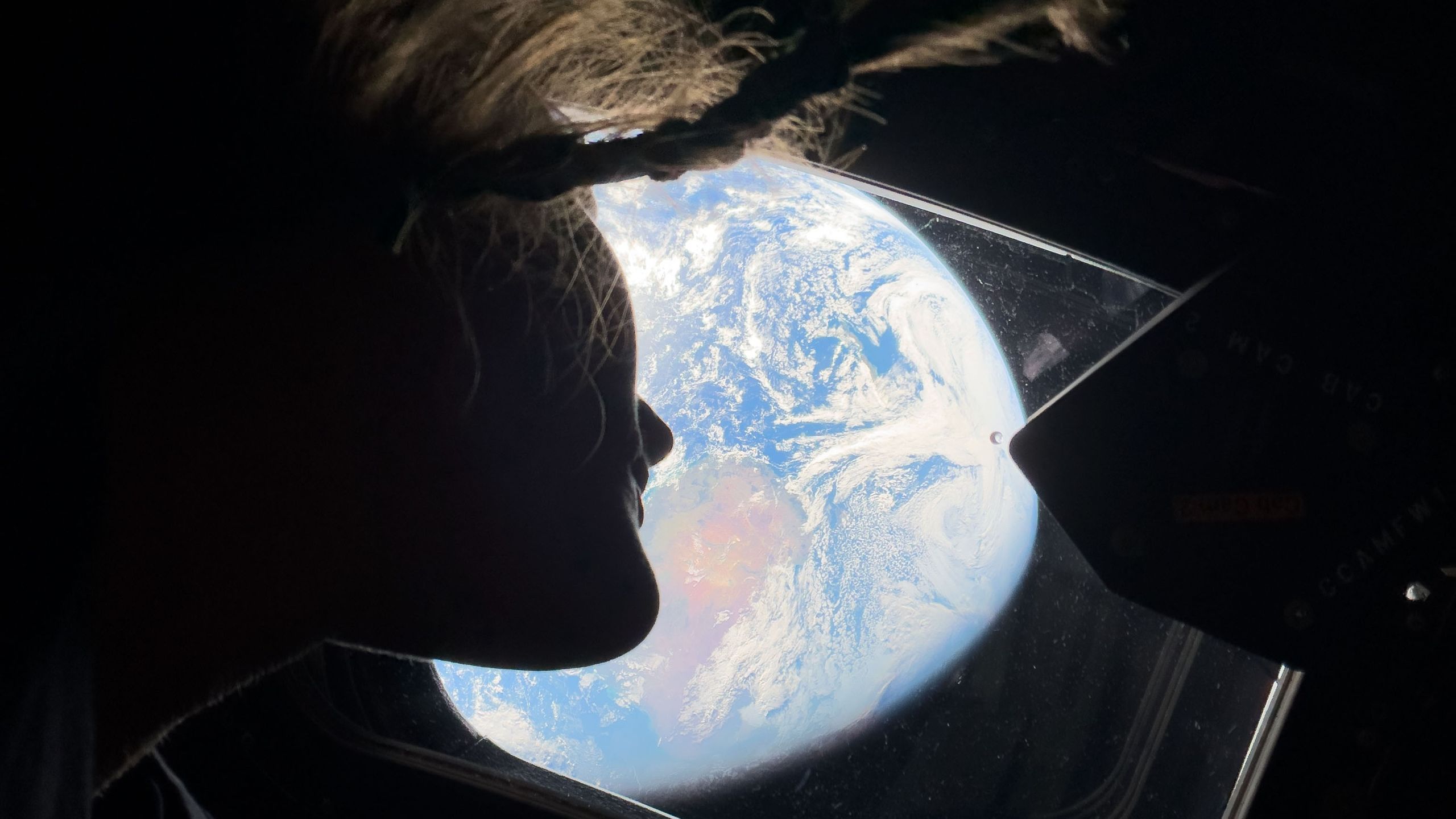
The view from Integrity

And here’s the view from Integrity’s solar array wing camera.
“The Earth will grow larger and larger in the field of view as we continue to move throughout the day,” Navias said.
Yeah, we get that bit, Rob.
NASA coverage begins

Rob Navias has appeared on NASA’s livestream to kick off the agency’s live coverage of the landing, and has also shared a handy visualization of where Orion is currently at.
“As you can see from this computer generated graphic based on real time telemetry, we are currently just 67,000 miles from the Earth,” Navias said. “We passed the halfway mark last night between the Earth and the Moon, and are 186,000 miles from the moon as we close in on the planet Earth.”
What does it feel like to disappear behind the moon?

The “overview effect,” is a term invented by the science philosopher Frank White to describe the shift in perspective humans feel when they see Earth from space — especially how small and vulnerable our patch of cosmic oasis appears against the uninhabitable and vast backdrop that surrounds it.
When asked what it felt like to disappear behind the moon and lose radio contact with Earth, Artemis II pilot Victor Glover expressed a similar sentiment.
“I took a brief moment to say a short prayer of gratitude for being sent on this mission and trusted with bringing back scientifically relevant information,” Glover said. “And I also just felt like I was hoping that people looked up and were watching to see when we came back into communication, and that maybe there was a chance that folks would feel a sense of togetherness.”
“We have a moment of silence whenever something solemn [occurs] that requires reverence, or someone that we love has passed away, but maybe we could call it a moment of togetherness,” he added. “And really was hoping that while we were waiting to get back in contact, that people could just feel that sense of togetherness, that we were all a crew on spaceship Earth.”
Artemis II — The Movie?

During the same in-flight news conference, the astronauts were also asked who they would want to play them in a movie.
“We’ve thought a little about the movie, and I think that’s way out of our pay grade,” Reid Wiseman said. “But one thing we do know for sure is that this guy [pointing at Canadian Space Agency astronaut Jeremy Hansen] is gonna be played by Buzz Lightyear. 100%. No doubt.”
I can see the likeness. But Wiseman knows Buzz Lightyear isn’t a real guy, right? Or what are they hiding from us?
The crew’s final reflections on their mission
While we can’t exactly give you the inside story on the contents of the crews’ dreams right now, we can at least tell you some of their reflections upon their historic journey before they went to bed.
When asked what they would tell their younger selves about what they’re doing right now, Christina Koch recalled a family vacation she took to Kennedy Space Centre at age 10.
“If I could have told that little girl who took home a picture of Earthrise, and hung it in her room, that she would eventually launch from that same place, to see that same view, I’m pretty sure she would not believe it,” Koch said. “But even though I still can’t believe it, and she certainly wouldn’t believe it, she chased that dream, and it ended up happening.”
“It’s such an honour to hear that we’ve inspired, that’s truly one of the top things we ever wanted to do,” she concluded.
What are the Artemis II astronauts doing right now?
3:05 a.m.: Crew sleep begins
11:35 a.m.: Flight Day 10 crew wakeup
1:50 p.m.: Orion cabin configuration for re-entry begins
2:53 p.m.: Return trajectory correction burn
6:30 p.m.: NASA+ coverage begins
7:33 p.m.: Crew module and service module separation
7:37 p.m.: Crew module raise burn
7:53 p.m.: Entry interface
8:07 p.m.: Splashdown in the Pacific Ocean
10:30 p.m.: Post-splashdown news conference at NASA Johnson Space Center
Ben Turner
What time is splashdown?

Patrick Pester
So what about the parachutes?

The heat shield’s durability is certainly the big question today, but what about those parachutes Ben just mentioned?
The Orion spacecraft is fitted with 11 total parachutes, all deployed in a very specific sequence to slow, stabilize and safely lower the capsule into the ocean. They includes three forward bay cover parachutes, two drogue parachutes, three pilot parachutes and three main parachutes.
The most iconic of these are the three main parachutes, which span 116 feet (35 meters) in diameter, weigh 300 pounds (136 kilograms) and consist of 10,000 square feet of fabric each.
Reentry will see the crew enter into a six-minute radio blackout caused by a buildup of superhot plasma surrounding the capsule. After this, NASA will first deploy the two drogue parachutes at an alitude of around 6.7 kilometers (22,000 feet). Then, at around 1.8 km (6,000 ft), the three main chutes will be released, slowing the Orion capsule to a leisurely 20 mile per hour (32 kilometers per hour) descent to splashdown.
Kenna Hughes-Castleberry
Feeling the heat

The speed at which the Artemis II crew will return to Earth is set to be record-breaking — hitting the top of the atmosphere at around 25,000 miles per hour (40,000 kilometers per hour).
To dissipate all that energy and arrive at a much more reasonable 20 mph (32 kph) splashdown in the Pacific Ocean off San Diego, the Orion capsule will use two key pieces of technology: parachutes and a heat shield.
Artemis II’s heat shield is designed to protect the crew and slow their capsule by heating up to temperatures of around 2,800 degrees Celsius (5,000 degrees Fahrenheit). Yet it has a problem: It is almost exactly the same as Artemis I’s heat shield, and that infamously cracked upon reentry.
That will make this coming stage of the mission among the most dangerous.
But while they have confessed to harboring “irrational” doubts, NASA officials have said they’re not worried. Why? Check out Patrick’s story here for the full answer.
What goes up

Good morning, science fans! We’re back to cover the nail-biting final stage of the Artemis II mission, which has seen a four-astronaut crew embark on a 685,000-mile (1.1 million kilometers) 10-day journey around the moon and back.
The crew — consisting of commander Reid Wiseman, pilot Victor Glover, and mission specialists Christina Koch and Jeremy Hansen — have captivated millions around the world with their voyage, beaming back stunning images, scientific insights, laughter and some tears as they made history and laid the groundwork for humanity’s return to the moon.
Now all they have to do is return home safely.
With their reentry at record-breaking speeds through Earth’s atmosphere just hours away, Live Science will be following every moment of this perilous finale to their journey, bringing you breaking updates and expert commentary. Let’s see them home.
Ben Turner
You must confirm your public display name before commenting
Please logout and then login again, you will then be prompted to enter your display name.