






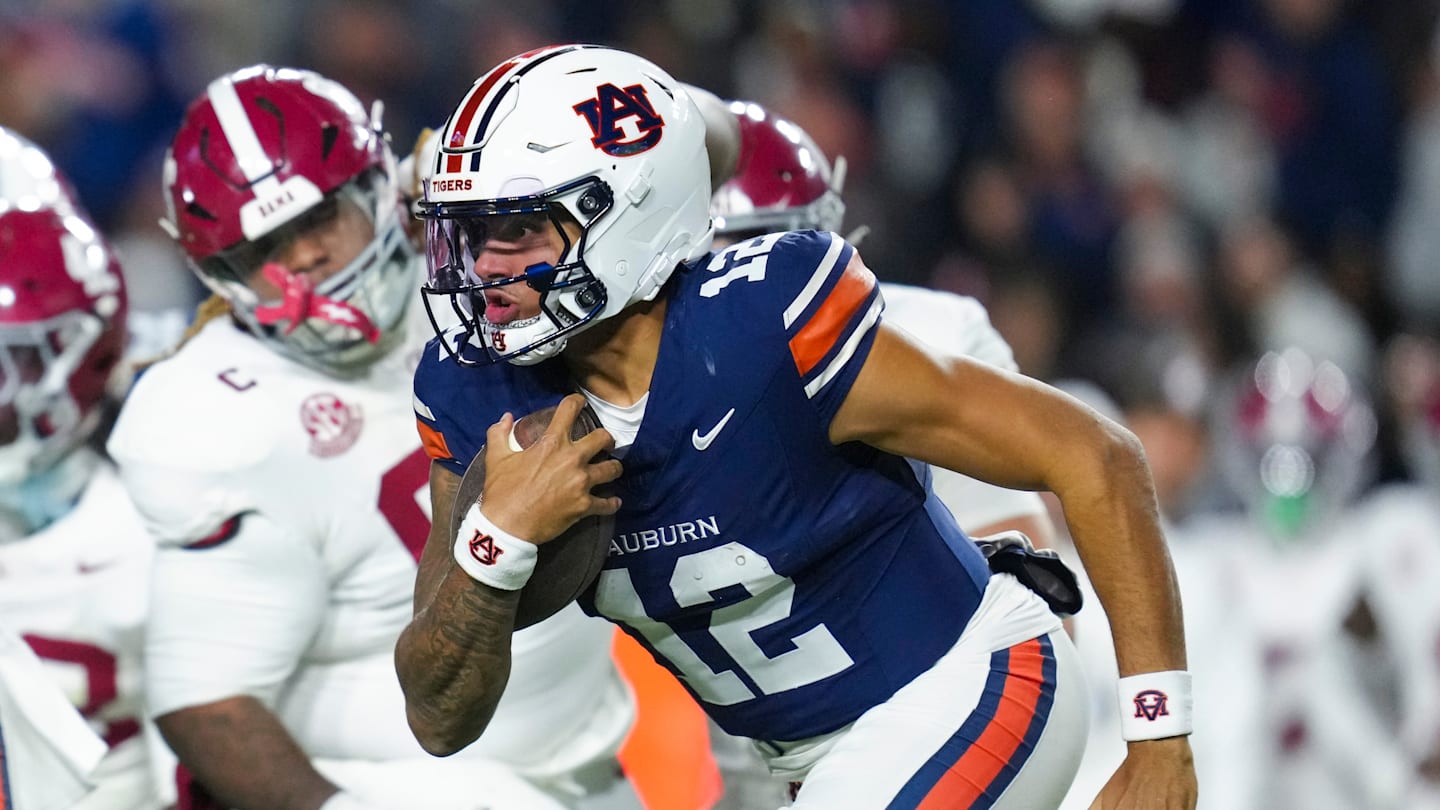
The Iron Bowl in Jordan-Hare lived up to its lore, coming down to an Auburn Tigers fumble with 33 seconds remaining that made the difference, as Alabama survived with a 27-20 victory. As the clock hit 0:00 on the Crimson Tide’s sixth straight win in the series, one item was obviously apparent – Auburn’s roster of players and coaches does not have a winning mentality.
Whatever that winning edge is, that clutch gene, the ability to make a play when the game is on the line, Auburn’s locker room doesn’t have it. And it hasn’t had it in a long time.
The player who fumbled at Alabama’s 20-yard line was receiver Cam Coleman, one of the highest-rated signees in Auburn history. With the clock ticking down on Auburn’s chances to send the game to overtime, Coleman should have gotten out of bounds. He cut back inside and had the ball jarred loose by Bama defenders, who recovered.
By no means did Coleman cost Auburn the game by himself. He was one of many players on Saturday wearing Navy who could have made a winning play and didn’t.
Minutes before the Coleman fumble, the game was tied 20-20 when Auburn was gifted an opportunity to remain tied on an inexplicable decision by Alabama coach Kalen DeBoer.
At 3:54 on the clock, the Tide faced a 4th and 2 at the Auburn six-yard line. A field goal would have given Alabama a 23-20 lead. Auburn’s defensive backs were incredible all night, they looked like they were two steps ahead of Alabama’s passing game from start to finish, yet DeBoer kept the offense on the field.
What he did was force Auburn to make a play in a clutch situation, and he was right that the Tigers would fold. Perhaps given that the Tigers defense had out-flanked Alabama on the edges all night, he thought he had a perfect play call to attack the middle of the field.
He gambled correctly that Auburn would not step up in a crucial situation. Ty Simpson dropped back with trips to the left. Isaiah Horton lined up on the outside, crossed over the middle, where he was open for a touchdown. He was a step ahead of true freshman Auburn DB AnQuon Fegans.
Auburn had its chances for big plays all night long. The Tide played one of its poorest games all season, and for context of Iron Bowl winners was one of the worst performances by a winning team in decades.
On the drive before Auburn tied the game at 20-20, there were a number of other non-winning type plays. Preston Howard briefly caught the ball from Ashton Daniels over the middle and had it quickly stripped for an incompletion. It was close enough to a fumble that the officials reviewed.
Two plays later, Eric Singleton Jr. fumbled after a 16-yard catch, which was recovered by Coleman. Two plays after that, running back Justin Jones fumbled the ball out of bounds. Two plays after that, Daniels threw a checkdown to Omar Mabson II, who had the ball bounce off his hands/helmet for an Alabama interception.
Earlier in the third quarter Auburn had Alabama’s 17-0 lead cut to 17-13. On a 3rd and 3 at Auburn’s 33-yard line, Simpson dropped back and threw over the middle right to defensive back Sylvester Smith. Smith dropped it. Alabama lined up to go for it on fourth, and end Keyron Crawford jumped offsides. The Crimson Tide went on to add a field goal after that sequence.
The Tigers never quit when it was 17-0, they never hung their heads, they kept battling and fighting. In fact, Alabama’s 17-6 halftime lead could have easily been 17-10 if not for another crucial miscue from Auburn.
Malcolm Simmons put in the biggest game of his career with three catches for 146 yards and a touchdown. It could have been more had he lined up correctly on a play near the end of the first half.
Came out swinging 😤@MalcolmSimmons0 takes it 64 yards to the crib!
📺 ABC pic.twitter.com/qUmf8QZiWd
— Auburn Football (@AuburnFootball) November 30, 2025
With the score 17-3 and the Tigers’ offense driving before halftime, Daniels escaped the pocket to his right and connected with Simmons at the 16. Simmons raced the rest of the way to the Tide end zone.
However, Auburn had only six on the line of scrimmage. Simmons was the only receiver on the right, outside the tackle. Later that drive Alex McPherson connected on a 43-yard field goal to make it 17-6 at halftime. Eric Singleton II also had a costly drop down field on that drive.
If not for drops, fumbles, and lining up incorrectly, Auburn would have in all likelihood won by double digits. But alas, bad plays by key players in crucial circumstances was the difference between Auburn winning and losing yet again.
This has been the same story for Auburn the last two seasons – play well enough to beat a Top 10 team in the country, but not execute when it matters. Auburn could have, should have or at least had an opportunity late in the game to beat Alabama, Vanderbilt, Kentucky, Missouri, Texas A&M, and Oklahoma. The Tigers were 0-6 in one-score games in 2025, and that doesn’t include the close loss to Georgia.
In 2024 Auburn was 1-3 in one-score games. There were other losses like Vanderbilt and Arkansas that were one-score games late. The 2023 squad couldn’t stop a 4th and 31 play, and lost its last three one-score games.
Overall, the Auburn program has lost 12 of its last 13 one-score games. Aside from dozens of individual miscues over that stretch, a common theme over the last two years is the defense’s inability to get a stop in the fourth quarter.
It’s happened over and over and over again. It has been a continuous theme since DJ Durkin became defensive coordinator. The Auburn defense has not been able to get a stop in the fourth quarter or overtime to seal the win with Durkin at the controls.
Heading into the Iron Bowl, Durkin’s name was on the short list to become Auburn’s next head coach. He deserves credit for Auburn playing well down the stretch in an interim duty. The Tigers were at rock bottom when Kentucky left Jordan-Hare with a 10-3 win, Freeze was fired, and Durkin took over.
Durkin worked with offensive coordinator Derrick Nix, the offensive staff, and retooled the Auburn offense to score 38 at 10-win Vanderbilt, 62 against Mercer, and to score 20 in the Iron Bowl – outgaining the Tide 411 to 280.
Late in the game, when Auburn needed a clutch play offensively to tie the game and send it to overtime, the losing mentality reared its ugly head. Before that, with the game tied at 20-20, the defense once again could not get a stop with the game on the line. DeBoer even offered an extra opportunity for the defense to rise to the occasion.
Jeremiah Cobb’s touchdown run with 11:43 remaining in the game tied it at 20-20. That’s when the Alabama offense went 75 yards in 15 plays taking 7:53 off the clock. The Crimson Tide converted a 3rd and 4 at its own 31 on a pass interference, which to be fair was a bad call.
They converted a 4th and 1 at midfield where Auburn defenders had chances to tackle Simpson short of the mark. Another 3rd and 7 play was bailed out by a low hit and roughing the quarterback. Then came the 4th and 2 that Alabama converted into the game-winning touchdown.
Looking back at the 2024-25 seasons under Durkin, late-game scoring drives like the one the Tide put together has been a theme close game after close game.
· Sept. 21, 2024. Trailing 17-7 to visiting Arkansas in the fourth quarter, Auburn’s offense gambled and won as it converted a 4th and 2 into a 67-yard touchdown. It was the first of a large number of games in two seasons where Auburn’s defense collapsed late in the game by allowing a long scoring drive after playing well all game previously. Arkansas’ offense got the ball up three with under 10 minutes remaining, and by the time the Tigers’ offense gained possession again, it was down 10 with 3:38 to play. Needing a stop for a chance to tie or win, Auburn’s defense allowed Arkansas to go 75 yards in 12 plays. The Razorbacks converted a 3rd and 10, 3rd and 4, and 3rd and Goal from the 1.
· Sept. 28, 2024. Auburn was leading Oklahoma 21-10 in a fairly dominating performance on both sides of the ball after being down 7-0. The Sooners got the ball after a missed field goal by Auburn with 10:12 left in the game. It certainly looked like the Tigers would finish it out, but on the Sooners’ second play of the drive, the Auburn secondary got beat deep down the sideline in man coverage for a 60-yard gain, which set up a two-yard rushing score. Auburn had the lead and the ball when Payton Thorne threw a pick-six. Oklahoma converted the ensuing two-point conversion and won 24-21.
· Oct. 4, 2024. Auburn competed at Georgia, showed signs of life, and trailed 28-13 midway through the fourth quarter. A 12-play 46-yard drive by the Bulldogs for a field goal put away any hopes the Tigers had of pulling it off.
· Oct. 19, 2024. Looking to get a rare road win versus a Top 25 opponent, Auburn was well on its way. Up 17-6 under a minute left in the third, Auburn dropped a touchdown that would have extended it. With Missouri quarterback Brady Cook returning from the hospital, he connected on a 78-yard pass on the final play of the third. Missouri then scored a touchdown and two-point conversion. Auburn still led 17-14 with 4:26 to go and pinned the home team deep. However, Missouri converted a 3rd and 1, 3rd and 7, 4th and 5, 3rd and 10, and scored the game-winning touchdown from four yards out with 46 seconds left. The Tigers went 95 yards in 17 plays to win.
· Nov. 2, 2024. Vanderbilt led Auburn 10-7 in a defensive battle at Jordan-Hare. The Tigers’ secondary had held Diego Pavia to zero completions in about 30 minutes of game action. An Auburn punt gave the Commodores the ball with 13:11 in the fourth, and the Tigers’ offense wouldn’t get the ball back until 4:18 remaining, down 17-7. Vandy converted a 3rd and 2 and 3rd and 1 to get into field goal range. In one of dozens of crucial individual mistakes over two years, the Tigers were called for a personal foul for leaping on a field goal attempt, which led to a Pavia touchdown pass two plays later. Auburn lost 17-7.
· Sept. 20, 2025. Despite an ugly offensive performance, Auburn fought and clawed and claimed a 17-16 lead in Norman midway through the fourth. The Tigers’ defense held OU in check much of the game, but when it mattered, the Sooners’ offense was able to go 75 yards in just six plays to reclaim the lead, 22-17. Oklahoma would win 24-17
· Oct. 11, 2025. Auburn raced out to a 10-0 lead and almost extended that to 17-0. Georgia fought back and claimed its first lead of the game in the third quarter at 13-10. Auburn punted the ball away with 10:38 on the fourth-quarter clock, and it didn’t get the ball back until it was 20-10 with 1:53 left. The Bulldogs went 78 yards in 16 plays, converting on 3rd and 8, 3rd and 4, 4th and 3, 3rd and 1, and 3rd and 3.
· Oct. 18, 2025. Auburn held visiting Missouri to just 10 points through just over three-and-a-half quarters. Trailing 17-10 with 6:16 left in the game, Missouri needed just five plays to march 60 yards and tie the game. Missouri threw for 118 yards in the fourth quarter alone and sent the game to overtime. On the second series of overtime, Missouri found the end zone for a 23-17 lead, which was the final score.
· Nov. 8, 2025. Auburn tied the game at 38-38 in the fourth quarter at Vanderbilt. In overtime the Commodores needed just three plays to go 25 yards and claim a 45-38 lead, which was the final score in Auburn’s sixth loss of the season.
· Nov. 29, 2025. Durkin has done a remarkable job overall as defensive coordinator at Auburn, but the 15-play, 75-yard touchdown drive was just another in a long line of late-game collapses by the Tigers the last two seasons.
Not to put blame on the defense for losses over the last two seasons, as it has certainly out-played the Auburn offense, but long drives to lose games have been a consistent reality.
It’s hard to define what characters, habits, practices, demeanor is that of a winning locker room. There are tons of cliches thrown around about a team that keeps losing games. Whatever it is, Auburn has found ways to lose close game after close game.
DJ Durkin has coached under Urban Meyer, Jim Harbaugh, and Jimbo Fisher – all national championship-winning coaches. The measurables like yards per game, points per game, all check out in his favor, but the fourth-quarter defensive collapses have also been very real.
The argument for Durkin becoming Auburn’s next head coach includes the fact that there is tons of talent on the defensive side of the ball, and player retention would be much higher if Durkin becomes the next head football coach at Auburn.
The individual talent was there for Auburn this year. They haven’t been physically out-matched in any game they’ve played this season, and strength and conditioning were a non-issue in the seven losses.
There’s talent, but there is a complete lack of the winning gene it takes to go better than 5-7. The locker room needs an overhaul and a change made at the top that can bring in a winning culture, regardless of personnel losses.


