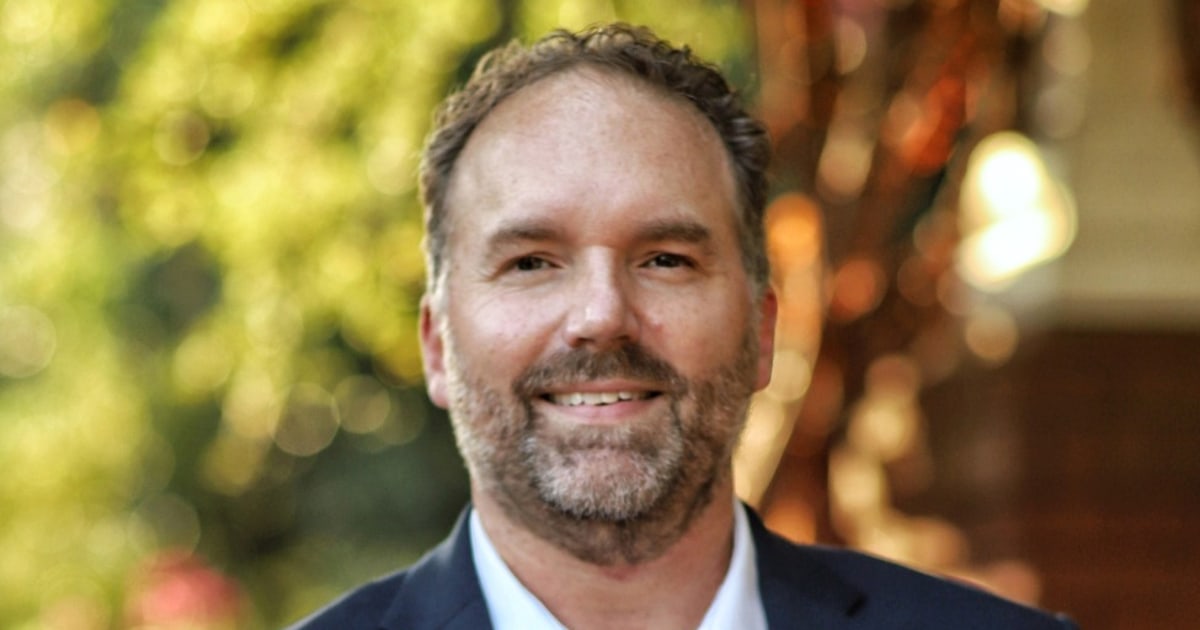
Daniel Alcozar stood in the corner of a mostly empty Ventura voting center and cast his ballot in favor of Proposition 50.
Alcozar, 77, of Fillmore, said he worries President Donald Trump is using gerrymandering in Texas and elsewhere to manipulate the election process. He thinks the tactic could dilute his vote.
“What happens to the little guys like us?” he asked moments after voting on Oct. 7. “We’re out of the loop.”
Daniel Alcozar of Fillmore casts an early vote in the Nov. 4 election that asks voters to pass or reject Proposition 50’s temporary redistricting plan. Alcozar supports the measure.
Across California, voters are already casting ballots in what is likely the most important contest of 2025, one that will play a substantial role in deciding which party controls the U.S. House for the last two years of Trump’s time in office.
And many are frustrated, angry and wanting to push back against Trump or Gov. Gavin Newsom − from the rural, Republican North State to liberal enclaves along California’s coast − with just weeks to go before the consequential Nov. 4 election.
Republicans hold a razor-thin majority in the U.S. House and historically, the party that controls the White House fares poorly in midterm elections.
A Trump friendly U.S. House could allow the president to continue one of the most aggressive and disruptive agendas in modern presidential history, while a Democratic majority opens the door to congressional investigations, legislative paralysis − even a third Trump impeachment.
California’s Proposition 50 seeks to let the legislature redraw the state’s congressional districts through 2030 to create five more seats favorable to Democrats. The map is already complete and public.
Passing the proposition could essentially negate the five new Republican-leaning congressional districts Texas created earlier this year at Trump’s urging. Similar actions by Republicans in Indiana, Missouri and Ohio and Democrats in Illinois, Maryland and New York are under consideration. Most recently, Republicans in North Carolina are making their own redistricting push.
This story was reported by Sarah D. Wire of USA TODAY; Michele Chandler of the Redding Record Searchlight; Terry Collins of USA TODAY; Tom Coulter of The Desert Sun; Rene De La Cruz of the Victorville Daily Press; Chris Kenning of USA TODAY; Tom Kisken of the Ventura County Star; Steve Pastis of the Visalia Times-Delta; Josh Peters of USA TODAY; and Hannah Workman of The Stockton Record. It was written by Wire.
The fight over Proposition 50, which is expected to cost $282.6 million in taxpayer funds, according to the California Department of Finance, is already one of the most expensive ballot fights in state history.
As of Oct. 7, state data show campaigns in support of the proposition have so far raised $127.5 million. Those fighting it have so far raised $78 million.
And big names like former President Barack Obama are urging Californians to act.
“California, the whole nation is counting on you,” Obama says in an ad. “Prop. 50 puts our elections back on a level playing field, preserves independent redistricting over the long term and lets the people decide.”
Political battle: Frustrated voters caught in redistricting war: ‘This isn’t how a well-run republic runs’
‘Really puts voters in a difficult situation’
Unlike Texas, though, California’s constitution requires district boundaries to be drawn by a nonpartisan commission. California Gov. Gavin Newsom is asking voters to approve Proposition 50 and waive that requirement to give Democrats a better chance of reclaiming the House. The commission would resume drawing the boundaries after the 2030 census.
Californians are proud of the commission, but also overwhelming disapprove of Trump and fear for the future of the country, said Mark Baldassare, survey director at the Public Policy Institute of California and a leading expert on California voter opinion.
“My sense is that this really puts voters in a difficult situation where there is a policy which the voters passed, which they feel relatively good about, but they don’t feel very good about what’s going on right now,” he said.
California voters have a history of revisiting constitutional amendments and passing temporary measures when needed. They also tend to vote in large numbers for special elections, he said.
Graphics: See how Texas redistricting maps could gain Trump more Republican seats in the House
The ballot language specifically mentions Texas, states that the change is temporary and lays out how long it will be in effect and what will happen after.
“If the word temporary wasn’t in there, it might be a different situation,” he said.
He said turnout could come down to how much do voters want to be part of history.
“People recognize that what they’re voting on not only has implications for the state, but it has implications for the nation,” he said.
USA TODAY Network reporters asked voters across California what they think of the move. With the Proposition 50 campaign entering its final stretches, many of their responses highlight California’s own political divide between coastal and inland areas.
Southern California
Alcozar of Fillmore worked as a teacher and softball coach for more than 25 years. He sees his vote for the proposition as a statement on a Trump administration he thinks contradicts what he taught students about the Constitution, honesty and the difference between right and wrong.
“Everything I taught them is like out the door,” he said.
He cast his ballot in an early voting center at the Ventura County Government Center. It saw just 11 voters on its first day and 11 more the next.
John Harrod, a 72-year-old retired machinist, sat in a nearby courtyard at the government center, waiting to take his wife to lunch after her morning session as a prospective juror.
They live in Simi Valley, the one city in Ventura County where a majority of voters supported Trump in the 2024 presidential election. Harrod, a Trump supporter, said he planned to cast his ballot against the redistricting measure.
“It’s a way for them to get more seats,” Harrod said of the Democrats. He worries the proposition, if successful, would push Simi Valley into a different congressional district.
“Keep the district the way it is,” he said.
Eddie Alamillo, a county mosquito-control worker from Ventura, voted in person and chose a paper ballot over a touch screen. He wanted to make sure no one can question that the vote in favor of the proposition is his.
He sees his vote as a way to counter Texas redistricting.
“This wouldn’t have happened if it wasn’t for that,” he said, noting California’s proposal will be decided by a vote of the people. “The system is rigged in Texas, and that is dead wrong.”
Bailey St. Louis, 30, of Oxnard, didn’t vote in the 2024 presidential election and is determined to cast a ballot in the special election even though she knows nothing about the proposal aside from a YouTube ad in support of the measure.
“It’s my civic duty,” she said.
If she decides the election is a referendum on Trump once she’s done her research, she’ll likely vote for the proposition.
“Anything against Trump would be the vote,” she said.
North State
Three days after ballots went out to Shasta County voters in the mail, Bob Braz took a day off from work at the fishing bait shop he owns to lead a one-man protest against Proposition 50.
Early on a Thursday, as commuters whizzed along busy Cypress Avenue, Braz held his homemade sign in front of Redding City Hall: “Redistrict Calif. #50 No!”
“I voted no because I think Gov. Gavin Newsom is breaking the law, the California Constitution,” Braz said. “It’s illegal for him to do it.”

Shasta County fishing bait shop owner Bob Braz protested against Proposition 50 in front of Redding City Hall Oct. 9. Braz said he’d be voting no.
The 73-year-old Redding resident said that in his opinion, Newsom “is just doing it to try and redistrict California so he can get five more Marxist seats in Congress,” which Braz said would give the California governor “a better advantage when he runs against Trump in 2028.”
The constitution bans Trump from a third term.
More: President Trump says Republicans will hold a midterm convention before 2026 elections
Braz said he’s also worried what the new district lines would mean for U.S. Rep. Doug LaMalfa, a Republican who has handily won elections to represent the area since 2012.
Renee Ashe, a retiree, said she voted no on redistricting, too, “because I think it should be up to a committee, not Sacramento telling us that’s the best way to go.”
Ashe said lawmakers and Newsom rushed to bring the proposition to voters and spent too much money on a special election
“We need cops, we need other resources, firemen,” she said. “We need help in other ways in this state. Not through spending the money like that.”
Bay Area
A few days into early voting, residents trickled into San Francisco’s ornate City Hall, passing newly married couples posing for photos on a marble staircase before descending to a basement voting site that was mostly deserted. San Francisco and the surrounding Bay Area have been Democratic strongholds for decades.
Michael Stephens, 70, a retired lawyer who worked as a public defender in South Carolina before relocating to California to be closer to his children, cast his ballot in favor of Proposition 50.

Michael Stephens, a San Francisco resident, stands outside a city hall voting center in early October.
Trump’s actions and statements have left him worried about the future for his young grandchildren, he said.
“It’s the damnedest thing I’ve ever seen,” Stephens said in his South Carolina drawl. “Sending troops to our cities. Vilifying people.”
That’s on top of stacking the election deck by asking Texas lawmakers to gerrymander districts to keep control of the House in the 2026 midterms, he said.
Normally, Stephens said he wouldn’t support a plan to “cheat to beat the cheater.” But he said the stakes were too high not to embrace the proposition.
“We might never get the chance to vote again if we don’t do something,” he said. “Desperate times, desperate measures.”
Court fight: Supreme Court asks if Black voter protections discriminate against White people
Across town, in San Francisco’s Sunset District, Barry Hermanson agreed with Stephens about the threat Trump poses to the county.
“The specter of this authoritarianism that is moving forward – I mean, troops in our cities – unbelievable,” said Hermanson, a former employment service owner.
But the 74-year-old Green Party member and unsuccessful congressional candidate is adamant about voting against Proposition 50.
Hermanson said the costly ballot measure isn’t necessary because he believes the 2026 midterms will wipe away Republicans’ narrow House majority, even if several other states gerrymander seats in favor of the GOP.
“I do have faith in the average voter to be stepping up and saying, ‘No’,” he said. “I have some Republican friends who look at this and go, ‘Oh, geez, this isn’t who we are.’ So I really think that the midterm election is going to be a watershed moment for American democracy.”

A ballot drop box in San Francisco ahead of the vote on Proposition 50.
Central Valley
Although Gregory Hagopian, 45, a criminal law attorney in Visalia, has some reservations about Proposition 50, he understands why it is on the ballot.
“We already know that other states have gerrymandered their districts unfairly to stack Republicans in the national legislature,” he said. “What California has said is, ‘We’ll do the same thing to even things out.’ So, yes, it’s a dangerous thing to do, but the gauntlet’s been thrown down by the other side already.”
Hagopian “absolutely” sees the ballot measure as a referendum on Trump.

Gregory Hagopian
“The issue here is a national legislature that would have ability and willingness to rein the Trump administration in,” he said. “Many people, including me, are afraid these days. We’re afraid because the current president has shown every indication that he wants to be a dictator, and the Republican-controlled Congress has shown no indication that they ever intend to ever rein him in.”
Retired Visalia businessman Johnny George, 90, said he plans to vote no.

Johnny George
“Anything that Newsom wants, I don’t want,” he explained. “I will vote, but I will vote with good common sense. I will not vote like a Democrat that doesn’t know what the hell they’re doing.”
Coachella Valley
As ballots arrived in the mail, some voters in the Coachella Valley, a desert area 100 miles east of Los Angeles that includes Palm Springs, were torn. Several said they typically wouldn’t support politically motivated redrawing of maps, but see the proposition as the best way to fight back against the Trump administration.
“I oppose gerrymandering, but I oppose it less than I oppose Trump,” said John Rhodes, an 88-year-old retired chemical engineer, after he dropped his ballot at Palm Springs City Hall. “I think (Newsom) is trying to do the best he can.”

John Rhodes of Palm Springs gives his thoughts on Proposition 50 after turning in his ballot at city hall in Palm Springs Oct. 8.
Some voters said they were excited at the prospect of removing U.S. Rep. Ken Calvert, a GOP congressman who’s represented parts of Southern California since 1993. Calvert won competitive races in his swing district in 2022 and 2024, but that district, which includes Palm Springs, would be carved up under Prop. 50’s new boundaries.
The Palm Springs area has a large and influential LGBTQ community, and some members of it said they were voting yes, in part, because of fears about the potential rollback of LGTBQ rights at the federal level.
Outside of Palm Desert City Hall, Doris Olivera and Linda Quigley, a retired married couple living in Palm Desert, said they saw voting for Proposition 50 as their only outlet to push back against Trump in Washington.
“We’re very scared,” said Olivera, 73. “It’s like, we want to go back into the closet, but we’re too old for that, and we’ve fought too long and too hard.”
This story was reported and written by Sarah D. Wire of USA TODAY with contributions from Michele Chandler of the Redding Record Searchlight; Terry Collins of USA TODAY; Tom Coulter of The Desert Sun; Rene De La Cruz of the Victorville Daily Press; Chris Kenning of USA TODAY; Tom Kisken of the Ventura County Star; Steve Pastis of the Visalia Times-Delta; Josh Peters of USA TODAY; and Hannah Workman of The Stockton Record.
This article originally appeared on USA TODAY: California Prop. 50 campaign fight has voters pushing back