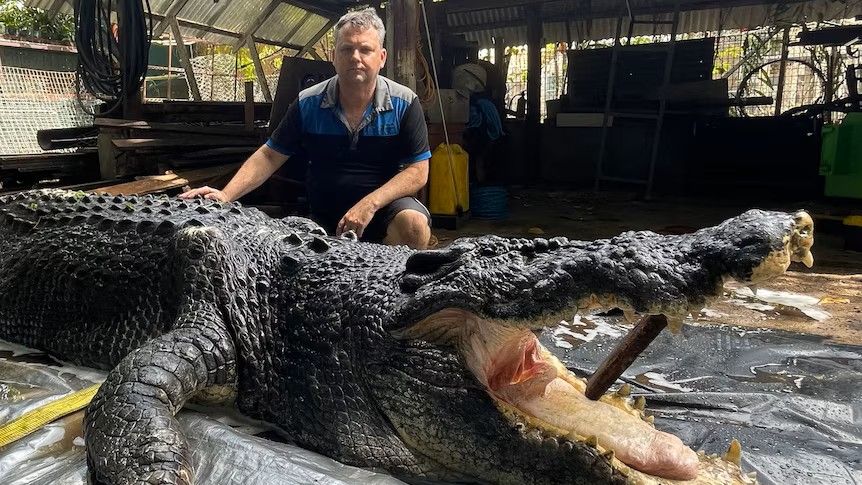
A postmortem examination has revealed that Cassius, an 18-foot-long (5.5 meters) captive crocodile that died last year in Australia at the age of about 120, succumbed to sepsis.
An infection from an injury that Cassius sustained in the wild more than 40 years ago burst out of a fibrous casing and “engulfed” the saltwater crocodile (Crocodylus porosus), killing him suddenly, Sally Isberg, the managing director of the Center for Crocodile Research in Darwin who conducted the examination, told ABC News.
Image 1 of 2
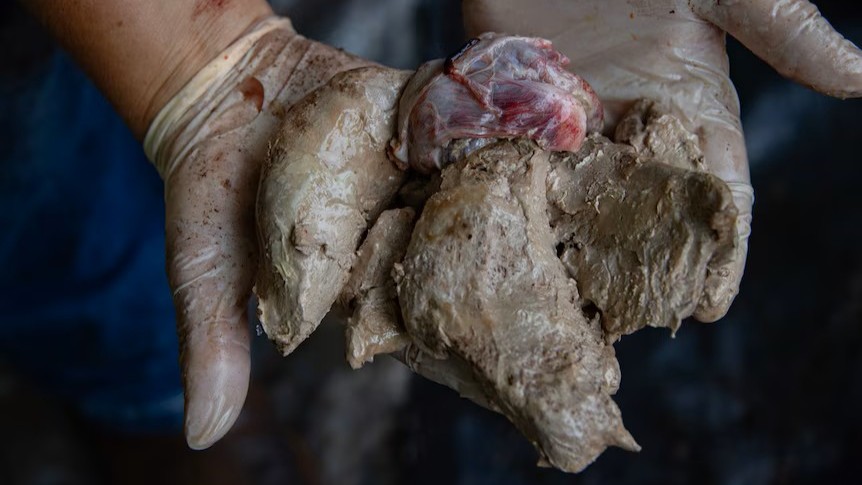
Cassius had a fibrosis lodged near his left lung that exploded last November, just a few months after Isberg conducted a health checkup and concluded that the crocodile was “happy and healthy.” Just 17 days before Cassius’s death, Isberg visited him and found no signs of disease. There had been no warning of an infection until the fibrosis ruptured, because the casing kept the infection neatly packaged and sealed, Isberg said.
The infection probably stemmed from when Cassius lost his front left leg as a youngster, before he was captured in the Northern Territory and brought into captivity in 1984.
“What we didn’t know was that the rib cage had also been damaged in that injury,” Isberg said. “Upon necropsy, his left rib was distended compared to his right one,” because it housed the fibrosis.
The fibrosis finally burst because Cassius was growing too old, Isberg explained. “It’s because the cells are breaking down, they’re not able to renew themselves,” she said. “He [Cassius] was not able to continue [making] that fibrous casing around that infection.”

After Cassius died, Isberg removed one of his thigh bones to estimate his age more precisely. Staff at Marineland Crocodile Park, where Cassius lived for 40 years until his death, celebrated Cassius’s 120th birthday in 2023 — but that age was a maximum estimate, given that the crocodile was between 30 and 80 years old when he was captured.
Isberg hoped that the thigh bone would show growth rings, but the tests didn’t give a definitive result, because temperatures at Marineland Crocodile Park are very stable, she said. Growth rings on crocodile bones vary with metabolism fluctuations, which are partly dependent on temperature.
Cassius has now been taxidermied and returned to the crocodile park for an exhibit that will open Saturday (Dec. 12).