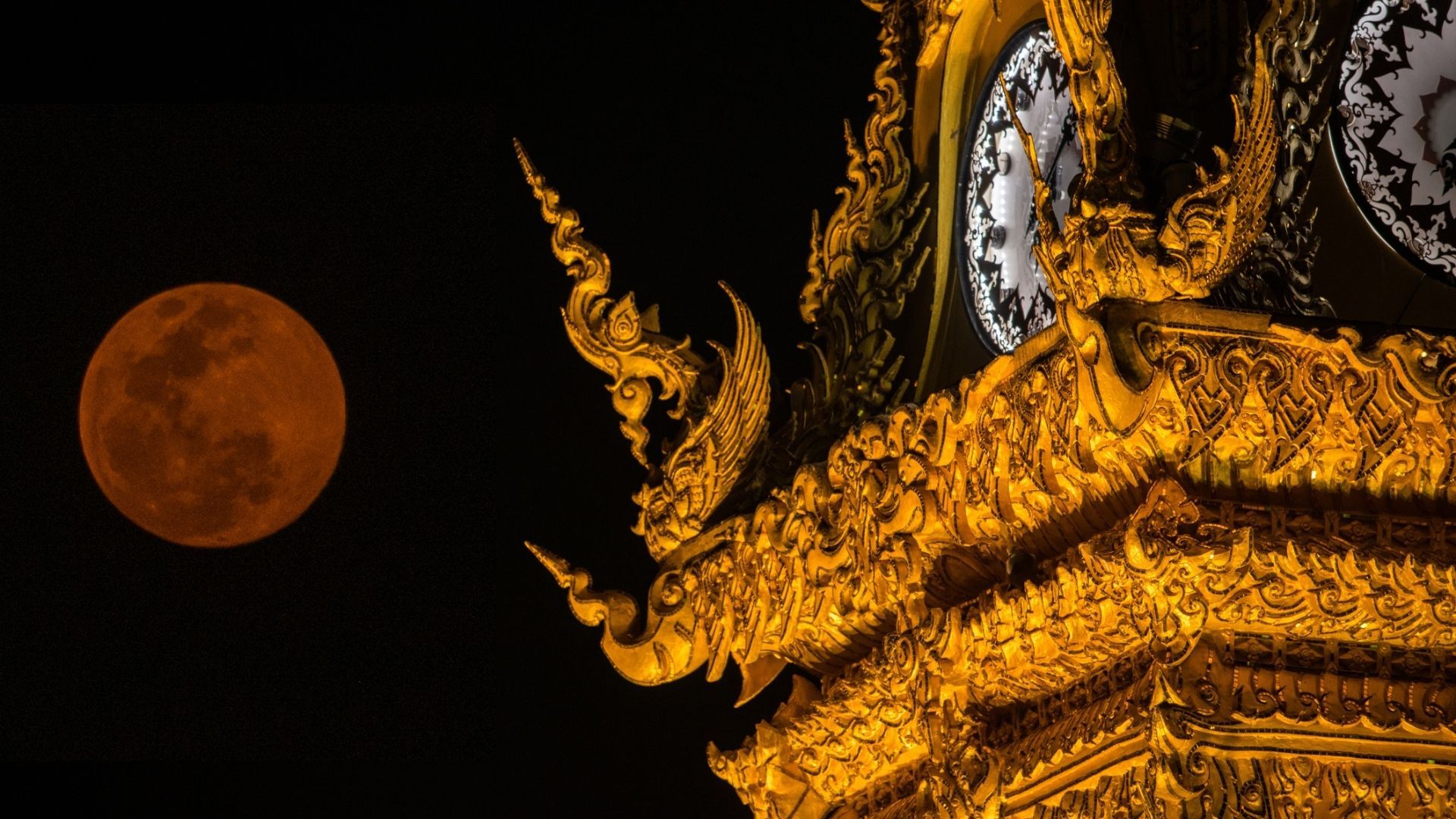
Did you ever wonder what time it is on the moon? A software package developed by researchers in China can finally tell you.
The model, built by a team from the Purple Mountain Observatory in Nanjing and the University of Science and Technology of China in Hefei, was detailed in a paper published in December 2025 in the journal Astronomy & Astrophysics. The new lunar timekeeping method promises to remain accurate over a 1,000-year time span.
But why create a distinct lunar clock in the first place? For the answer, we turn — as we so often do — to Albert Einstein.
Because the moon has less gravity than Earth does, time passes slightly differently there. This effect was first predicted by Einstein’s theory of general relativity. For every 24 hours that pass here on terra firma, the moon gains about 56 microseconds, according to NASA.
While small, this discrepancy adds up over prolonged periods — a fact that could pose major issues for future crewed moon missions, like NASA’s Artemis initiative or Russia and China’s joint International Lunar Research Station. (Mars is an even bigger challenge, with clocks there ticking about 477 microseconds faster per Earth day.)
Astronauts living and working on the moon will need to be able to coordinate video calls, data sharing, and navigation with their Earthbound colleagues — hence the need for an algorithm that can reliably convert Earth time to moon time. In 2024, researchers introduced the idea of Lunar Coordinate Time (TCL), an equation that resolves this relativistic time dilation based on the distance from a particular point on the moon relative to Earth’s gravitational field.
“This is not just about telling time — it’s about navigation, communication, and safety,” Sergei Kopeikin, an astronomer at the University of Missouri and co-author of the TCL paper, told Live Science in an email.
The new system from the team in China builds on Kopeikin’s original algorithm. It essentially calculates a version of the TCL equation very quickly while considering some additional factors, like Barycentric Coordinate Time (TCB), an International Astronomical Union standard. The researchers dubbed the system “lunar time ephemeris,” or LTE440.
Kopeikin called LTE440 “a solid piece of engineering.” It shows that China is serious about moving forward with its ambitious moon program. However, he noted that NASA is still developing its own lunar time system, called Coordinated Lunar Time (LTC). The agency aims to finalize the system, which will be anchored in Coordinated Universal Time (UTC) for maximum interoperability across time zones, by the end of this year.
Likewise, the European Space Agency is currently fielding applications for its own moon clock. These systems may use LTE440 as a benchmark to cross-check space agencies’ calculations, but it remains to be seen whether the Chinese system will become the international standard.
Ultimately, the moon’s time standard needs to be coordinated across countries, or else we risk plunging lunar research into chaos. “If we fail,” Kopeikin said, “we risk a ‘time zone war’ in space.”