



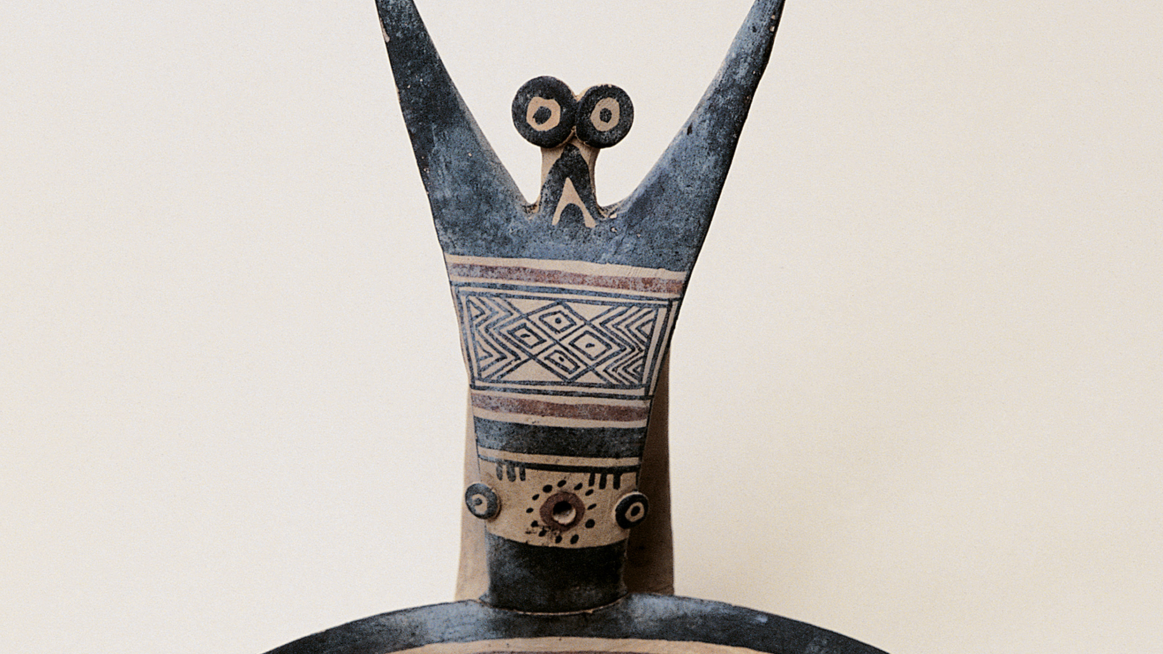
An ancient ceramic vessel, possibly a wine ladle, from southern Italy.
(Image credit: Getty Images)
QUICK FACTS
Name: Daunian kyathos
What it is: A painted, one-handled ceramic cup or ladle
Where it is from: Foggia, Italy
When it was made: Sixth century B.C.
Archaeologists excavated the Daunian city of Herdonia, in the present-day province of Foggia, for four decades and discovered that the city was one of the primary places where Daunian potters produced the “extraordinary” vessels “that rank among the finest products of pre-Roman Italian ceramics,” Popular Archaeology reported.
The Daunians’ unusual style of ceramic decoration can be seen in their take on the single-handled cup that art historians call a kyathos. The base is a small, rimmed plate about 5 inches (12.7 centimeters) in diameter, and a human figure with raised arms and wide-open eyes has been attached to the side as a handle. The figure is decorated with geometric designs, and a stylized, bird-like figure is in the middle of the base. This kyathos was found at Herdonia and is in the collection of the Civic Museum of Foggia.
A number of Daunian ceramics are also kept in the Herdonia Archaeological Museum, whose logo includes a similar human-handled kyathos, as well as in international collections at The Metropolitan Museum of Art in New York City and the British Museum in London.
MORE ASTONISHING ARTIFACTS
Although the exact purpose of the Daunian kyathos is unknown, there are two main ideas. One is that it served as a wine ladle. The ancient Greeks used a vessel called a kyathos, which was a cup with a tall vertical handle, to dip into containers of wine and mix with water at feasts. But the Daunian examples slightly predate the common use of the kyathos in Greece and look more like a bowl than a cup, so it is unclear if they served the same function.
A second hypothesis is that many Daunian ceramics were used in religious and healing contexts. In a 2023 research study, scientists tested a series of Daunian ceramics and detected opium alkaloids in most of them, supporting the idea that some vessels were used to create opium mixtures, perhaps to induce religious trances or to aid in pain relief. It is not clear, though, if the distinctive appearance of Daunian ceramics can be explained by opiate use.
For more stunning archaeological discoveries, check out our Astonishing Artifacts archives.
TOPICS