

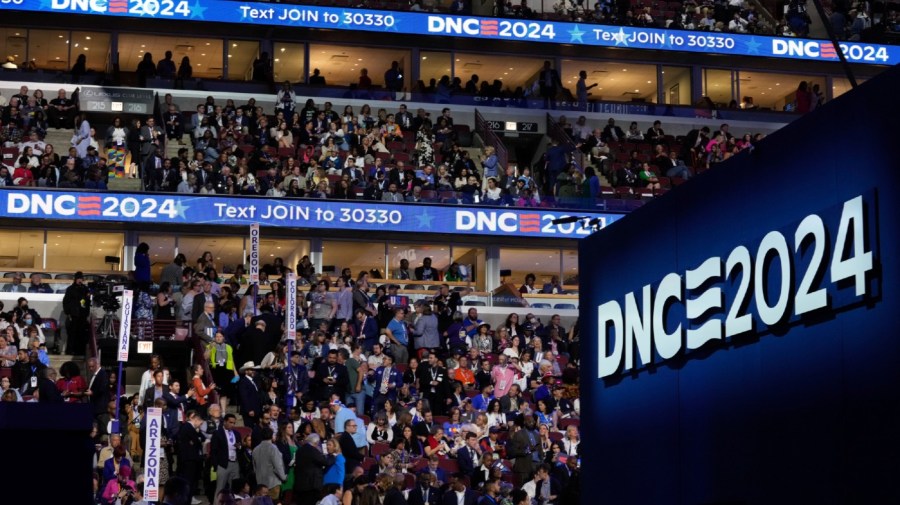
Democrats performing postmortems on the 2024 presidential race have taken a closer look at how to best utilize super PACs to boost their future campaigns.
In previous election cycles, there has been one “chosen” super PAC, and donors are encouraged to support that organization and not support other organizations. In 2024, the super PAC Future Forward was former President Biden and former Vice President Kamala Harris’s preferred super PAC. But even before Harris lost, the organization had come under criticism by Democrats for a seemingly faulty strategy that included holding a majority of its funds until the tail end of the campaign.
Now, Democrats are discussing taking a broader, more inclusive strategy that allows multiple super PACs to play a role in helping their candidate win.
“One of the things that was clear in 2024 was that there should not be a single super PAC that has so much power and control,” said Democratic strategist Karen Finney, who has been in discussions about what role super PACs should take in the run-up to the next election.
“Instead of going to one or two super PACs and telling them to funnel the money, how about 10?”
The discussions come amid a broader reckoning among Democrats over what went wrong in 2024, including with the party’s spending strategy. During last year’s election, Democratic strategists quietly grumbled about the approach that Future Forward had taken even before Biden stepped away from the race, and then again after Harris became the Democratic nominee.
At the time, a number of Biden allies complained to The Hill that the super PAC wasn’t doing enough, particularly in the late spring, to boost the Democratic ticket. The allies groused that the super PAC was sitting on a massive war chest but was doing very little to make the case for Biden at the time, particularly as a number of polls revealed that Trump was leading in battleground states.
Much of Future Forward’s strategy centered around costly ad buys in the final months of the cycle instead of framing the argument earlier.
“I don’t get the strategy,” one veteran Democratic operative told The Hill at the time. “They’re sitting on a s‑‑‑ ton of money and we all know voters are framing their decisions earlier and earlier.”
Strategists at the time argued the approach was flawed from the outset because it’s less expensive to make ad buys earlier in the cycle as opposed to the fall, when advertising is more expensive and networks are flooded with wall-to-wall campaign spots from national and local races.
“It defies logic and how we have run modern presidential campaigns up to this point,” the operative said in May 2024. “And every day that goes by is a wasted day.”
Another Democratic source at the time argued that more needed to be done earlier to educate voters on the Biden administration’s policy successes.
“We have a financial advantage. I don’t know why you wouldn’t flex that,” the source told The Hill then. “I’m certainly not someone who thinks we shouldn’t be spending late. We definitely should be spending late. And I’m not here to say it wasn’t effective in the past. It was effective. But this isn’t 2020.”
Now, another major super PAC, Priorities USA, is looking to take advantage of Democrats’ dissatisfaction with Future Forward.
Amid the potential rivalry between the two super PACs, which was first reported by Axios, Priorities USA — which was the chosen super PAC in previous election cycles — has been telling donors and donor advisers that Democrats should not have a singular super PAC leading the charge, which some see as a dig at Future Forward.
“We no longer should be relying on one super PAC to determine spending decisions for the entire ecosystem,” Danielle Butterfield, the executive director for Priorities USA, told Axios. “It’s a gross underutilization of the expertise that exists within different organizations and super PACs across the party apparatus.”
Democratic strategist Steve Schale, the CEO of Unite the Country, another super PAC, agreed, saying Democrats should move toward a more inclusive system where a number of super PACs can help push the party’s nominee and messaging.
“The model of having a single super PAC is a model that doesn’t work for anyone except that [independent expenditure],” Schale said. “On the Republican side, they’ve figured it out, and it’s never going to be perfect or pretty, but it works.
“Why wouldn’t we create an ecosystem that brought more smart people to the table?” Schale continued.
Finney, who has had conversations with other Democratic operatives about the best ways to utilize super PACs in the future, said one of the biggest criticisms she’s heard is that the messaging put out by Future Forward wasn’t community- or state-specific and failed to meet voters where they are.
“And what the data shows is that that’s important,” Finney said. “What people are talking about in Philadelphia is not the same as Madison, Wis., Oklahoma City and Chicago.”
Donors — still frustrated by how the 2024 election played out — are also in agreement that something has to change.
“We should all realize that the system we were operating in doesn’t work, full stop,” said one major Democratic donor. “I’m not going to sit here and point fingers because there is a lot of blame to go around, but having one super PAC calling the shots seems like a bad idea.”
Copyright 2025 Nexstar Media, Inc. All rights reserved. This material may not be published, broadcast, rewritten, or redistributed.
For the latest news, weather, sports, and streaming video, head to The Hill.