The patient: A man in his 20s in China
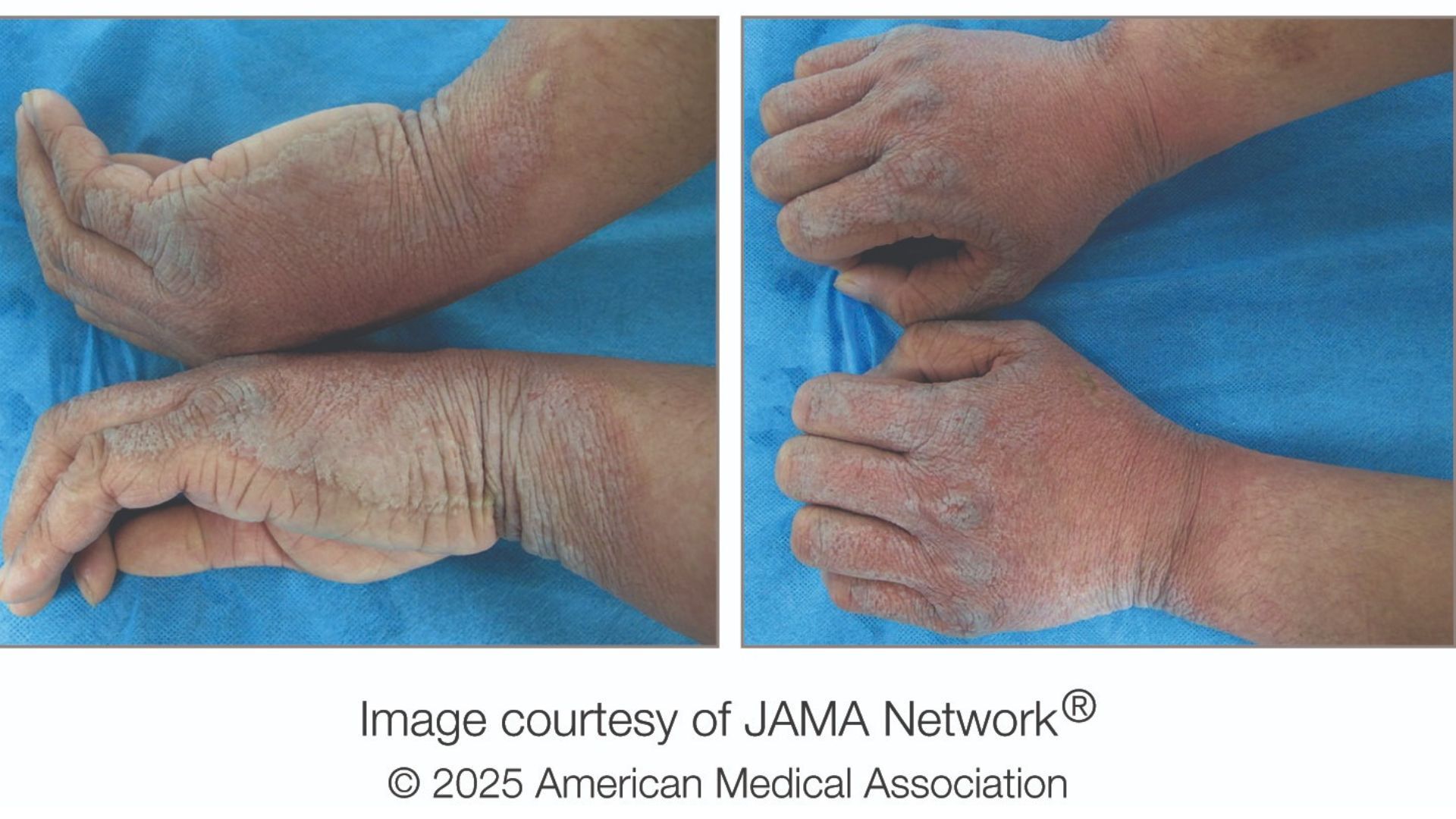
The symptoms: A man went to the dermatology department of a hospital after experiencing an array of symptoms for about three years. When he submerged his hands in water, such as during hand-washing, the skin on the back of the man’s hands thickened and became overly wrinkly, with white bumps and growths appearing.
The man had previously sought treatment at his local clinic, where he was diagnosed with chronic eczema — which causes skin to become dry, thick and itchy — and prescribed a strong retinoid ointment, which he used intermittently. However, this treatment didn’t work, and his symptoms gradually worsened. His wrists and elbows had also started to develop the skin lesions over the 1.5 years prior to the hospital visit.
The patient had no family history of similar skin conditions and did not experience excessive sweating or have any allergies, and he had never injured his hands. The man attributed the worsening of his condition to him washing his hands more frequently during the COVID-19 pandemic, the doctors wrote in the report of the case.
What happened next: During a physical examination at the hospital, the man’s hands were immersed in water for 10 minutes, immediately causing the tops of his hands, fingers and wrists to grow red, scaly and wrinkly with white lesions. Notably, the “excessive wrinkling” and bumps ended in a straight line on the sides of his hands, leaving his palms unaffected.
The doctors took biopsies from the white bumps on his right hand, which revealed that the sweat ducts in the top layer of skin had widened and contained more sweat glands than normal. The results also showed he had hyperkeratosis, meaning his body was producing too much of the protein keratin, causing the outer layer of skin to thicken.
The medical team wrote that “the patient’s clinical process was quite interesting,” because the symptoms of the skin condition appeared only after his hands were immersed in water and all symptoms disappeared around 30 minutes after his hands dried.
The diagnosis: The doctors diagnosed the patient with a condition called aquagenic syringeal acrokeratoderma (ASA) based on how his symptoms appeared in the clinic and the results of the biopsy. In almost all other cases, however, it affects the palms of the hands, not the backs of the hands or fingers.
The short-lived symptoms of this skin disease are known as the “hand in the bucket sign,” because they occur after the hands are submerged in water. The symptoms normally disappear within a few hours of drying, but a subset of people with ASA have persistent skin lesions that are aggravated by water exposure, according to the Genetic and Rare Diseases Information Center (GARD).
The cause of ASA is currently unknown, but it may be linked to “an acquired sweat gland abnormality” or some trigger that causes thickening of the skin, according to research published in the Journal of the American Academy of Dermatology.
The treatment: The patient was treated with topical hydrocortisone urea ointment, which is a corticosteroid and skin moisturizer that can be applied directly to the affected area. It is typically used to treat skin irritation, swelling and redness.
The doctors also recommended that the patient avoid getting his hands wet more than what was strictly necessary. The man was still attending follow-up appointments when the doctors wrote about his case, and they noted that his symptoms had eased substantially after just one month.
What makes the case unique: ASA is thought to be a rare condition, although its exact prevalence is unknown.
Data suggests the condition is most common in female adolescents, the case report authors noted. It also occurs in about 40% to 84% of cystic fibrosis (CF) patients and carriers, meaning people who have just one copy of the CF gene mutation, according to GARD. (You need two copies to develop CF.) This pattern hints at ASA being caused in part by mutations in that gene, at least in some cases.
The patient described in this case was the first known to have ASA that didn’t affect his palms, the doctors wrote in the report. It’s unclear why his case manifested differently than others previously reported.
For more intriguing medical cases, check out our Diagnostic Dilemma archives.
This article is for informational purposes only and is not meant to offer medical advice.