


At the entrance to a Stone Age neighborhood in Slovakia, archaeologists have uncovered a ditch full of headless human skeletons.
While the bones reveal cut marks that signal decapitation, researchers think the practice was not a violent mass killing but rather part of a complex burial ritual more than 7,000 years ago. In other words, the individuals were likely beheaded postmortem.
The Neolithic site of Vráble was occupied between 5250 and 4950 B.C. by the people behind the Linear Pottery culture (LBK), whose pottery covered in parallel lines has been found throughout Central Europe. Located in the southwest region of Slovakia, the settlement, which was first investigated in 2012, included more than 300 houses grouped into three distinct neighborhoods.
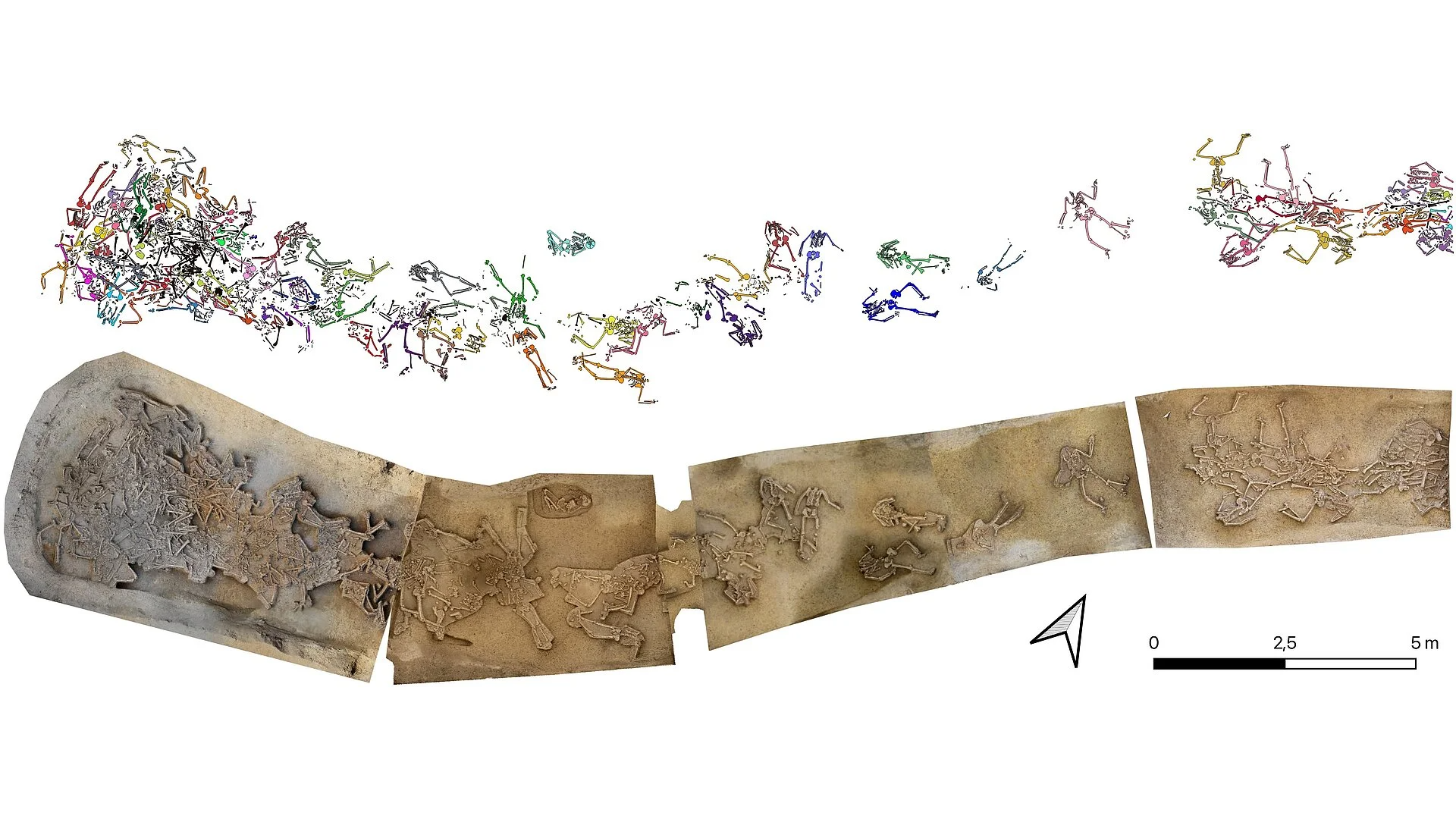
One of the Stone Age neighborhoods was surrounded by a double ditch roughly 0.8 miles (1.3 kilometers) in length. When archaeologists began excavating the ditch in 2022, they found four pairs of headless skeletons as well as a mass burial of at least 77 headless skeletons. Only one skeleton still had a head, and it belonged to a child.
Although the archaeologists have not yet finished excavating the ditch, they reported their preliminary findings in a study published June 2 in the Proceedings of the Prehistoric Society.
“First analyses suggest, above all, that violent ‘decapitations’ were not conducted here, but rather skilful removal of the skulls,” study co-author Katharina Fuchs, a biological anthropologist at Kiel University in Germany, said in a statement.
The researchers analyzed cut marks on the upper neck vertebrae of the headless skeletons and found that the skulls had been removed with sharp tools. The lower jaws were missing as well, suggesting that keeping the head and face intact was important to this ancient society, the researchers wrote. Because the neck vertebrae of many individuals were found touching the ditch wall, the researchers think they were likely deposited there after their heads were removed, in a practice of intentional manipulation of corpses.
Get the world’s most fascinating discoveries delivered straight to your inbox.
“The deposition of bodies and body parts may have been part of more complex, meaningful and recurring practices,” study co-author Nils Müller-Scheeßel, an archaeologist at Kiel University, said in the statement.
Archaeologists excavating skeletons at the site of Vráble in Slovakia.
(Image credit: Katharina Fuchs)
Headless bodies and body parts have been found in burials at other Neolithic sites in Europe. For example, a Neolithic family was apparently massacred and eaten 5,600 years ago, according to an analysis of the bones of 11 people found in a cave in Spain. And in a Neolithic village in Italy, archaeologists found a pile of 15 human skulls that were probably handled repeatedly as some form of ancestor ritual 7,400 years ago.
The researchers noted in the study that they do not yet know if violence played a role in how the individuals in the ditch died. However, given the fact that some of the headless individuals were buried together as couples and some were buried in clusters in a mass grave, the beheading practice may have been motivated by a burial rite that focused on the human head, possibly as a symbol of personhood and life.
This interpretation would fit in with head-focused ancestor worship in other parts of the Neolithic world, such as at Çatalhöyük in southern Turkey and Jericho, now a Palestinian city in the West Bank. In Jericho and other Neolithic Near East sites, people often extracted skulls from venerated ancestors, plastered over them to form a face, painted them, and then displayed them in the community.
But Vráble is particularly unusual because, to date, no skulls belonging to the headless skeletons have been found.
“Currently, the heads are archaeologically ‘invisible’ to us,” the researchers wrote in the study, noting that this makes it hard to determine whether these individuals were the targets of violence or ritual.
It is possible, the researchers wrote, that some sort of community tension existed between the three Neolithic neighborhoods at Vráble. This tension could explain why only one neighborhood was surrounded by a protective ditch and why its entrances faced away from the other two neighborhoods. Burying human bodies in the ditch may have been a way to manipulate the community’s space or mark it as specifically belonging to the group and its ancestors.
Further work is planned at the site to excavate the rest of the ditch and to further analyze the human remains in the hopes of resolving the open questions about the Stone Age settlement.
“The first results already show that Vráble is an exceptional excavation site,” study first author Martin Furholt, an archaeologist at the University of Kiel, said in the statement. “It provides us with the keys for the discussion of fundamental questions; for example, how were death and the body understood in the Neolithic and what role did the associated practices play in the social fabric of early farming societies?”
Furholt, M., Cheben, I., Hukel’ová, Z., Wunderlich, M., Bistáková, A., Furholt, K., Kühl, T., Müller-Scheeßel, N., Fuchs, K. (2026). Neolithic bodies in Vráble – 7000 year-old headless human skeletons in an enclosed LBK settlement in south-west Slovakia. Proceedings of the Prehistoric Society. https://doi.org/10.1017/ppr.2026.10082
What do you know about the Paleolithic, Mesolithic and Neolithic eras? Find out with our Stone Age quiz!