
In women’s reproductive years, their brains are exposed to high levels of sex hormones, and their neurons may come to depend on those hormones to function optimally. But leading up to and after menopause, the ovaries produce far less estrogen and progesterone, raising concerns that this drop in hormones may contribute to women’s dementia risk.
“We think that the loss of those hormones at menopause renders those neurons more vulnerable to age-related cellular decline and pathologies like Alzheimer’s,” said Karyn Frick, a neuroscientist and professor of psychological and brain sciences at the University of Wisconsin-Milwaukee.
So, if falling hormone levels are a risk factor for dementia, could replacing those hormones help stave off the disease?
While the idea sounds logical on its face, studies that have looked at hormone replacement therapy (HRT) for dementia prevention have had mixed results. There are early hints that restoring estrogen during early menopause may protect brain health, but ultimately, more gold-standard clinical trials are needed to know for sure, experts told Live Science.
Support for estrogen protecting the brain
The idea that estrogen could help ward off dementia is plausible. Women are more likely to develop Alzheimer’s disease than men are, and scientists think the loss of estrogen during menopause may be partly to blame, said Jennifer Bruno, an instructor of psychiatry and behavioral sciences at Stanford University.
Lab and animal studies buttress the idea that estrogen could protect brain health.
In the brain, estrogens act as neuromodulators, or chemical messengers that alter how neurons behave. Estrogen also helps neurons keep their shape. Estrogen loss in female mice triggers a drop in the number of dendritic spines — the small, bud-like bumps on neurons that receive chemical messages.
An estrogen molecule. The body’s levels of estrogen fluctuate in perimenopause, and they then dramatically decline and level off during and after menopause.
(Image credit: theasis via Getty Images)
Researchers think that estrogen may help prevent the formation of the abnormal proteins — including one called amyloid beta — that accumulate, disrupt communication between neurons and ultimately kill cells in Alzheimer’s disease. Amyloid beta is produced when a larger protein is cut the “wrong” way by an enzyme, Frick explained. Estrogen promotes the “normal” cutting of this protein, thus reducing amyloid beta, studies in lab mice show.
And estrogen may limit the buildup of a second Alzheimer’s-related protein, called tau, by preventing the chemical processes that cause the tau proteins to clump together. This helps prevent the formation of tau tangles, a hallmark of Alzheimer’s disease.
The hormone may also support brain health indirectly by improving sleep quality.
“It’s well documented that menopausal women have difficulty sleeping, whether it’s due to hot flashes or insomnia,” Frick said. Estrogen can ease those nighttime hot flashes, thus helping menopausal women get more, less-fragmented sleep. Deep rest may help the brain clean out toxic proteins, while research shows sleep deficiency is linked to Alzheimer’s disease.
Mixed results with estrogen-only HRT
HRT for menopause comes in two main forms: treatments that include only estrogen, and combined therapies with both estrogen and progesterone. The treatment has a complicated history.
HRT was popular in the 1990s but fell out of favor after results from the Women’s Health Initiative study were published in 2002. That study identified various risks tied to both estrogen-only and combined HRT options, some of which have since been overturned by newer data.
That said, the Women’s Health Initiative study found that estrogen-only HRT came with an increased risk of endometrial cancers, and later analyses have backed up this idea. That’s why today, clinical guidelines recommend that women who have not gotten a hysterectomy take combined HRT, while estrogen-only options are reserved for those who have had their uterus removed. (The added progesterone counteracts estrogen’s thickening effect on the uterine lining.)
For the subset of women who take estrogen-only HRT, observational data published in August showed that this form of the treatment was linked to a reduced risk of dementia. The study, published in the journal Neurology, found that women who took estrogen-only HRT were less likely to show Alzheimer’s-related changes in the brain than women who didn’t take any HRT.

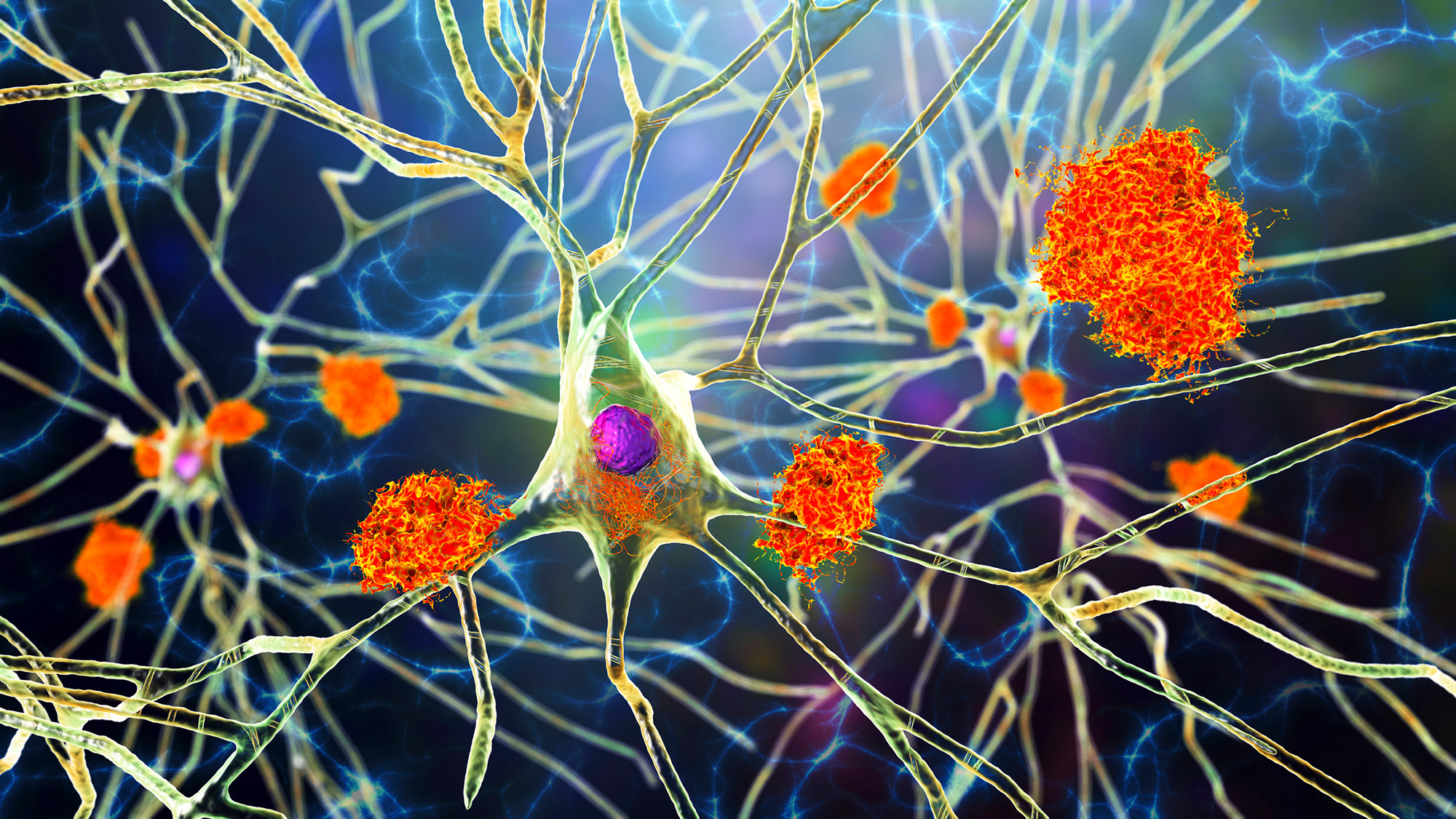
Laboratory data suggest that estrogen may help prevent the formation and accumulation of abnormal proteins that are related to Alzheimer’s.
(Image credit: KATERYNA KON/SCIENCE PHOTO LIBRARY via Getty Images)
Estrogen-only HRT was also tied to better clinical outcomes: Treated women were less likely to be diagnosed with dementia, were less likely to show clinical and functional cognitive decline, and had better scores on memory tests, on average, compared with untreated women. These findings drew on two large, separate groups of older women, reporting data from 21,400 people in total, but they didn’t include data on when each woman started HRT.
Whereas earlier studies of HRT and dementia risk relied on doctors’ ratings of patients’ symptoms, the Neurology study measured levels of Alzheimer’s-related proteins in the brain after death. That’s a more “definitive” marker of disease, said Bruno, a co-author of the study. However, the research was observational, so it can’t say whether estrogen-only HRT directly causes the better brain outcomes the team observed, she stressed.
Although the Neurology study’s findings are promising, they don’t necessarily match the results of other studies of estrogen-only HRT and dementia. For example, a slightly larger observational study, published in 2023, found that estrogen-only HRT was associated with an increased dementia rate.
In that research, most of the women took a type of estrogen called estradiol, while Bruno’s study included a greater variety of estrogens. That may have been the difference in the two studies’ results, but teasing that out would require further study. Meanwhile, the conflicting findings muddy the waters of what estrogen-only HRT can do for brain health.
Does timing matter?
One big finding from the Women’s Health Initiative study was that starting HRT — either estrogen-only or combined — after age 65 was associated with worse cognitive function and increased dementia risk, said Yuko Hara, director of aging and Alzheimer’s prevention at the Alzheimer’s Drug Discovery Foundation.
The same may not be true for people who start HRT earlier. For context, menopause starts around age 51 to 52, on average, and it’s preceded by perimenopause, a transitional period when hormone levels begin to drop, typically around the mid-40s.
An observational study published in August in the journal Alzheimer’s & Dementia found that starting HRT between ages 46 and 56 was linked to a reduced risk of dementia. That study did not differentiate between estrogen-only and combined treatment; it lumped all of the data together.

Patches (pictured) are one form of systemic HRT. They deliver hormones through the skin and into the bloodstream.
(Image credit: SVPhilon via Getty Images)
The protective link was especially strong in three groups: women with “surgical menopause,” triggered by the removal of one or both ovaries; carriers of a certain variant of a gene called APOE that raises Alzheimer’s risk; and women who had a relatively short time between their first period and menopause.
A 2024 meta-analysis of randomized controlled trials also found that HRT had a cognitive benefit for women with surgical menopause; that finding was tied mostly to estrogen-only therapies.
However, outside of that specific group, the idea of early HRT protecting brain health is far from settled.
Who might benefit, if anyone?
When it comes to using hormone replacement to protect brain health, the evidence isn’t yet strong enough to recommend any kind of HRT as a way to protect the brain in all women, Hara said. Women who had one or both of their ovaries surgically removed are the exception to this rule.
“This is a distinct clinical population because the procedure can cause an abrupt, early loss of estrogen, rather than the gradual hormonal decline that occurs with natural menopause,” Hara said.
For most women who have gone through natural menopause, “there is not enough evidence to recommend [HRT] specifically for preventing cognitive decline or dementia,” she said.
HRT is not currently prescribed to prevent dementia — it is prescribed to ease menopause symptoms, such as hot flashes, night sweats and sleep disturbances. To settle the science on HRT and the brain, what’s really needed is a well-designed clinical trial that follows women from perimenopause to postmenopause, Bruno said. That would reveal the effects of HRT on brain health and dementia risk more reliably than the studies done so far.
This article is for informational purposes only and is not meant to offer medical advice.
Help us improve Live Science Pro: We’re always trying to make our content better. Leave us feedback about Pro here.