

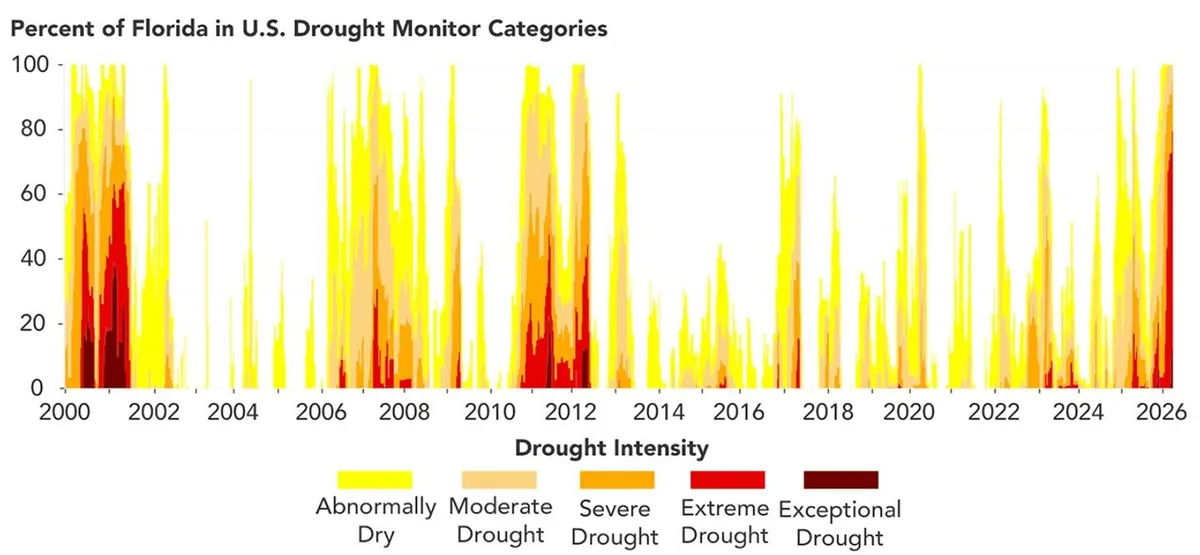
Florida is experiencing its most intense drought in 15 years, with more than 70% of the Sunshine State facing what the U.S. Drought Monitor calls “extreme” to “exceptional” drought conditions.
Northern Florida is suffering the driest conditions in the state, and recent rainfall has brought almost no relief, according to the latest drought data. Forecasts show no rain and high temperatures over the next week, so the situation will likely get worse before it gets better, experts told Live Science.
Why is Florida in a drought?
Florida, along with Georgia and other parts of the U.S. Southeast, currently sits beneath a ridge of high atmospheric pressure that has moved in and out of the region since fall last year but remained stationary since March. This means the air above the Southeast is sinking and compressing, which reduces humidity and prevents cloud formation.
“Rain cannot form in sinking air so it just stays warm and dry,” Pam Knox, an agricultural climatologist at the University of Georgia and the director of the Georgia Weather Network, told Live Science in an email.
Clear skies have dominated for weeks over Florida and other parts of the Southeast. But it’s not just high pressure that’s driving the current drought, because rainfall has been below average for months. Florida was unusually dry for much of last year, and many areas have received less than 50% of their normal rainfall since Sept. 1, 2025, according to the National Weather Service.
“That means they are about 20 to 25 inches [50 to 65 centimeters] below what would be considered average rainfall,” Knox said.
Months of dry weather were followed by a La Niña winter, which shifted the jet stream northward. This brought colder, wetter conditions to the northern U.S. and Canada, while the southern U.S. became warmer and drier.
“The combined effects of the lack of tropical storms last year with the La Nina over the winter, which is usually a time of warmer and drier climate than average, have helped lead to this current situation,” Knox said.
Why is the current Florida drought so bad?
The current drought in Florida differs from previous bad droughts because it has hit in spring instead of summer. The last time the U.S. Drought Monitor recorded such exceptionally dry conditions in the Sunshine State was June 2011, but it has not been this dry so early in the year since 2000, Knox said.
While the La Niña, low precipitation, and fewer storms this season are attributable to natural variability, global warming and shifts in the water cycle caused by higher temperatures may be contributing to the dryness, Knox said.
The impact of climate change is difficult to disentangle from natural variation without proper attribution studies, Mullens agreed.
How long will the Florida drought last?
Current drought conditions in Florida will probably worsen until the end of April, but they are expected to improve slightly in May as the high-pressure area in the atmosphere moves away from the Southeast.
“In the Southeast, the worst drought is in northern Florida and southern Georgia, but other areas are likely to get worse over the next couple of weeks with high temperatures and no rain in the forecast,” Knox said. “We expect the weather pattern to change around the end of the month as the high pressure shrinks off to the east, which will allow cold fronts that could produce rain to enter the Southeast again.”
It’s unclear how conditions will evolve through summer, but a lot of moisture will be needed to end the drought. Ideally, a tropical storm or a stationary front should bring enough rain in the coming weeks to quench plants and replenish soil moisture.
“It is difficult to get out of drought in summer because the plants and evaporation tend to use every bit of rain that falls,” Knox said.
A strong El Niño is on the horizon, which could bring wetter weather this summer, Mullens said. But a clear picture of this year’s drought will emerge only once it’s over, when scientists will be able to more accurately compare its length with droughts that struck Florida in 2000 and 2011.
What are the impacts?
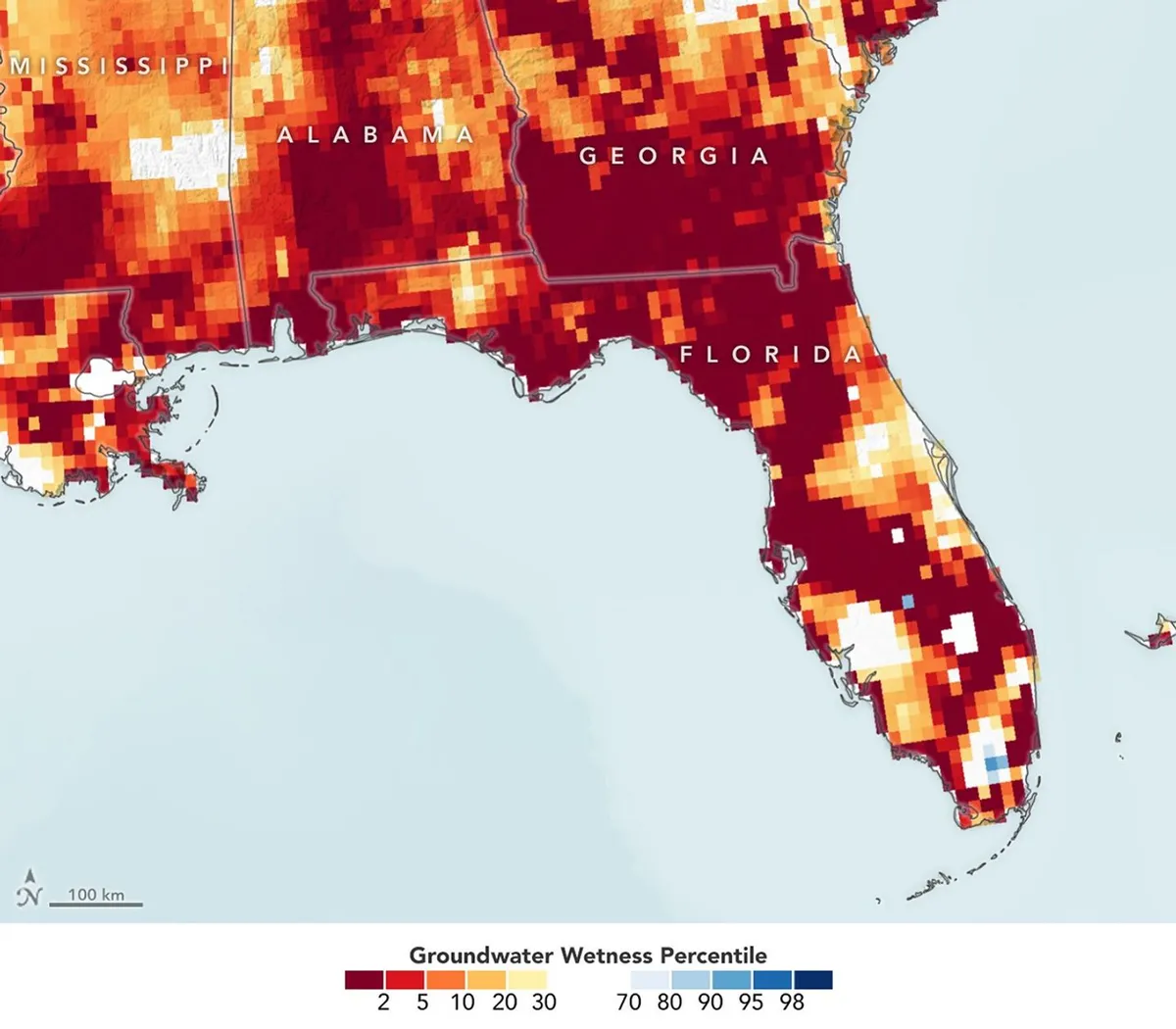
Satellite data shows that shallow groundwater aquifers have dried up across the U.S. Southeast during this year’s drought. That’s because more water has been extracted from these aquifers than usual to irrigate farmland and provide drinking water for people under exceptionally dry conditions.
In Florida, aquifers are especially dry in the northern and central regions. Aquifers do not immediately recover from drought, because rainfall first has to wet the entire soil column before it can trickle down to replenish groundwater stores.
“Aquifers are considered to be a lagging indicator of drought because they get worse after the drought is bad at the surface and it takes them longer to recover,” Knox said.
The drought has been felt across Florida, with some water districts imposing restrictions on water use for certain activities such as lawn irrigation. Dry vegetation has also provided ample fuel for wildfires, including a blaze in February in Big Cypress National Preserve, about 25 miles (40 kilometers) east of Naples. And even the Everglades are facing unusually dry conditions, news reports show.
If the drought lasts much longer, there will be more wildfires and possibly even water shortages, Knox said.
It might take several weeks of consistent rain or a tropical storm lasting multiple days to recover from this drought. Ideally, precipitation should be abundant but not come all at once; soils have limits on how much water they can absorb, and the surplus would likely run off, Knox said.
“Florida soils are generally pretty sandy so if it is really dry, they could probably absorb 2 [to] 3 inches [5 to 8 cm] easily over a few hours,” she said. “Other areas in the Southeast with more clay soil would not be able to absorb as much.”
Farmers, in particular, are desperate for rain. “In all my years of farming, I’ve never personally experienced a spring this dry,” Shannon Nixon, a soybean and peanut farmer near Baker, Florida, told Farm Progress. “To be this dry this early in the spring is very concerning.”
The drought may take a huge toll on farmers’ income, as many have likely delayed planting crops or decided not to plant crops at all for fear of them dying, Knox said. And if these dry conditions persist, consumers will also be affected, because food production will decrease locally and some of it will not be made up by imports.
“That will mean shortages of some products that are produced locally like vegetables,” Knox said.