



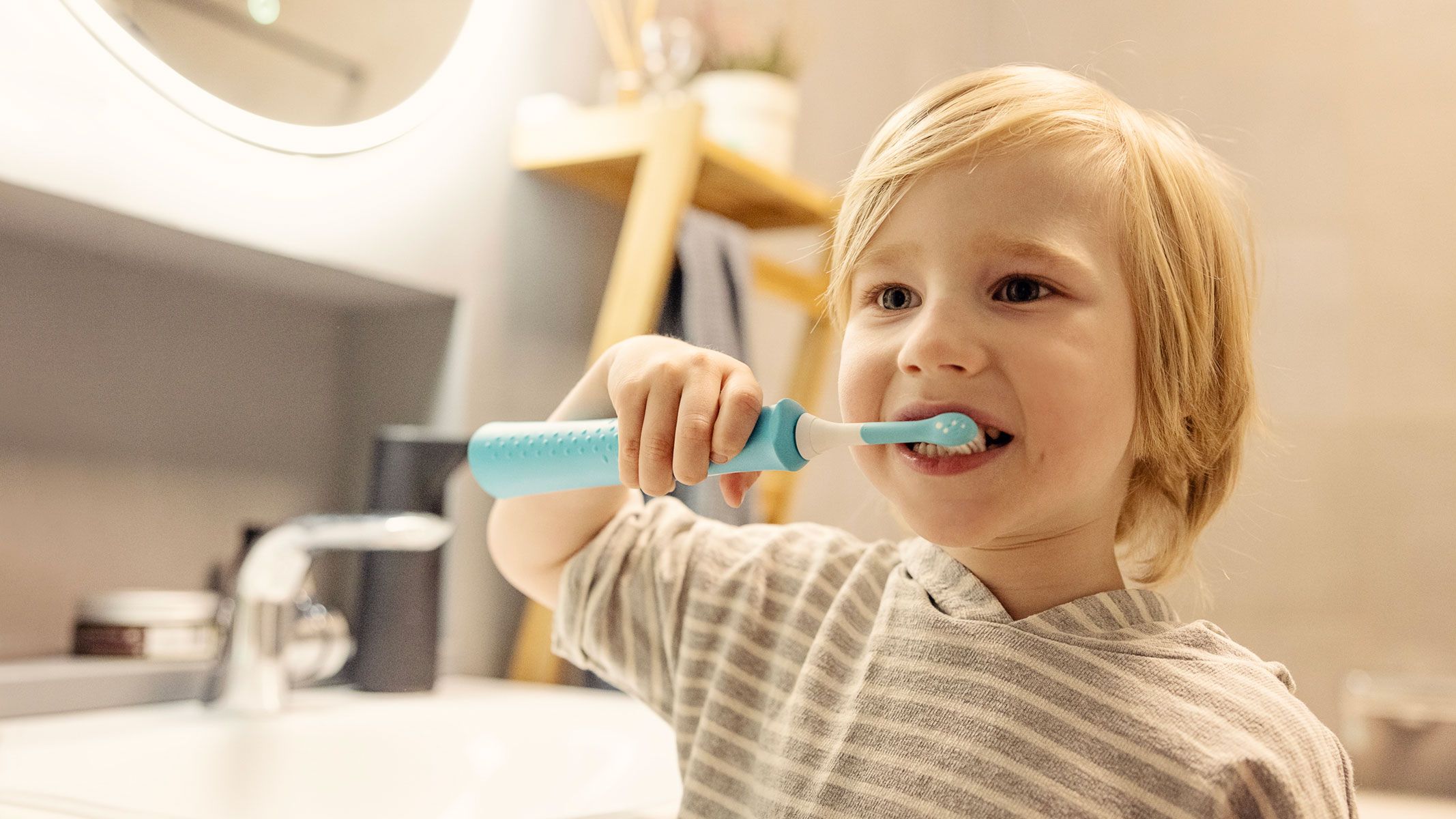
February is National Children’s Dental Health Month, making it a perfect time to talk about the teeth and gums of our little ones. This annual event, launched by the American Dental Association in 1981, aims to raise awareness about children’s oral health and the importance of establishing an effective brushing routine. And what better way to take care of your kid’s pearly whites than by presenting them with an electric toothbrush?
Both manual and electric toothbrushes can keep their little teeth squeaky clean, true, but the latter has the unique ability to transform a boring daily chore into a fun adventure. Electric toothbrushes can also help children develop a better brushing technique and teach them healthy habits that will last a lifetime. Some high-end models even come with gamified features and apps that monitor their brushing progress. No matter how you look at it, a manual toothbrush simply cannot compete here.
1: Choose a brush designed for your child’s age
This is probably an obvious tip to begin with, but it is essential nonetheless: Choose a toothbrush that is designed for your child’s specific age range. The reason is simple — a 3-year-old will have different needs than a 6-year-old, and a 6-year-old will have different needs than a preteen. A toothbrush that’s too big, powerful or complex for their age can do more harm than good, and even discourage them from using it altogether.
Excessive brushing intensity that irritates gums and makes brushing uncomfortable can really put kids off the idea of regularly cleaning their teeth, Dr. Fazeela Khan-Osborne, the founder of The One-to-One Dental Clinic in London, U.K., and a former pediatric dentist and school inspector, told Live Science by email.
This brings up an important question: Exactly when should your child make the switch from a manual toothbrush to an electric one? As Dr. Nora Albaldawi, principal dentist and orthodontist at the Beautiful Smiles dental clinic in Leicester, U.K., told Live Science, there is no fixed date here. The best practice is to introduce an electric brush from around age 3 — but only when the child can tolerate the vibration, she said.

Children aged 3 to 6
When choosing an electric toothbrush for a 3-year-old, do not fret about smart frills and sophisticated designs. Toddlers are simple creatures, and the toothbrushes designed for this age range fully reflect that. Look for models that have extra-soft bristles, intuitive, one-button controls and are more geared towards introducing the “buzzing” sensation than deep cleaning.
Size is another key factor. “Start by matching the brush to the child’s age and mouth size, so the head is no wider than the two front teeth,” Albaldawi said.
The only feature that you really need at this stage is a built-in pacer. The best toothbrushes for kids have a 2-minute timer that causes the brush head to pause or buzz every 30 seconds, to signal to a child when they should move the brush to a different part of the mouth.
“Most kids simply do not have an internal sense of how long they should brush, and a timer takes the pressure off parents constantly reminding them,” Dr. Jasveen Singh, a board-certified pediatric dentist at the Pediatric Dentistry and Beyond clinic in Tewksbury, Massachusetts, told Live Science by email.

Children aged 6 to 9
Once your child reaches the age of 6 or 7, you can start experimenting with more advanced models. Most importantly, look for models that feature a reliable pressure sensor and an automatic shut-off. “[These features] allow the child to brush effectively and efficiently without worrying about brushing too hard and possibly damaging the developing gums,” Khan-Osborne said.
Bristle softness is still an important factor at this stage — children aged 6 to 9 need delicate brush heads so their young enamel and sensitive gums are shielded from excessive brushing.
Children aged 10 and older
As permanent teeth come in, the focus shifts from fun play to effective cleaning and plaque removal. Children aged 10 and older can start transitioning to toothbrushes with more “adult” features, such as multiple cleaning modes and purpose-specific brush heads.
The brushing intensity, however, should still stay relatively gentle. Toothbrushes with overly strong or aggressive vibrations can be overwhelming for younger kids and teens with sensory sensitivities, our experts agreed.
2: Don’t forget about fun features

As most parents can attest, getting kids to brush for a full 2 minutes is not a walk in the park. However, the right toothbrush can flip this script on its head — simply by making brushing fun. In the battle to keep your kid’s teeth clean and healthy, engagement matters just as much as brushing performance, Singh said.
“[Fun features] can dramatically improve consistency because they give children a reason to want to brush. When brushing feels interactive or playful, kids are more likely to stick with it long term,” Singh said.
Now, that does not necessarily mean that the toothbrush has to be particularly high-tech or prohibitively expensive. Simple features, such as flashing LED lights, sounds and reward stickers, can be just as effective as apps and interactive games at keeping your child engaged and entertained. Models based on kid-friendly characters or superheroes do particularly well here.
“Always opt for a fun design or pattern — we want children to be excited to brush their teeth,” Dr. Sam Jethwa, a former president of the British Academy of Cosmetic Dentistry and the founder of the Bespoke Smile dental clinic in London, U.K., told Live Science.
3: Account for your kid’s individual needs

An electric toothbrush can have all the best features possible, but if your kid can’t hold it comfortably or is scared of its sound, it will likely be left unused. Comfort and ease of use are of paramount importance for establishing a brushing habit, and it is important to note that these qualities can look different to different children. Before you decide on a particular toothbrush, make sure it suits your kid’s individual needs.
For example, many children (and toddlers in particular) struggle with fine motor skills. If your little one has not yet developed good hand-eye coordination, pay close attention to the handle. It should be easy to control, light and chunky enough for small, uncoordinated hands to hold securely. Ideally, it would also be durable enough to withstand an occasional drop to the floor and covered with a non-slip material, our experts agreed.
“Try to do a store test if possible,” Dr. Nicole Khalife, a dentist and owner of the Lux Smiles NYC dental practice, told Live Science by email. “Have your child hold the handle, turn it on briefly if the store allows it, and see if the sound or sensation is uncomfortable for your child. If they recoil, you have learned something before spending your money,” Khalife said.

Noise level is another factor to consider. Electric toothbrushes vary significantly in terms of volume and the type of sound they produce. Some have a high-pitched whirr, while others are a lower, quieter hum. “A frightening noise can create early dental anxiety, while a gentle or low-power mode and a quiet motor help younger children tolerate vibration,” Albaldawi said.
If your child is sensitive to sound, try to test the toothbrush in-store. If that is not possible, look for audio and video clips that can give you a sense of its noise level — many parents and reviewers post them online, either on parenting forums or in the user review sections of the toothbrush in question. These steps may sound overly precautionary, but they could also save you some money in the long run.
“If your child is anxious, sensitive to vibration, or has a strong gag reflex, the best choice is the one your child can tolerate,” Khalife concluded.
4: Consider long-term costs

The upfront cost of an electric toothbrush is only part of the financial picture. Most kid-friendly models do not come with spare brush heads, and these will need to be replaced every three to four months. A budget-friendly toothbrush may also not be so budget-friendly if your child keeps breaking it, forcing you to buy new ones.
The main take here is to think beyond the initial cost. Factor in the ongoing price and availability of brush head replacements, consider the toothbrush’s build quality, and you should avoid any unpleasant surprises later down the line.
Replacement brush heads: Check how much they cost and how readily available they are. Some brands offer convenient subscription services that mail you new brush heads on a schedule, while others require you to remember to buy them at the store or online.
Quality: It is difficult to assess the safety and durability of a toothbrush you have never used before — but this is exactly why third-party certifications exist.
“Look for an independent evaluation that is not just written to sell the product,” Khalife said. “The easiest shortcut is the ADA seal of acceptance. It is not the ‘best toothbrush award’, but it means that the product has met the ADA’s safety and efficacy requirements for its intended use,” Khalife said.
Similarly, you can look for the Oral Health Foundation’s ‘Approved’ sign, Albaldawi added.
5: Compare the prices

Last but not least, do not buy an electric toothbrush without having a look around for the best offer. Kid-friendly models tend to be relatively budget-friendly, especially when compared with their “adult” counterparts, but their prices can vary widely depending on the retailer. The pricing of a specific product may also heavily depend on the cartoon character it depicts: for example, a toothbrush with a Star Wars or Disney character may be more expensive than the same toothbrush with an original design).
We would also advise caution when it comes to big discounts and too-good-to-be-true deals. Many electric toothbrushes are “on sale” for most of the year, so whenever possible, check their price history (if you are shopping on Amazon, for example, use the CamelCamelCamel website) to see whether you really are getting the best value for your money.
The bottom line
Buying an electric toothbrush for your child is an investment in their long-term oral health. By focusing on age-appropriate design, engaging motivational features and sensible long-term costs, you are not just buying a colorful gadget — you are choosing something that will help them build lifelong habits and keep their teeth healthy for years to come.
“I always encourage parents to think beyond just whether it looks fun and focus on how the brush will feel and function in a child’s mouth. A toothbrush that is gentle, predictable, and engaging helps set the foundation for a positive relationship with oral care that can last a lifetime,” Singh concluded.