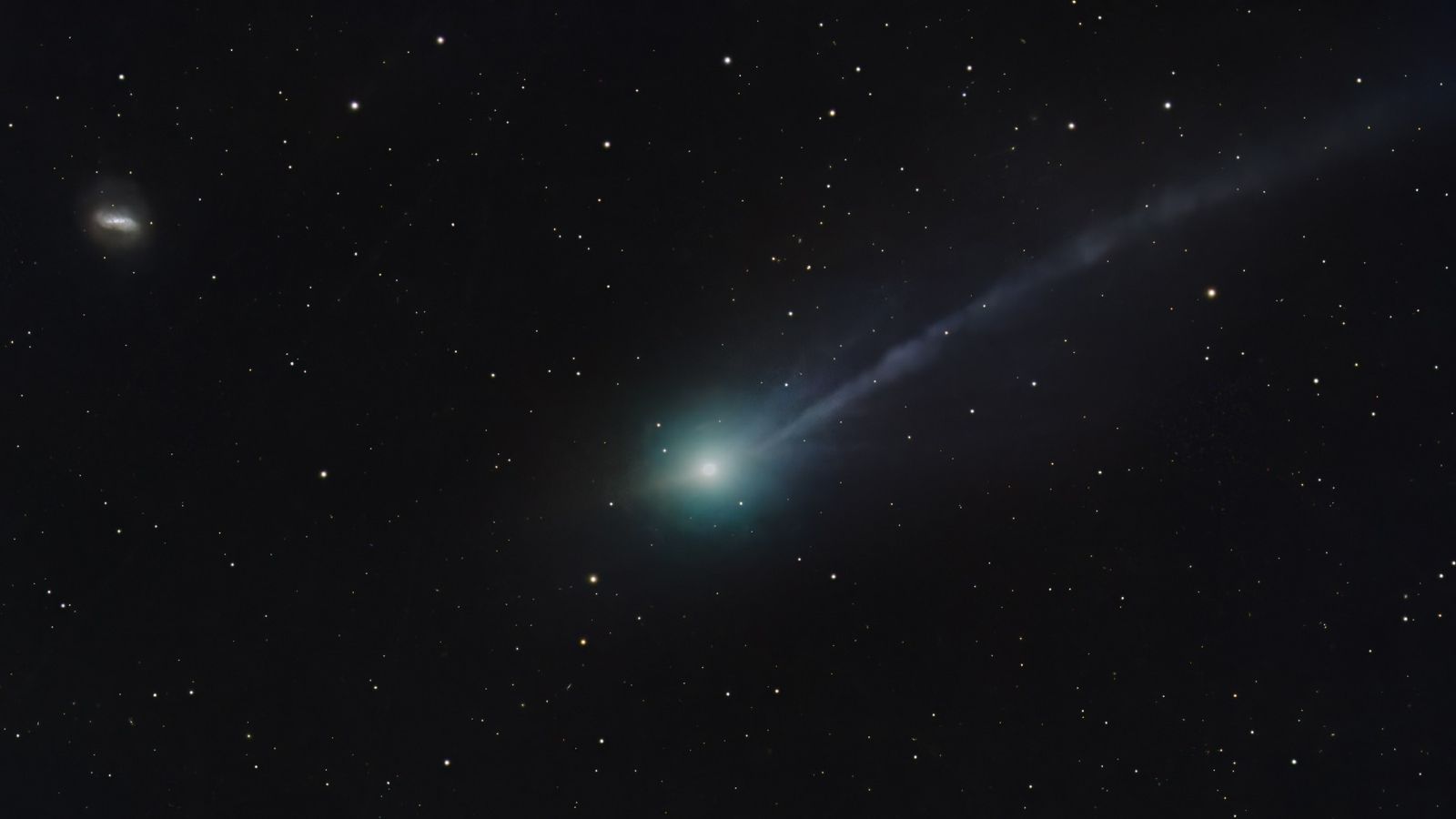
Comet 3I/ATLAS whizzed past Earth last night as astronomers worldwide continue to gather data on the interstellar visitor.
The comet made its closest approach at around 1 a.m. EST on Friday (Dec. 19), coming within about 168 million miles (270 million kilometers) of our planet.
Comet 3I/ATLAS is up to a few miles wide and didn’t get close enough to be visible to the naked eye. However, skywatchers observed it using telescopes.
And last night was far from our last chance to see the comet. It will remain observable in the pre-dawn sky with a small telescope until spring, according to NASA. If you don’t have a telescope, then the best way to see comet 3I/ATLAS is online.
The Virtual Telescope Project in Italy is hosting a livestream of the comet passing Earth at 11 p.m. EST on Friday. The livestream, which was scheduled for last night but postponed due to rain, will feature real-time images of the comet as it zooms toward Jupiter.
Comet 3I/ATLAS is worth checking out because it’s a rare example of an interstellar object from outside of our solar system. This is only the third interstellar visitor ever detected and could be the oldest comet ever seen.
The comet’s origins have been the subject of considerable speculation, most notoriously the repeated suggestions that it could be an alien spacecraft. However, nearly all astronomers are confident that 3I/ATLAS is a comet from another star system.
Researchers discovered comet 3I/ATLAS in July, when they spotted an unknown object racing along at around 137,000 mph (221,000 km/h) within the orbit of Jupiter. Having swung past the sun, reaching the closest point to our star (perihelion) at the end of October, the comet is now making its way out of our solar system.
After getting daily requests for literally months- I’m pleased to share with you 3i/Atlas. The “Alien” comet, captured entirely with my own equipment. What do I think about it? I’ll share my observations in the replies. pic.twitter.com/XfPDhosoJNDecember 17, 2025
What’s next for comet 3I/ATLAS?
Comet 3I/ATLAS will pass Jupiter next, where it is expected to make its closest approach on March 15, 2026, according to NASA. The comet will get much closer to Jupiter than it did to Earth, coming within about 33 million miles (54 million km) of the gas giant. Spacecraft stationed at Jupiter, like Juno, might be able to observe the comet as it approaches.
The interstellar interloper will then cross Saturn’s orbit in July 2026; Uranus’ orbit in April 2027; and Neptune’s orbit in March 2028. However, it won’t get close to any of these planets. You can track comet 3I/ATLAS for yourself using NASA’s Eyes on the Solar System simulation of the comet’s trajectory.
Researchers will keep an eye on comet 3I/ATLAS while it remains in our cosmic neighborhood. After all, there’s a lot they still don’t know about its properties. For example, the size of the comet is uncertain. Hubble Space Telescope observations suggest that it’s somewhere between 1,440 feet (440 meters) and 3.5 miles (5.6 km) wide.
Researchers also don’t know which star system forged comet 3I/ATLAS, and they may never find out. The comet travelled a very long way and could have been hurtling through space for billions of years before visiting our solar system.