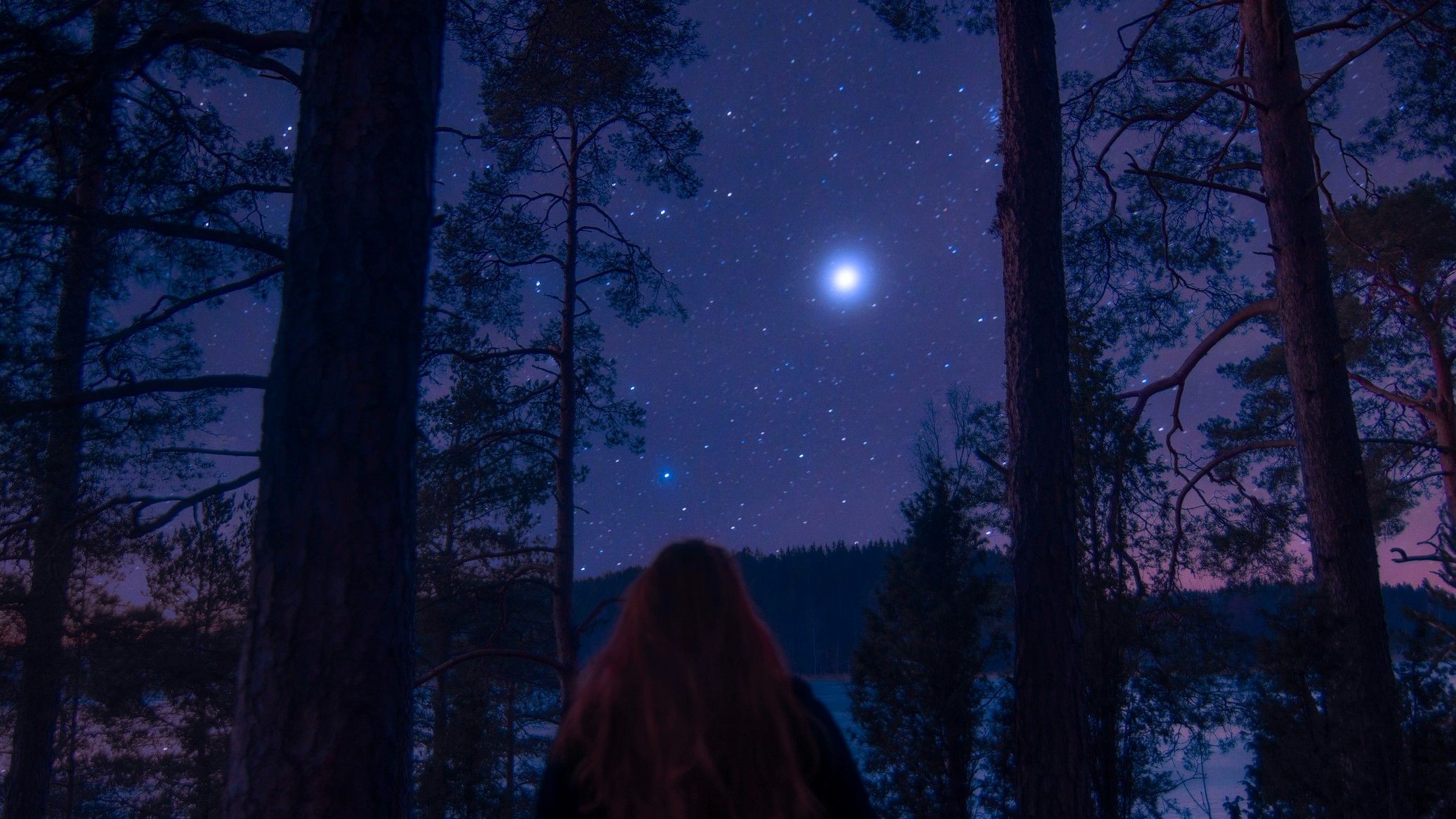
Christians are well aware of the Nativity story, in which three wise men follow the “Star of Bethlehem” to the newborn Jesus. But does this biblical story have astronomical origins? What was the “Christmas Star”?
Modern skywatchers have posited many theories, such as the star being a very close conjunction of Venus and Jupiter in 2 B.C or a less visually striking triple conjunction of Jupiter and Saturn seen throughout 7 B.C. (Historians continue to debate the actual date of Jesus’ birth.) Another theory suggests it may have been a bright stellar explosion.
In December, a month before opposition, Jupiter is rising about two hours after sunset. However, because sunset occurs early during December in the Northern Hemisphere, Jupiter dominates the sky for much of the night. Easily visible in the eastern sky after 8 p.m. local time, Jupiter dominates the night sky as a neatly timed “Christmas Star.”
Shining at a very bright magnitude of -2.4 at the beginning of December, Jupiter will get even brighter as it approaches opposition, reaching -2.5 by the end of 2025. (In astronomy, a lower magnitude corresponds to a brighter object; negative magnitudes are the brightest.)
Was Jupiter the Star of Bethlehem? We may never know — but in December 2025, its brilliance will make it a worthy stand-in.