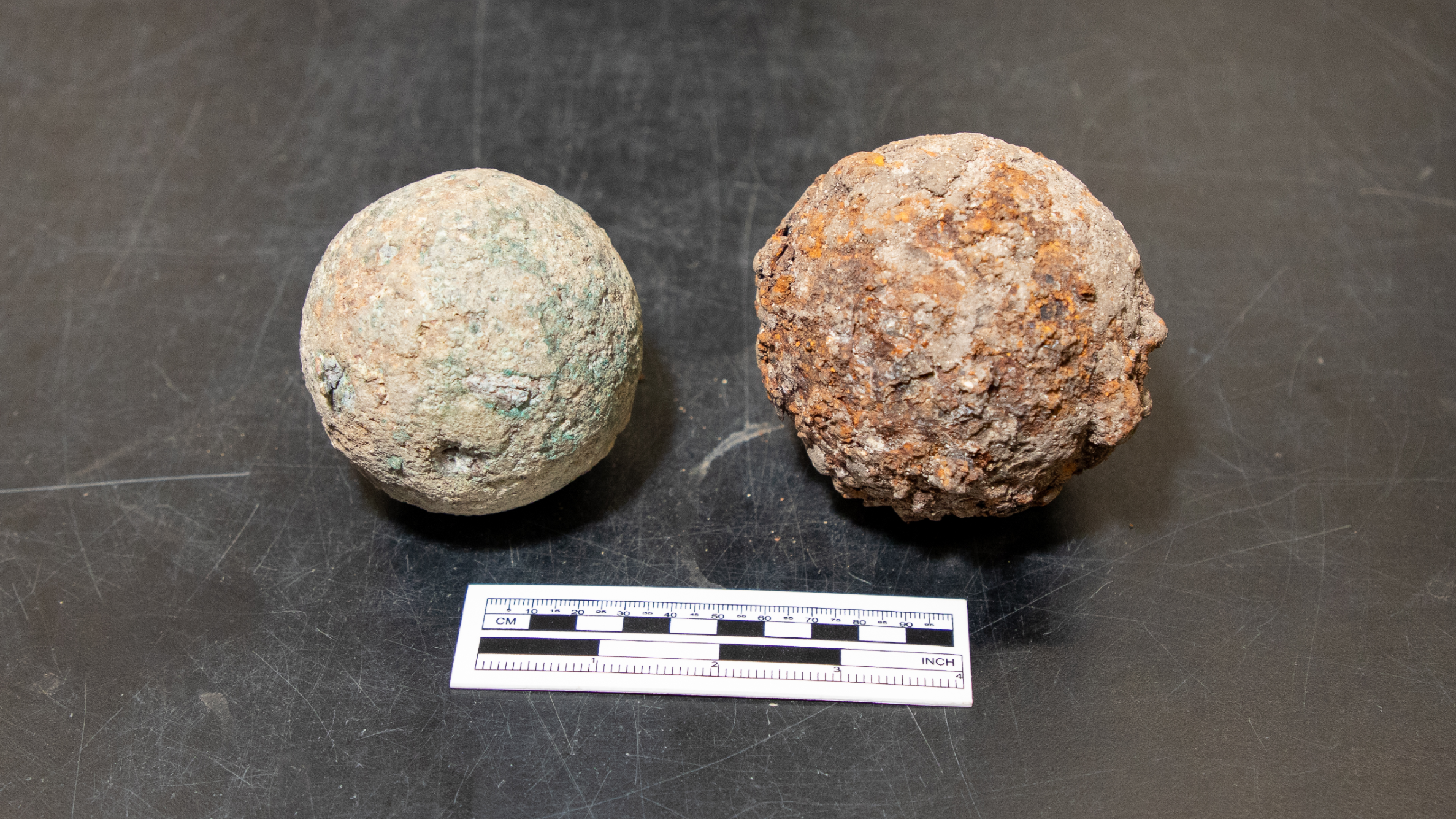
Archaeologists have discovered an iron cannonball fired by Texans at the Battle of the Alamo in 1836. This is the second intact cannonball they have discovered from the famous conflict. The first one, a bronze cannonball, was found earlier this year and was likely fired by the Mexican army.
“It’s a huge deal,” Tiffany Lindley, director of archaeology at the Alamo, said in a video statement from Alamo Trust. “We all thought, ‘There’s no way we can top it,'” she said, referring to the bronze cannonball discovered March 5, just a day before the 190th anniversary of the conflict that killed Davy Crockett, “and then we found another one.”
Both cannonballs were recovered from the northeast corner of the church at the Alamo, which was originally built in 1718 as a Spanish mission and fortress in what is now San Antonio. But the Alamo is better known as the location of an 1836 battle during the Texas Revolution, in which Anglo-American settlers and Hispanic Texans known as Tejanos seceded from the Republic of Mexico.
In a 13-day siege culminating in a deadly assault on March 6, 1836, Mexican troops, commanded by Gen. Antonio López de Santa Anna, surrounded the Alamo and killed the 180 Texan rebels defending the structure, including Davy Crockett. The cry “Remember the Alamo!” was used in later skirmishes in the Texas Revolution as soldiers fought Mexican troops for independence.
The newly excavated iron cannonball was found June 2, according to a statement from Alamo Trust.
Of the two cannonballs, “the newest one is slightly larger” and was likely fired from a cannon that shot 6-pound [2.7 kilogram] cannonballs, Kolby Lanham, a senior researcher and historian at the Alamo, said in the statement. “The likelihood is that the bronze one belonged to the Mexican Army and the iron one belonged to the Texans.”
Over the years, archaeologists have found numerous pieces of ammunition and shrapnel at the Alamo, Lindley said, but these cannonballs are the first examples of solid shots — spherical projectiles fired from a gun or cannon — they have ever found.
Get the world’s most fascinating discoveries delivered straight to your inbox.
“It’s just a huge kind of once-in-a-lifetime deal,” Lanham said. “But obviously, it’s happened twice.”
The size and weight of the cannonball suggests it was fired by a cannon that shot 6-pound cannonballs.
(Image credit: Alamo Trust)
The Mexican and Texan cannonballs were found near each other, so they are likely the historic remains of the two sides shooting at each other in the fateful siege nearly two centuries ago.
“Whenever they were dropped the very first time — possibly in 1836, probably — they haven’t been touched since, and that’s what makes them extra special,” Lindley said. “I don’t think you can undersell it.”
The Alamo remains an active archaeological site, where experts have discovered artifacts that span its centuries of history, from Indigenous stone tools that predate the Spanish mission through the late 19th century, when the structure was converted into a general store and warehouse.
Can you identify these historical objects of war? Test your smarts with our weapons of the world quiz!