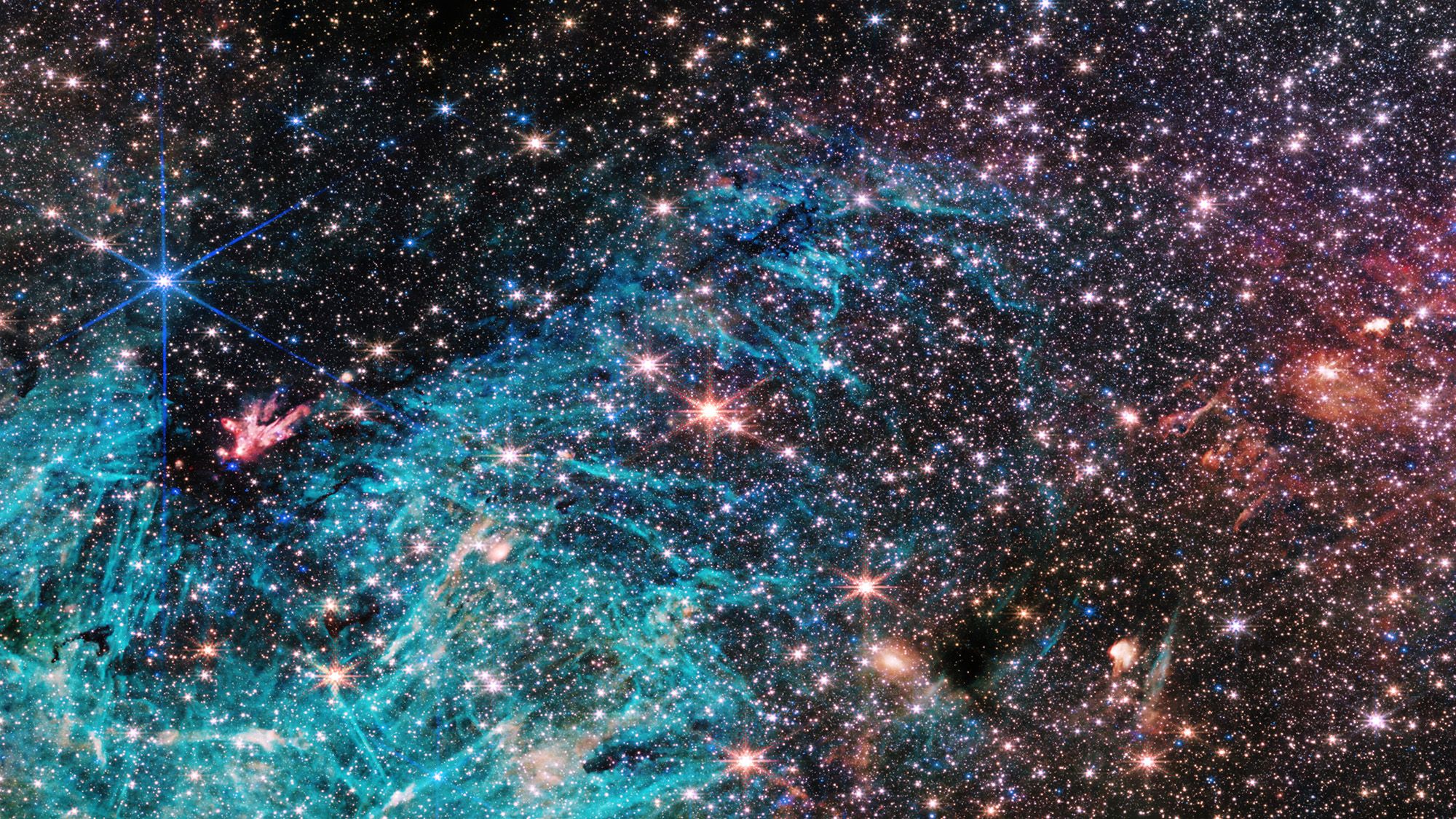
The Milky Way’s supermassive black hole is surrounded by a surprising trove of heavy metals, according to new observations by the James Webb Space Telescope (JWST). The metals may offer new clues about how Earth got its share of heavy elements — but it could also make one of the greatest mysteries about our local black hole even harder to solve.
In astronomy, metals refer to any element heavier than hydrogen or helium, with common examples including oxygen, carbon, iron or gold. These elements are forged through nuclear fusion in the hearts of stars that are reaching the ends of their lives, before being sprayed into space and incorporated into new generations of stars.
Scientists say the material spotted by JWST likely came from supernovas — stellar explosions that blasted the metal into the region around Sagittarius A (Sgr A*), the monster black hole in the middle of our galaxy.
Latest Videos FromLive Science
The metals, detected as gas, appear to have the same composition as several nearby stars, which suggests both the stars and the gas originated at the same time. Researchers shared the observations in a paper published Oct. 19 in The Astronomical Journal, following up on work published in The Astrophysical Journal in May.
“We know there’s a black hole at the centre of our galaxy pulling material into itself, but we see that it’s eating a lot less material than other supermassive black holes, and more slowly,” Nicole Ford, first author of the new paper and a doctoral student in astrophysics at McGill University in Montreal, said in a statement. “Part of understanding why this is happening means looking at the properties of the materials available for it to consume, including gas, dust and the stars orbiting around it.”
JWST orbits at Lagrange point 2, which is about 1 million miles (1.5 million kilometers) from Earth in the opposite direction of the sun. The telescope identified the heat signatures of specific gas clouds billowing near the black hole, as well as the metal content within those clouds.
Three views of the galactic center in infrared light, with the location of the black hole Sagittarius A* marked by a white star. From left to right, the images zoom in and show the region at different wavelengths.
(Image credit: JWST, NASA, STScI, CSA, ESA, ESO/VLT)
“These findings could advance understanding of how metals are distributed around supermassive black holes in more distant galaxies, as well as the processes that supplied Earth with many of these elements,” McGill researchers said in the statement. The metals’ presence “influences how quickly gases cool, which in turn influences how readily the gas can be drawn into a black hole,” they added.
Get the world’s most fascinating discoveries delivered straight to your inbox.
The previous study in The Astrophysical Journal showed that gas emissions near the black hole have been influenced by conditions in the local clouds. Unfortunately, this means the gas alone cannot serve as a proxy for how often the black hole has been active, the researchers said.
Ford, N. M., Balakrishnan, M., Von Fellenberg, S. D., Haggard, D., Michail, J. M., Cui, Y., Hora, J. L., Neilsen, J., Principe, G., Roychowdhury, T., Sabha, N. B., Smith, H. A., Sumners, Z., & Willner, S. P. (2026). Ionization Structure and Metal Enrichment of the Galactic Center Minispiral Observed with JWST. The Astronomical Journal, 172(5), 267. https://doi.org/10.3847/1538-3881/ae994d
See how much you know about black holes with our black hole quiz!