

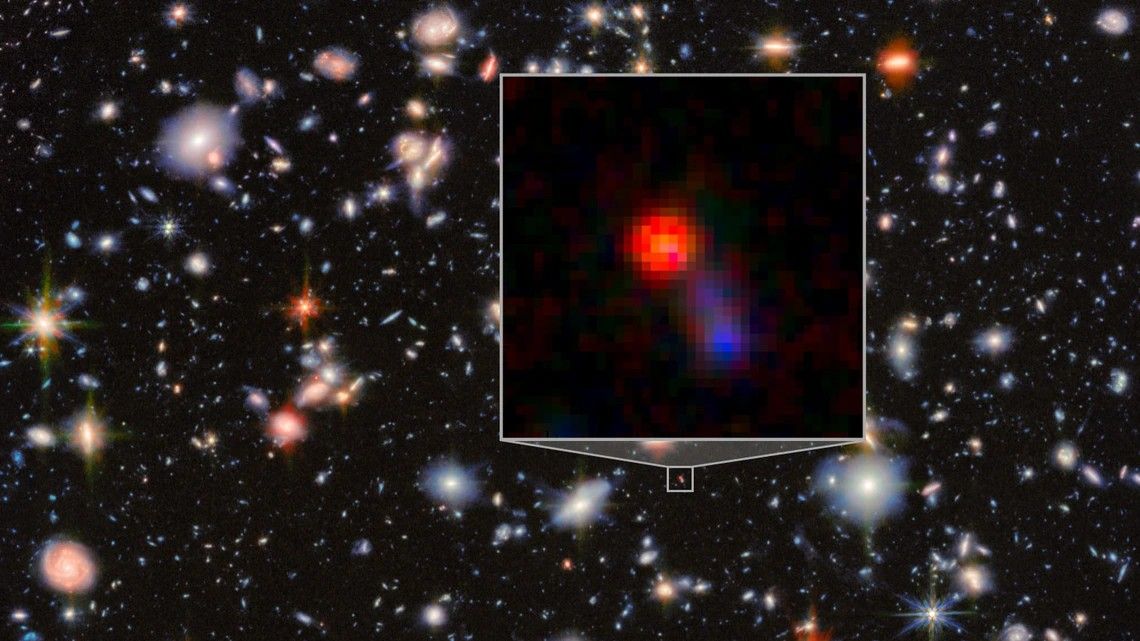
NASA’s James Webb Space Telescope (JWST) has detected a supermassive black hole hiding in an ancient “Jekyll and Hyde” galaxy that changes its appearance depending on how you look at it.
The galaxy, nicknamed Virgil, looked like an ordinary star-forming galaxy when observed in optical wavelengths (the kind of light that human eyes and optical telescopes like Hubble can see). However, when JWST viewed the object in infrared via its Mid-Infrared Instrument (MIRI), a monster black hole became visible in the galaxy’s core.
“Virgil has two personalities,” George Rieke, an astronomer at the University of Arizona who co-led the discovery, said in a statement released Dec. 10. “The UV and optical show its ‘good’ side — a typical young galaxy quietly forming stars. But when MIRI data are added, Virgil transforms into the host of a heavily obscured supermassive black hole pouring out immense quantities of energy.”
Rieke and his colleagues published their findings Nov. 17 in The Astrophysical Journal. The findings suggest that some of our universe’s most extreme objects could be invisible unless observed in infrared wavelengths.
Light takes a long time to travel across the galaxy, so when a powerful telescope like JWST observes distant objects, it sees the objects as they appeared in the distant past. Basically, JWST acts like a time machine into the early universe. Virgil appears to JWST as it existed 800 million years after the Big Bang. (For context, the universe is thought to be around 13.8 billion years old.)
The researchers classified Virgil as a little red dot (LRD). This is the name given to mysterious red objects that appear in JWST observations of the distant, early universe, and that astronomers don’t fully understand.
LRDs appear in large numbers at around 600 million years after the Big Bang, before rapidly declining at around 1.5 billion years after the Big Bang. Observing galaxies like Virgil should help researchers unravel the mysteries of LRDs, which have been linked to actively feeding supermassive black holes that are heavily obscured by dust.
JWST’s Virgil observations also help researchers better understand how supermassive black holes grew in the early universe. The one at the center of Virgil was a so-called “overmassive” black hole — meaning a massive black hole that shouldn’t be able to exist in a host galaxy of that size, according to the statement.
Astronomers used to think that black holes at the centers of galaxies grew at the same rate as their hosts, with the galaxies forming first and growing black holes over time as large quantities of matter coalesced at their centers. However, JWST observations like this one suggest that the opposite might be true — first comes the black hole, then the galaxy around it.
“JWST has shown that our ideas about how supermassive black holes formed were pretty much completely wrong,” Rieke said. “It looks like the black holes actually get ahead of the galaxies in a lot of cases. That’s the most exciting thing about what we’re finding.”