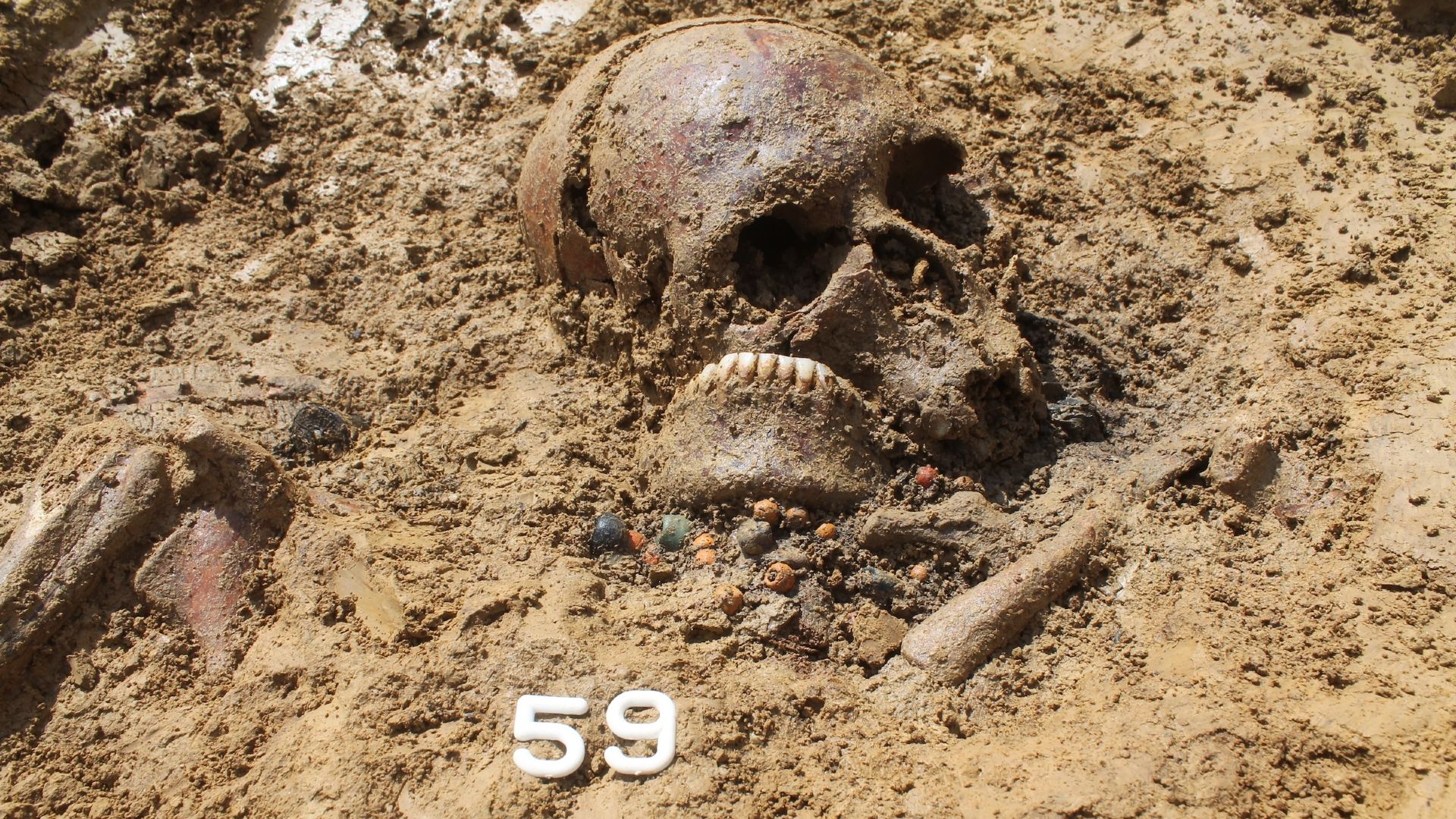
Burials that date to just after the fall of the Roman Empire are revealing the secrets of people who lived on the Roman frontier in what is now southern Germany.
A new DNA analysis of more than 200 skeletons in these cemeteries uncovered clues about the people who lived on the Roman frontier between 400 and 700. For example, many people engaged in lifelong monogamy, and nearly one-quarter of children lost at least one parent by age 10, the researchers wrote in the study, which was published Wednesday (April 29) in the journal Nature.
They also found that, after the Roman Empire fell in 476, life expectancy may have risen to 43.3 years for men and 39.8 years for women. Previous studies have suggested that life expectancies during the Roman Empire may have been between 20 and 25 years of age.
It’s likely that women had a lower life expectancy because of a “higher mortality of females after about 10 years of age, suggesting that giving birth was a major risk factor,” the researchers wrote in the study.
The generation time was about 28 years, the researchers estimated. Although many children were “half-orphans” (had lost one parent), most — nearly 82% — were born into a family with at least one living grandparent.
After the empire
The Roman Empire entered a period of decline between the third and fifth centuries. It split in two, and although the Western Roman Empire ended in the fifth century, the Constantinople-centered Eastern Roman Empire, also known as the Byzantine Empire, lasted until 1453. Southern Germany was on the border of the Western Roman Empire.
For the new study, scientists analyzed the remains of 258 people at sites in southern Germany who lived between the fourth and seventh centuries and had been previously excavated by other teams. They took DNA samples and analyzed their bones to determine how old the people were when they died. The researchers also performed strontium isotope analysis, which reveals chemical signatures that can indicate where each person grew up. Finally, they compared these findings with 2,500 ancient and 379 modern genomes.
The results gave scientists a fairly detailed look at what life was like in southern Germany during the collapse of the Roman Empire.
“Population genetic analyses reveal a major demographic shift coinciding with the late fifth century collapse of Roman state structures, when a founding population of northern European ancestry mixed with genetically diverse Roman provincial groups,” the scientists wrote in their paper. They noted that people had migrated north, away from Roman territory, into southern Germany, where they intermarried with the locals.
By the seventh century, the population of southern Germany was genetically similar to that of Central Europeans today, the researchers reported.
A scientist examines the skeleton of a woman who lived in southern Germany during the early Middle Ages.
(Image credit: © SAM / Harbeck)
The team found no evidence for polygamy and little evidence for remarriage. They did not uncover any evidence for incest or close-kin marriages, either.
“Our data suggests that lifelong monogamy, with limited divorce or remarriage of widows, was the prevailing norm in sixth century Southern Germany,” the team wrote in their paper. They noted that during the fourth to seventh centuries, many people in southern Germany converted to Christianity, and churches in the region discouraged polygamy, divorce, remarriage and close-kin relationships.
Rising life expectancy?
People on the old empire’s frontier may have had a somewhat longer life expectancy than people did during the Roman period, study co-author Joachim Burger, an anthropology professor at Johannes Gutenberg University Mainz in Germany, told Live Science in an email.
Previous studies that analyzed life expectancy on the Roman frontier between the third and fifth centuries indicated that people lived “around twenty to twenty‑five years at birth and roughly thirty‑five to forty‑five years for those who survive their first fifteen years,” Burger said. This suggests that “the average age at death [during late Roman times] is somewhat younger than what is recorded for the early Middle Ages,” Burger said. However, he cautioned that the previous studies used different methods than the new study did.
If life expectancy did rise, one reason may have been that fewer people died in violent conflicts. “Evidence of violent trauma in civilian skeletal remains from the early medieval period is significantly lower than in late Roman contexts,” Burger said.
During “the 3rd and 5th centuries, large-scale, state-organized military campaigns and civil wars occurred, claiming thousands to tens of thousands of lives,” Burger said. “In the early Middle Ages, such large-scale conflicts became rarer; violence was more decentralized and often confined to smaller groups.”
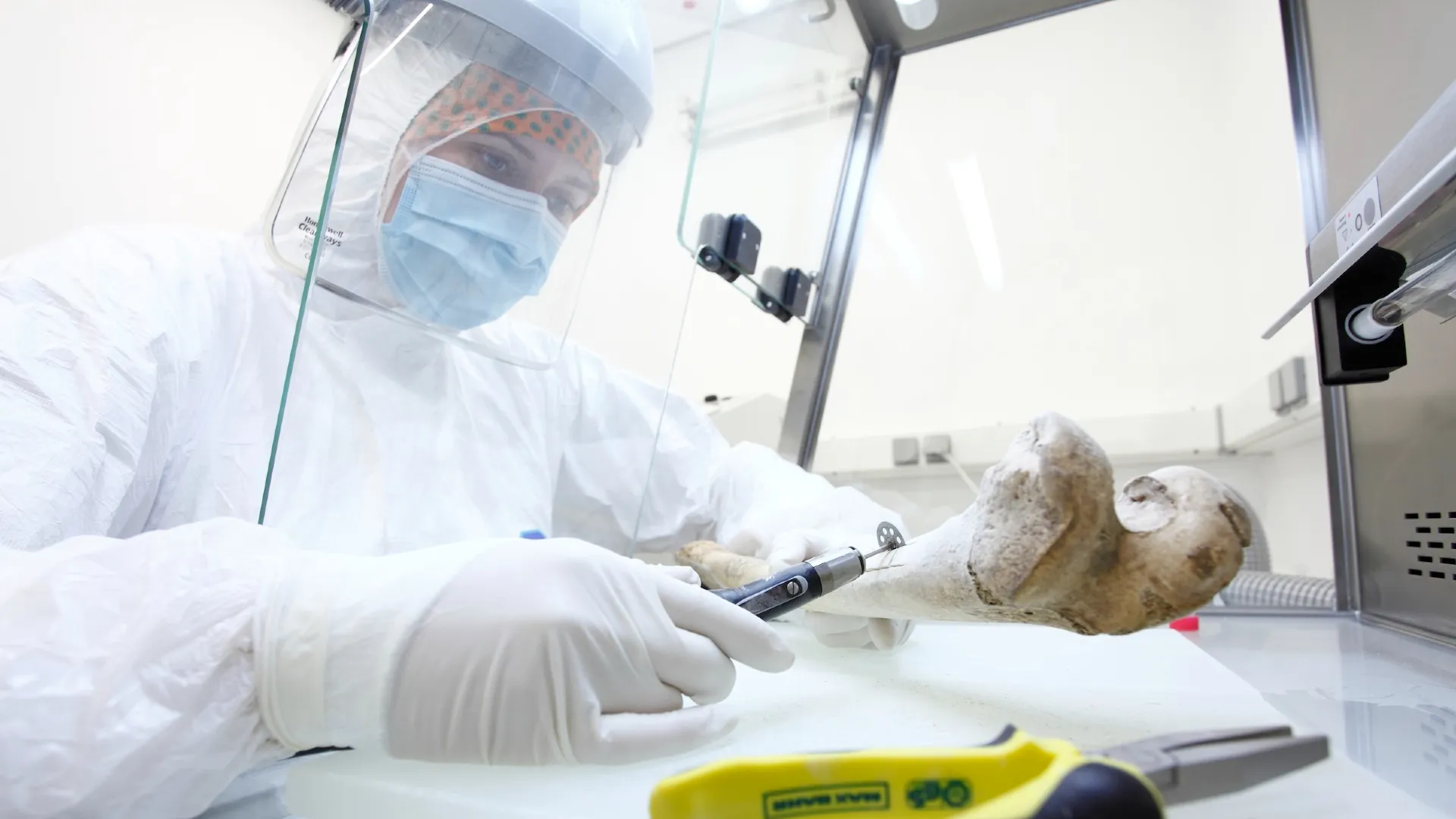
An analysis of ancient DNA being carried out in a lab. Conditions are kept sterile to prevent contamination from modern-day DNA.
(Image credit: © Johannes Gutenberg University Mainz/Burger)
Marriage, but not remarriage
Burger noted that the lack of remarriage, polygamy and close-kin relationships continued a trend that was going on before the Roman Empire collapsed.
“It appears that the new early medieval societies consistently implemented what had already been codified in legal texts during late Roman times,” Burger said. He noted that the Roman Empire had laws against polygamy and close-kin relationships, but the government could not always enforce them. By contrast, the people living in post-Roman southern Germany do not seem to have engaged in these practices at all.
The team’s discoveries are “consistent with other findings” from previous studies that looked at life in Europe after the Roman Empire ended, David Bachrach, a history professor at the University of New Hampshire who was not involved in the study, told Live Science.
Although the new results suggest that “they had better life expectancy than a lot of people had assumed,” Bachcrach doesn’t think life expectancy was higher than during the Roman Empire. “I think what we need is more study of the Roman population,” he said.
Shane Bobrycki, a history professor at the University of Iowa, told Live Science in an email that what “is striking is how high these life expectancies are. Ancient Roman life expectancies, by contrast, are often put in the low-to-mid 20s.”
He noted that studies that tried to estimate life expectancies during the Roman Empire are problematic, but it is plausible that life expectancies increased after the empire ended.
“A number of historians and demographers have posited that the Fall of the Roman Empire may have been good for longevity,” Bobryczki said. “Think about those huge cities, with all their baths and aqueducts. Impressive feats of scale and engineering, but remember: there was no chlorine,” which can be used to cleanse water.
“The societies being studied here were much, much, much smaller-scale, so they may have escaped from some of the crowd diseases that afflicted Romans, and in their small rural worlds they may have lived less precarious economic lives and faced less food insecurity than poor Romans,” Bobryczki noted.
Blöcher, J., Vallini, L., Velte, M., Eckel, R., Guyon, L., Winkelbach, L., Thomas, M. G., Gharehbaghi, N., Mitchell, C. T., Schümann, J., Köhler, S., Seyr, E., Krichel, K., Rau, S., Hirsch, J., Duras, J., Cloarec-Pioffet, P., Füglistaler, A., Klement, K., . . . Burger, J. (2026). Demography and life histories across the Roman frontier in Germany 400–700 ce. Nature. https://doi.org/10.1038/s41586-026-10437-3
From Nero to Julius Caesar, see how much you know about ancient Rome’s famous leaders with our Roman emperor quiz!