

Two massive Iron Age hoards of burned metal weapons, vessels, and chariots or carts, found in the north of England, may have been part of a royal funeral, possibly for a queen, archaeologists say.
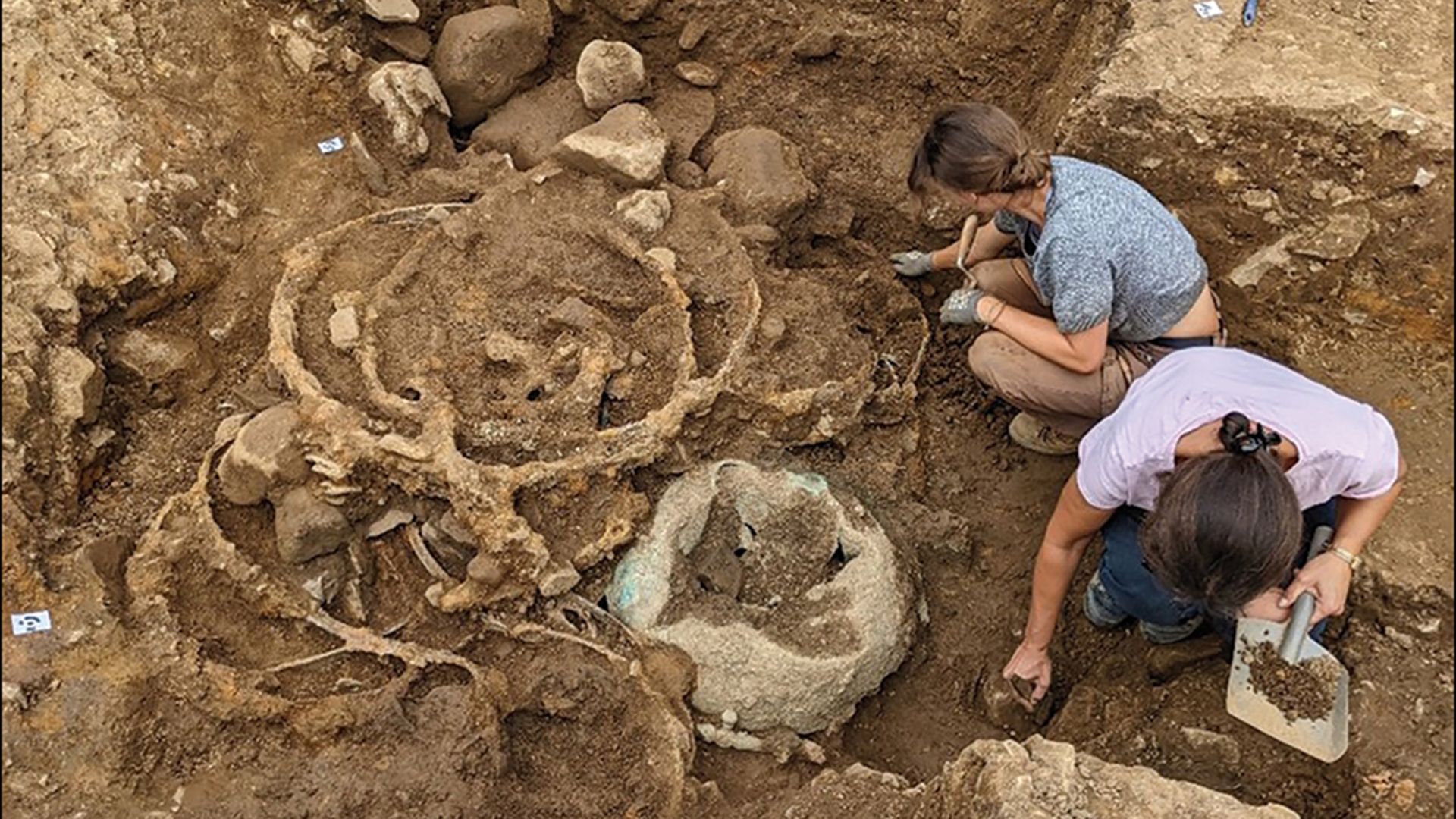
A metal detectorist found the hoards in 2021 near the village of Melsonby in Yorkshire and alerted archaeologists. Excavators discovered two separate deposits with a total of more than 950 artifacts, including iron “tires” for wooden wheels, a cauldron, an ornate wine-mixing bowl and ceremonial spearheads.
Article continues below
“It is clear that Melsonby was not a burial [because] we have no evidence of a body,” study co-author Tom Moore, an archaeologist at Durham University in the U.K., told Live Science in an email. “So our question is — why deposit this material?”
Moore and his colleagues think the size of the Melsonby hoards and the large number of expensive artifacts indicate they were part of an elite funeral held by the Brigantes, a powerful tribe of Iron Age Britons of mainly Celtic origin.
The Brigantes ruled the nearby Stanwick royal site, a few hundred feet away from the location where the hoards were found. At that time, Stanwick was a fortified village that the Romans called an “oppidum“; they were typically built by Celts on hilltops or other defensive areas.
Burnt artifacts
Moore said burning or destroying objects had been a key practice in many prehistoric funerals.
“Much of the material … was burnt to high temperatures — enough to melt copper alloy and silver,” he said. “At this time, cremation was becoming a popular funerary rite for elites in parts of Britain.” No signs of a burial had been found nearby, but the remains could have been buried elsewhere.
The exact reason for the hoards’ burials, however, may never be known. “There are several possibilities for that event,” Moore said, “but a funeral of an important leader seems one of the most likely.”
The researchers used radiocarbon dating to determine that the artifacts originated in the first century B.C., while their style and decorations, including coral from the Mediterranean Sea, indicate that the elites at Stanwick had connections with the European mainland.
The Brigantes were allies of the Romans after their conquest of much of Britain after A.D. 43. Roman sources after A.D. 69 said the Brigantes were then ruled by a queen named Cartimandua, a “client ruler” and ally.
But the researchers think the hoards date to several generations before that and may have been used in a funeral for one of Cartimandua’s royal ancestors. (Royal power among the Brigantes seems to have passed from mother to daughter, so it is likely that some of Cartimandua’s ancestors were also ruling queens.)
Four-wheeled carts
A key discovery was that the Melsonby hoards contained several strange, U-shaped iron brackets, which have been found in continental Europe but not in Britain. The brackets have now been identified as parts of four-wheeled carts, which the Iron Age Britons used alongside their two-wheeled chariots, according to the study authors. This indicates the Britons had connections with other Celtic groups on the European continent.

“The fact that we have elements which can only be ascribed to such vehicles … is a first for Britain,” Moore said. “Why we have never found them before is a mystery.”
Melanie Giles, an archaeologist at the University of Manchester who wasn’t involved in the Melsonby study but is excavating a chariot funeral from about the same time in Wales, said the chariot in Wales and the artifacts in the Melsonby hoards have several things in common. For one, “They’re sharing the same style of Celtic art,” Giles said.
In both cases, the Celtic motifs seemed to have been exaggerated, which may have been a sign of Celtic opposition to Roman expansion on the European continent, Giles proposed. “Some people think this is a kind of resistance to the Romans,” she said. “It’s people celebrating their Celtic art and being a bit more ‘in your face’ about it.”
Adams, S., Armstrong, J., Bayliss, A., Moore, T., & Williams, E. (2026). Vehicles of change: two exceptional deposits of destroyed chariots or wagons from Late Iron Age Britain. Antiquity, 1–21. https://doi.org/10.15184/aqy.2026.10311