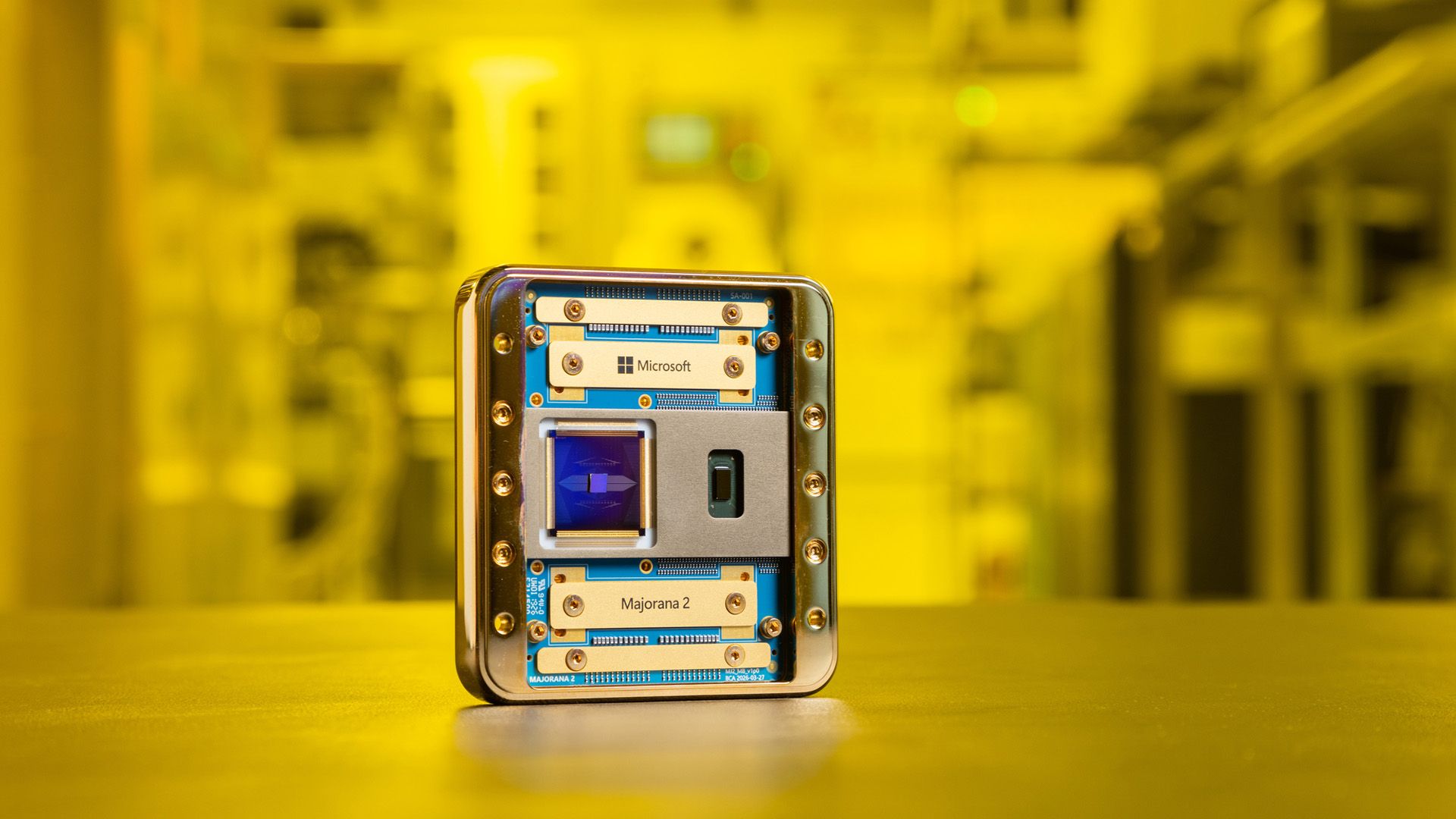
Microsoft has revealed a new quantum computing chip with quantum bits (qubits) it says are capable of maintaining their quantum state for 1,000 times longer than its predecessor — paving the way for more reliable quantum computers by 2029. But not all scientists believe the company’s claims.
The experimental quantum processing unit (QPU), dubbed Majorana 2, features a four-qubit array that offers a reported mean qubit lifetime of 20 seconds and, in some instances, up to a minute. This is a massive improvement in quantum coherence times — the time that qubits are entangled so that calculations can run in parallel — typically seen in QPUs. Normally, this lifetime is measured in milliseconds (thousandths of a second).
The new chip could put scientists on the path to building a quantum computer that’s commercially viable by 2029 — halving the timespan researchers initially expected — Microsoft representatives said in a statement. The scientists who worked on the new processor outlined their findings in a June 2 preprint study, and the results have not yet been peer-reviewed.
“We need to make improvements each year that will get us closer to delivering a computer that we believe will have massive commercial and societal value,” Chetan Nayak, Microsoft technical fellow, said in the statement. “We’ve got to keep marching to that roadmap to accomplish that, but where are we relative to last year? We’re 1,000 times better.”
Despite the claimed progress against the first chip, Majorna 1, experts have called Microsoft’s work in this specific niche of quantum computing research (called topological quantum computing) into question. They have previously questioned whether the underlying technology has yet been proven and have called for a wider evidence base for suggestions on qubit coherence times.
Despite the criticism, Microsoft representatives say this has halved the development time in building a future fault-tolerant quantum computer — a machine that can overcome errors and sustain long-duration calculations to potentially outperform supercomputers.
Next-generation topological qubits
The Majorana 2’s predecessor was revealed in February last year. Both chips are based on a 90-year-old theory by Italian physicist Ettore Majorana that a particle could be its own antiparticle, meaning that it either annihilates itself in a massive release of energy or coexists stably when paired, enabling it to store quantum information as a qubit.
Get the world’s most fascinating discoveries delivered straight to your inbox.
Because Majorana particles aren’t found in nature, much of the research into them, including Microsoft’s previous findings, centers on nudging them into existence.
Under the right conditions, the qubits in these chips can reach a “topological” state of matter — a specific phase in which atoms are entangled over long distances — which lets them tap into the laws of quantum mechanics to process the 1s and 0s of computing data in parallel.
Representatives said on the launch of Majorana 1 that these qubits were more stable, smaller, more scalable, and drained less power than qubits made from superconducting metals — like the ones commonly used in quantum computing systems made by companies like IBM, Google and Microsoft.
Qubits in the first Majorana chip consisted of a material stack combining a semiconductor made of indium arsenide (used in devices like night vision goggles) with an aluminum superconductor. This forms a “topoconductor,” a topological superconductor whose qubits are stored in the shape of the material stack.
Each qubit is made from two superconducting nanowires ended by Majorana zero modes (MZMs) – the building blocks of topological qubits that store information through parity, evenness or oddness in the number of electrons in a topoconductor wire.
At Microsoft’s Quantum Lab in Lyngby, Denmark, the team is using agentic AI to help develop more reliable topological qubits.
(Image credit: Microsoft)
Instead of aluminum, Majorana 2 uses lead to shield fragile qubits from disturbances like electromagnetic waves or cosmic radiation. For the semiconductor, researchers swapped out indium arsenide for a combination of indium arsenide and indium arsenide antimonide. The change doubled the “topological gap” — the physical barrier that protects the qubits from environmental noise and errors during calculations.
It also led to a major increase in stability and reliability: boosting the quantum coherence lifetime from between 1 and 12 milliseconds in Majorana 1 to an average of 20 seconds (with a maximum lifespan of 1 minute), the researchers said in the study.
Combining AI and quantum computing
The key components of the Majorana 2 were designed atom by atom, so the scientists needed to add impurities in the form of other materials into the crystalline structure to lock each atom in its correct spot. But adding too many impurities, or adding them in the wrong way, would disturb the structure. To get these impurities into the right spots, the scientists turned to artificial intelligence (AI).
“Finding the exact recipe, the right amount to put to get the desired energy structure, requires a lot of experimentation in the old world order. In the new world order, through simulations, you can see where the highly probable target is. And then with that knowledge, you ideally only have to experiment once,” Zulfi Alam, corporate vice president for quantum at Microsoft, said in the statement.
Using the Microsoft Discovery platform, the scientists deployed AI agents to keep track of the complex intersectional elements while designing Majorana 2 — with changes to any of the software, architecture, design, the materials stack, the fabrication processes, measurements, and others, carrying ramifications for every other element. The project also had close to two decades’ worth of data in many different formats, which were stuck in different silos. But AI agents were able to resynthesize the data and establish connections between the different pieces of information.
AI also slashed the time it took to conduct experiments from weeks by “several orders of magnitude,” Alam said in the statement, but did not specify the exact time saving.

Microsoft’s Majorana 2 chip was designed in part by AI.
(Image credit: John Brecher/Microsoft)
“Using agentic AI to automate the measurements was a game changer,” said Alam said in the statement. “It goes through some math and starts saying, ‘”Hey, where do I find the lowest point where everything sort of works?'” And it can do all these voltage adjustments in parallel, which a human cannot do. The way our minds work, we are more linear.”
Pathway to the holy grail
Nayak said in a technical blog post that the company is now cutting its timeline to build a practical and scalable quantum computer in half with a new target of 2029. “This achievement will mark a major milestone on the path to a transformative fault-tolerant quantum computer that has the potential to solve problems that affect all of humanity.”
This timeline sits roughly in line with competitors in the field. But this apparent progress in the field of topological quantum computing is not without its detractors.
Following the release of Majorana 1 last year, physicists questioned the extent to which Microsoft researchers proved that MZMs were present in the device. Nayak, who was involved in last year’s research, later presented additional evidence at a talk at the Global Physics Summit in March.
Others have criticized the evidence for the claims made in the new study. Speaking with Scientific American, scientists including Sergey Frolov, a quantum computing researcher at the University of Pittsburgh, suggested that the data reported has yet to be proven credible. Frolov cites the fact that Microsoft’s last preprint of this kind was unpublished, meaning it wasn’t peer-reviewed
Speaking with Live Science, Yuval Boger, quantum computing researcher and chief commercial officer at QuEra, a quantum computing company that is building neutral atom machines, lauded the progress but urged caution.
“Topological qubits are a bold, long-horizon bet, and the device improvements they reported are worth noting,” he said. “As with any announcement of this kind, the sensible thing is to wait for peer review and independent reproduction before drawing conclusions,” he added.
“The community has debated the topological evidence since 2018, and that scrutiny is healthy for everyone,” he said. “It’s also worth keeping the news in proportion. Topological computing has not yet demonstrated a working qubit, while other modalities are considerably further along.”
Competing entities, including companies and research institutions, are working on a host of different qubit modalities as they all strive to hit the holy grail of building a fault-tolerant quantum computer that exponentially scales down its errors as you increase the size of the system. This is known as “below threshold” quantum error correction. They may include superconducting qubits, neutral atom qubits, photonic qubits, or, in Microsoft’s case here, topological qubits, among others.
“In the end, any real progress in quantum computing is good for all of us,” he said. “The field moves fastest when many approaches are pushing at once, and we welcome that.”