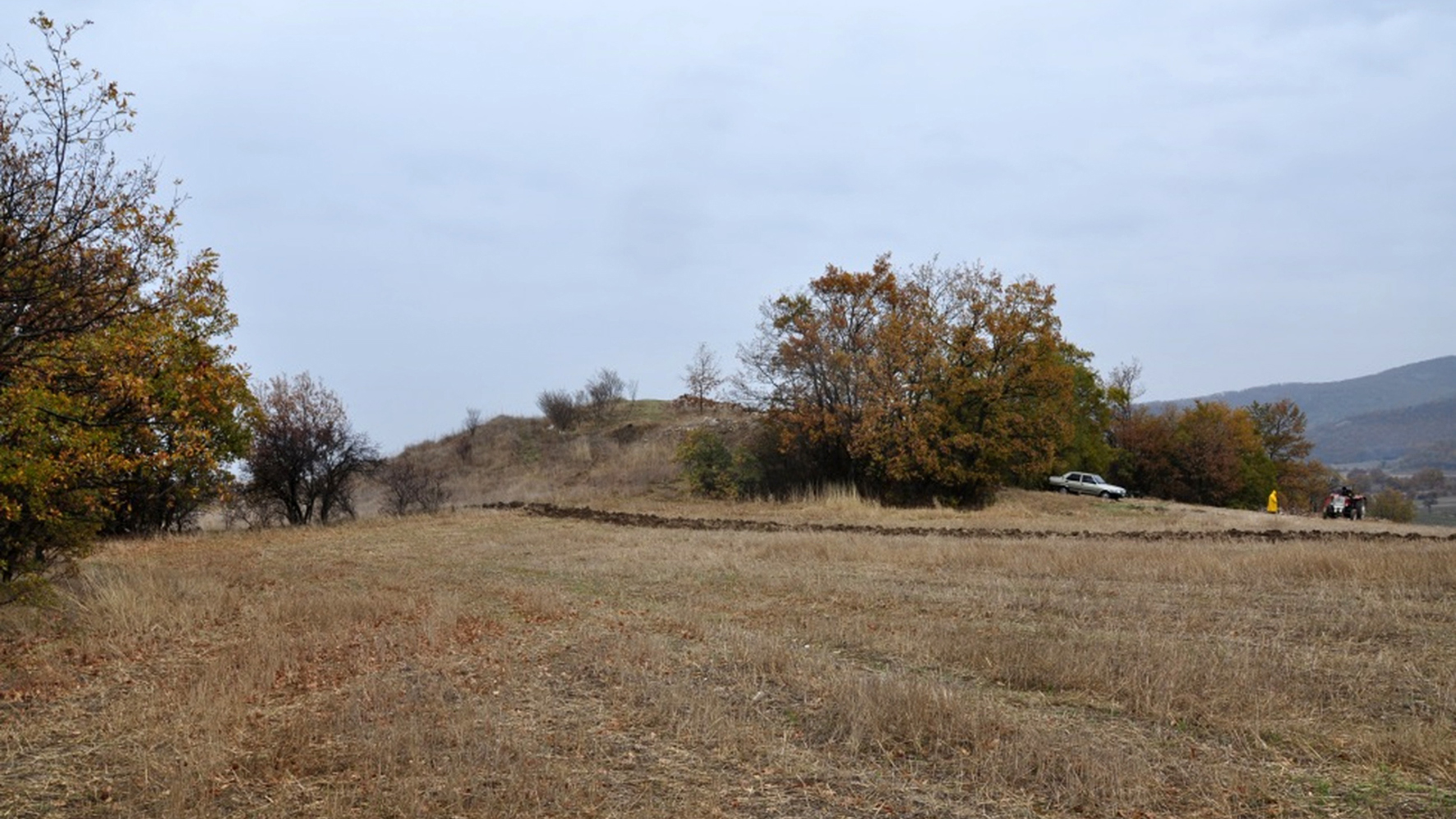
An ancient tomb discovered in Turkey may have been made for a member of the family of the legendary King Midas, who lived in the eighth century B.C. and is renowned for his mythical “golden touch.”
The possibly royal tomb, from the ancient kingdom of Phrygia (1200 to 675 B.C.), is more than 100 miles west of the kingdom’s ancient capital at Gordion. Its distant location suggests Phrygian society wasn’t politically concentrated in the capital city, a new study finds. Rather, it seems that political power was distributed over the ancient kingdom in central Anatolia.
“Historically, Phrygia was often viewed as a centralized kingdom similar to the Assyrian or Urartian empires,” archaeologist Hüseyin Erpehlivan of Turkey’s Bilecik University told Live Science in an email.
But the tomb, in the Karaağaç Tumulus in Turkey’s northwestern Bozüyük district, suggests otherwise; the fact that an elite tomb was made so far from the capital “supports the idea that the Phrygian political organization was not limited to a strictly-centralized, urban-focused system” at Gordion, Erpehlivan said.
However, he acknowledged that the tomb’s lavish grave goods might not indicate a royal burial, but rather a royal gift exchange with an important person who had regal connections, such as the area’s governor.
Remote tumulus
The tumulus (or burial mound) now stands about 26 feet (8 meters) above a natural hillock and more than 100 ft (30 m) above the surrounding plain, with a diameter of about 110 ft (60 m). It was discovered in 2010 when satellite photographs showed damage from looting, and researchers have been academically excavating it since 2013.
In a new investigation of the tumulus, published in the January issue of the American Journal of Archaeology, Erpehlivan analyzed the tomb’s architecture and grave goods.
Erpehlivan said the monumental architecture of the wooden-chambered tomb inside the tumulus is comparable to elite burials near Gordion, while grave goods in the tomb are similar to those found in royal burials at the capital. These aspects of the burial in the Karaağaç Tumulus “exceed what would be expected for a purely local, non-elite individual, instead pointing to a figure embedded within Phrygian power structures,” he said.
Erpehlivan and his colleagues determined that the grave goods included numerous ceramic jars, one of which was inscribed with a Phrygian name, and several situlas — elaborately-crafted bronze vessels, often decorated with scenes of battles, hunts and processions — that could indicate the person in the grave had a local royal rank or ties to the royal family of Midas.
The presence of situlas is important because, before this study, the only documented examples were discovered in the “Midas Mound” at Gordion, which was likely the tomb of his father Gordias. Erpehlivan wrote that the artifacts also help date the tomb to between 740 and 690 B.C.
Ancient kingdom
Midas is widely known today for the myth of his “Golden Touch” or “Midas Touch” that turned everything to gold — including his food, his drink and his daughter. This cautionary tale was known to the ancient Greek philosopher Aristotle, who cited it in fourth century B.C. as an example of greed. The myth was embellished by later writers; the daughter was added in the 19th century by the American author Nathaniel Hawthorne.
But Midas was also a real king of Phrygia in central Anatolia who lived in the eighth century B.C. The ancient Greeks thought he was fabulously wealthy, and that part of the legend seems to have been true: Ornate metalwork, jewelry, pottery, rare wooden furniture and traces of fine textiles have been discovered in several Phrygian royal tombs. There are more than 120 burial mounds near Gordion, of which about half have been investigated; the tomb of Midas, however, has not yet been found.

Old bones
Erpehlivan and his colleagues discovered human remains inside the Karaağaç Tumulus, but they don’t think they belong to the tomb’s original occupant. Some of the bones are from an ancient cemetery that already existed at the site, while others are from burials made after the Phrygian burial mound and tomb were built.
“The newly discovered tumulus is unique in that it contains graves spanning a period of nearly three millennia,” University of Pennsylvania archaeologist Brian Rose told Live Science in an email. Rose was not involved in the latest study but has excavated tombs at Gordion for decades. “Especially welcome is the information that it dates to the reign of King Midas in the late eighth century, since two other newly excavated burial mounds at the Phrygian capital of Gordion date to the same period,” he said.

Archaeologist Maya Vassileva of the New Bulgarian University in Sofia, who was not involved in the study, told Live Science in an email that the Karaağaç Tumulus is “very important evidence” for an elite Phrygian burial far from Gordion.
But Vassileva is not convinced that the situla fragments from the tomb are a sign of royal links. “I would not consider the presence of situlae as evidence for a local royal status or royal ties,” she said. “The other suggested hypothesis for an elite gift exchange seems more plausible.”