


NASA has revealed the next steps in its plans to build humanity’s first lunar outpost, with three uncrewed missions to the moon targeted for later this year.
The missions, announced by the U.S. space agency at a news conference on Tuesday (May 26), are the first of many to begin laying the foundations for a permanent base on the moon’s surface, which NASA hopes will one day pave the way to sending humans to Mars.
“America returns to the moon again, and this time to stay,” NASA Administrator Jared Isaacman said at the news conference.
NASA has been proposing concepts for a permanent lunar presence since the 1950s, and hinting at establishing a “sustainable lunar presence” since the rollout of the Artemis program in 2019. But the agency made these ambitions more concrete at its Ignition event on March 24 of this year, where it announced its $20 billion plans to build a Moon Base to act as a hub for scientific and technological research and development, as well as exploration of the moon’s surface.
“The Moon Base will be America’s and humanity’s first outpost on another celestial world,” Isaacman said in a statement after Tuesday’s news conference. “Every mission, crewed and uncrewed, will be a learning opportunity as we return to the lunar surface, build the infrastructure to stay, and master the skills required to live and operate in one of the most demanding and dangerous environments imaginable.”
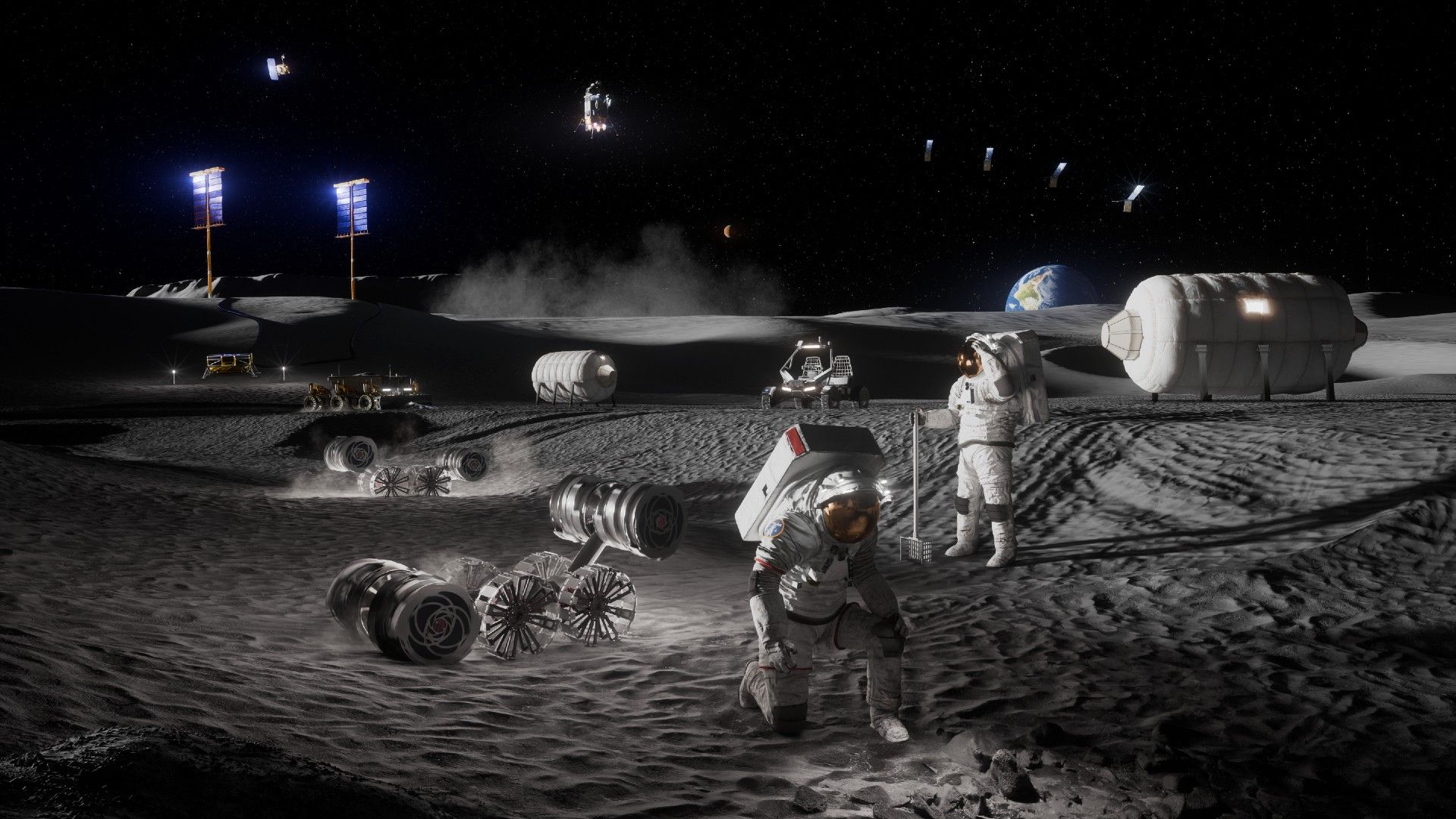
The base, which NASA hopes to build near the lunar South Pole, could one day look like a sprawling city, Moon Base program manager Carlos García-Galán said at the press conference. “We envision the moon base to be hundreds of square miles, with different assets all building up to the objective of permanent lunar presence on the moon.”
The first three missions
At Tuesday’s event, the space agency revealed its first steps toward building that outpost.
Get the world’s most fascinating discoveries delivered straight to your inbox.
- Moon Base I, scheduled to launch as early as fall 2026, will deliver NASA payloads to the lunar surface. This will include instruments to study how thrusters interact with the moon’s surface and technologies to allow for more precise tracking of objects on the moon by orbiting spacecraft.
- Moon Base II, planned for later this year, will deliver lunar rovers and other mobility systems for getting around on the moon.
- Moon Base III, also planned for this year, will deliver payloads from NASA, alongside several other space agencies, whose main aim will be to study how the lunar surface changes over time and how different materials withstand its extreme conditions.
These three missions are part of NASA’s phase I Moon Base plan, which aims to create the first tangible footprint for a base on the moon. Phase II, scheduled for 2029 to 2032, aims to transition to semi-permanent infrastructure and early habitation, while phase III, scheduled for 2032 and beyond, aims to scale operations to achieve a sustained human presence.
In the news conference, the agency also announced that the first mission would be conducted by Jeff Bezos’s space company Blue Origin, using the company’s Blue Moon Mark 1 Endurance lander to deliver the required payloads. Blue Origin was the biggest winner from yesterday’s announcement, netting $468 million in contracts.
However, many experts are skeptical about the feasibility of NASA’s ambitious timeline, alongside the untested nature of much of the tech included in the contracts. (Axiom Space, for example, has been chosen as a rover partner despite its late space suits risking significant delays to the Artemis program; and Astrobotic and Intuitive Machines, chosen to send payloads, both failed in their previous lunar delivery missions.)
While Isaacman said that scientific discovery was at the forefront of these missions, NASA is also under significant political pressure to return humans to the moon. China is continuing to hit “major milestones” on its own roadmap to land astronauts on the moon by 2030, and a report by the Commercial Space Federation in September 2025 warned that China could soon overtake the U.S. in the “new space race.”
Despite the recent success of Artemis II, NASA’s Artemis program — which aims to land humans on the moon by 2028 — is over budget and behind schedule; originally, the agency had planned to land humans on the moon by 2024.
Citing these setbacks, Simeon Barber, a Lunar Scientist at The Open University, told BBC News: “It would not surprise me at all if China gets there first.”
Barber added: “It sounds to me like [NASA] feel they’re in a position where they have to start saying they’ve got plans. So I think there’s a lot of political drive behind this.”
However, NASA remains optimistic. “We are building the Moon Base for all we will learn, the innovation that will improve life on Earth, the inspiration for the next generation of explorers, and to master the skills needed for where we will inevitably go next…Mars,” Isaacman said in a post on X. “The Golden Age of lunar exploration has begun.”