


Quick facts
What it is: RCW 86, a supernova remnant
Where it is: 8,000 light-years away, in the constellation Circinus
When it was shared: March 24, 2026
One of the oldest recorded astronomical events observed by humans has gotten a fresh look from a new NASA space telescope. In A.D. 185, Chinese astronomers recorded the appearance of a “guest star” in the night sky. The star shone for about eight months in the direction of Alpha Centauri, one of the closest star systems to the sun.
This stellar visitor was a supernova — a large and extremely bright explosion marking the end of a massive star’s life. It left a remnant — a ring of glowing debris — in the night sky that’s now known as RCW 86. It’s all that remains of the exploded white dwarf star, but there’s a mystery surrounding it: why it appears to have expanded far more quickly than other supernova remnants.
Although RCW 86 has been imaged many times before — notably by NASA’s Chandra X-ray Observatory and the Dark Energy Camera — new data from NASA’s Imaging X-ray Polarimetry Explorer (IXPE) has delivered a fresh perspective. Launched in 2021, IXPE captures X-ray data and high-energy, short-wavelength light with an all-new level of sensitivity to examine the most extreme objects in the universe, including supernova remnants.
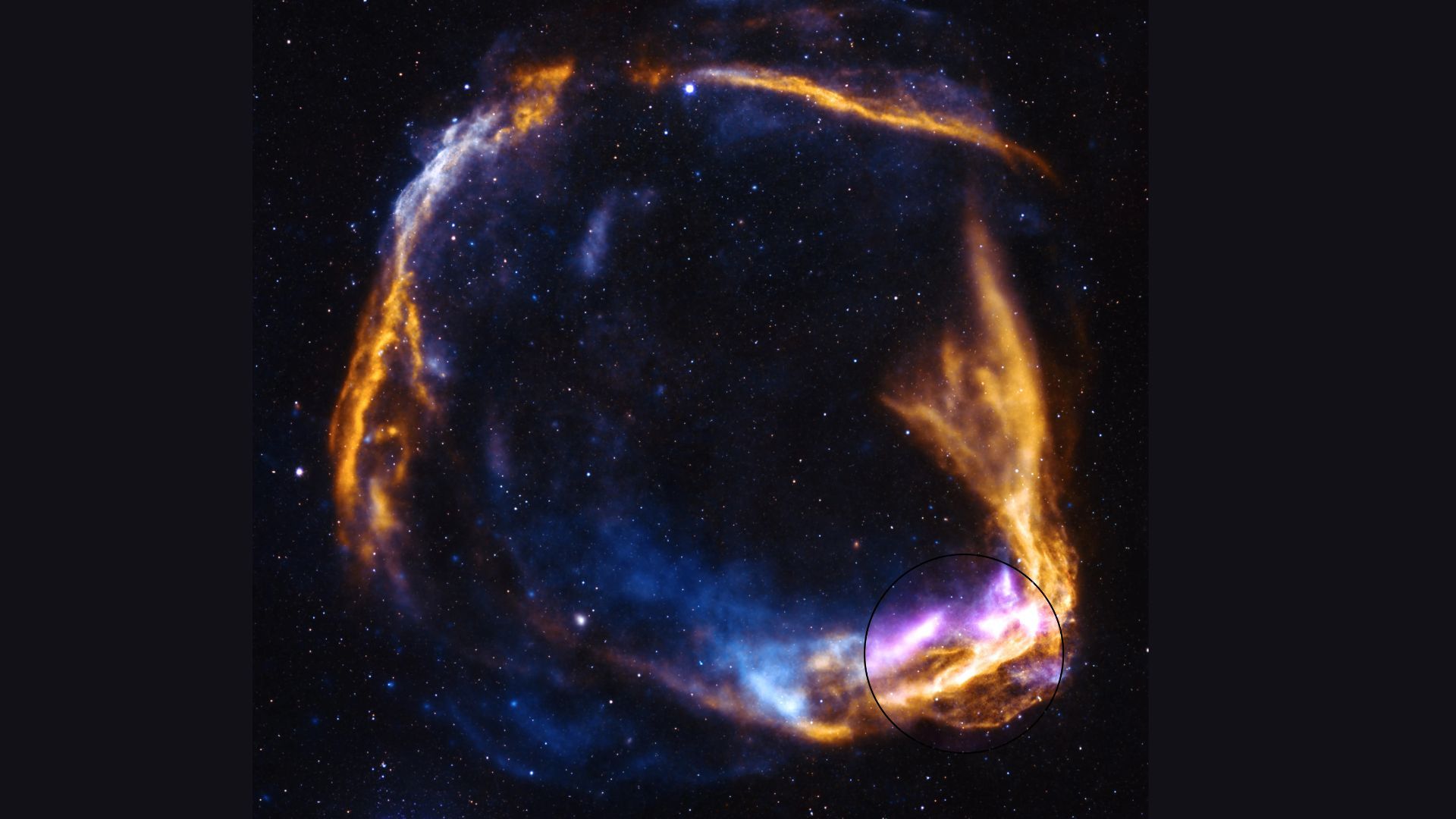
IXPE was put to work on RCW 86 because of the remnant’s irregular shape and the strange way it’s expanding. Earlier observations from Chandra suggested that the supernova spread into a low-density “cavity,” allowing it to grow faster than other supernova remnants. This image combines data from IXPE, Chandra and the European Space Agency’s XMM-Newton telescope, with low-energy X-rays shown in yellow and higher-energy emissions in blue.
IXPE’s data is crucial because it can highlight polarized X-ray emissions, revealing magnetic-field structures in the remnant’s outer rim. This region, marked in purple, is particularly significant because it shows where the supernova’s expansion likely slowed at the edge of the cavity. IXPE’s data reveals a “reflected shock” effect in RCW 86. As the expanding material from the supernova collided with the cavity boundary, shock waves were reflected toward the cavity, offering a potential explanation for both the remnant’s shape and the distribution of high-energy particles.