In a first, researchers have sequenced genetic material from 400,000-year-old Homo erectus fossils — and the results reveal deep genetic links to both modern humans and the enigmatic Denisovans.
H. erectus was the earliest human ancestor to travel outside Africa and successfully spread into Europe, Asia and Oceania beginning 1.8 million years ago. With a relatively large brain and the ability to craft complex stone tools, H. erectus was the longest-lasting human ancestor until it disappeared around 108,000 years ago. But paleoanthropologists have long wondered if H. erectus overlapped and interbred with Homo sapiens, which evolved around 300,000 years ago in Africa.
Two of those amino acid variants surprised the researchers — one was present in all six H. erectus individuals but not in any other human lineage, while the other was present in all H. erectus samples as well as in Denisovans, a group of archaic humans who lived in Asia and went extinct around 30,000 years ago. This amino acid variant was then passed from Denisovans to some H. sapiens groups through interbreeding tens of thousands of years ago.
The results are the first to show “deep genetic links” between these H. erectus individuals and present-day modern humans, the researchers wrote in a statement. The results are also a step forward for the relatively new technique called paleoproteomics, which allows scientists to sequence genetic material that lasts longer than DNA does.
“I don’t believe that any previous DNA or proteomics have been done before” on H. erectus, study first author Qiaomei Fu, director of the Ancient DNA Laboratory at the Institute of Vertebrate Paleontology and Paleoanthropology, part of the Chinese Academy of Sciences, in Beijing, told Live Science in an email. But “how they evolved into modern humans and are related to the Denisovans, we really need to get DNA to understand that,” she said.
DNA has a shorter shelf life than proteins do, and so far, researchers haven’t found any H. erectus DNA that can be sequenced. However, Denisovan DNA has been sequenced.
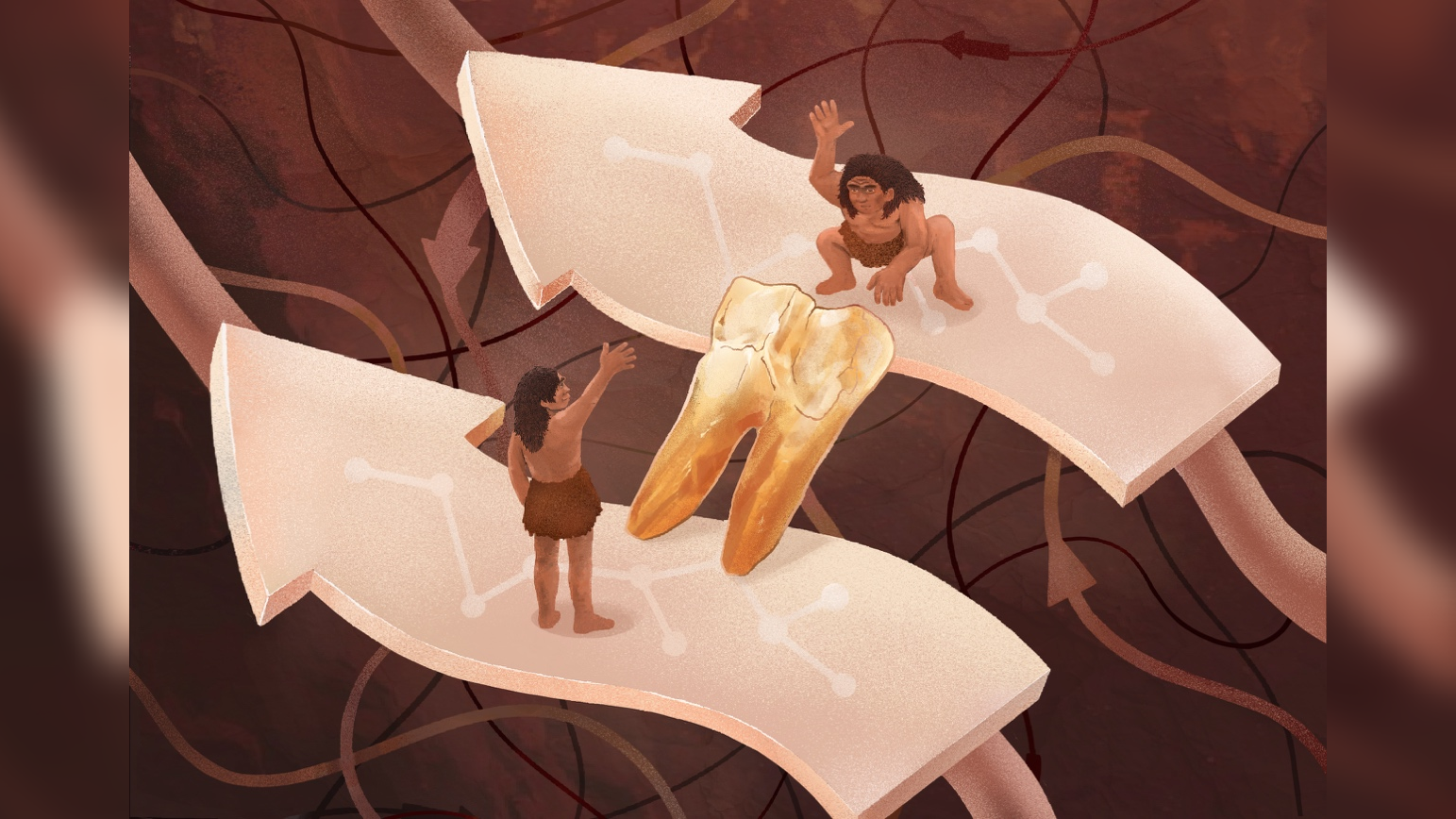
Scientists analyzed this Homo erectus tooth from the site of Zhoukoudian in China.
(Image credit: Qiaomei Fu)
The muddle in the middle
The Middle Pleistocene era (also called the Chibanian age) spanned from 774,000 to 129,000 years ago. During this era, a number of ancient human groups overlapped in Africa, Europe and Asia, including H. erectus, H. sapiens, Neanderthals and Denisovans, presenting paleoanthropologists with the difficult task of figuring out how they were all related — a confusion they call a “muddle.”
“Scientists used to call this ‘the muddle in the Middle Pleistocene,'” John Hawks, a paleoanthropologist at the University of Wisconsin-Madison who was not involved in the study, told Live Science in an email, “and now we know that muddling is just mixing.” The new study of 400,000-year-old enamel proteins shows that mixing of different evolutionary branches was important to our evolution, “even earlier than DNA evidence can show us,” Hawks said.
But what exactly the new results mean for the evolution of H. erectus — and the possibility that it interbred with modern H. sapiens in Eurasia — is still murky. “I think this raises the question of whether we know what Homo erectus even is,” Hawks said.
Paleoanthropologists often define an ancient human species based on a group’s physical features, such as the size and shape of their bones and teeth — a method called the “morphological species concept.” But that way of determining species has been complicated by the rise in genomic analysis over the past two decades, which has revealed interbreeding among groups such as Neanderthals, Denisovans and modern humans, proving that there is some biological overlap among these groups.
But whereas the genetic information shared among groups around 50,000 years ago in Europe and Asia is relatively clear-cut thanks to DNA and genomic analysis, the newly revealed amino acid variations in 400,000-year-old fossils from China are just the first step in clarifying the “muddle in the Middle Pleistocene.”
“What I’m concluding is that probably paleoanthropologists of the past were too willing to glom these Middle Pleistocene fossils from China into Homo erectus,” Hawks said. “Many of these fossils are probably Denisovan relatives, or possibly they came from other groups we’ve been calling ‘erectus’ just because we don’t really understand them.”
The bottom line, according to Hawks, is that the new study is a great piece of work. “It’s tough to look at data like these and not be impressed with the uncertainty of boundaries and the mixing between them in these past people,” he said.
Fu, Q., Wu, Z., Bennett, E.A., Xing, S., Ji, Q., Dong, Z., Rao, H., Gu, X., Dang, Y., Xing, J., Zhou, K., Feng, X. (2026). Enamel proteins from six Homo erectus specimens across China. Nature. https://doi.org/10.1038/s41586-026-10478-8
What do you know about early humans? Test your knowledge with our human origins quiz!