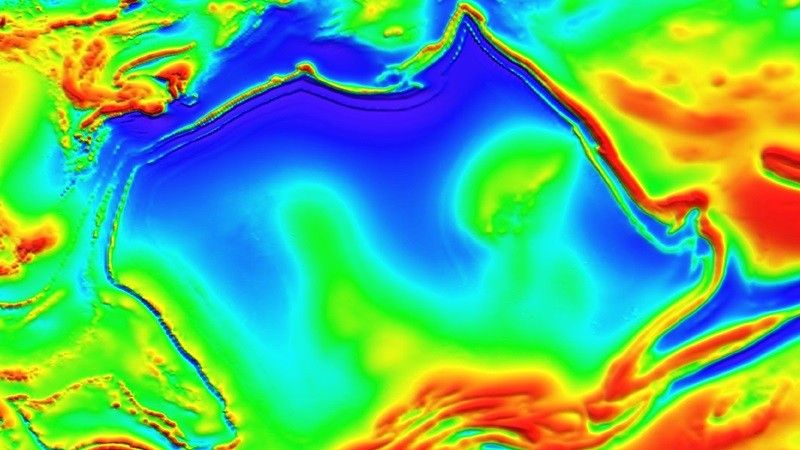
New mapping in Australia has revealed a strange dent in the magnetic field beneath the country’s Northern Territory.
The Australia Magnetic Anomaly, named after its similarity in shape to the country, holds valuable information about Australia’s geological history, including how different rock layers formed and acquired their distinctive magnetic properties.
A magnetic anomaly is a local variation in Earth’s magnetic field caused by the magnetic properties of certain minerals and rocks, such as iron ore deposits, in the crust.
From the moment they form, rocks start to develop magnetic signatures that incorporate information about the direction of Earth’s magnetic field at that specific time. This “magnetic memory,” known as remanent magnetism, helps scientists reconstruct rocks’ past.
However, the magnetic field occasionally flips, and tectonic processes can change rocks’ orientation, which muddles the picture. But if scientists can decipher the various clues encrypted in a rock’s magnetic signature, they can reconstruct exactly what the rock went through and when.
The Australia Magnetic Anomaly contains structures such as faults, folds and basins that traditional mapping techniques haven’t been able to detect, according to the statement. To explore these hidden layers, Foss and his team used advanced modeling techniques to better visualize magnetic data collected during the Northern Territory Government’s 1999 Bonney Well Survey.
For that survey, planes fitted with magnetometers — instruments that measure magnetic fields — flew across the Northern Territory in regular lines separated by about 1,300 feet (400 meters). Scientists previously tried to map these data, but the maps didn’t always render magnetic signals clearly — particularly along the flight lines, according to the statement.
The new modeling has solved this problem. “My colleague, Dr Aaron Davis, created an innovative gridding algorithm which refined the dataset and produced cleaner, more consistent images,” Foss said. “By improving how we process and model these datasets, we can extract more geological information than ever before.”
The researchers identified subtle magnetic layers, as well as buried geological boundaries and structures that previous mapping didn’t pick up.
The team is still working to interpret these findings, but preliminary results show that the western margin of the Australia Magnetic Anomaly is exposed at the surface in the Northern Territory’s Hatches Creek Formation — a geological unit composed of sandstones and volcanic rocks that were deposited between 2.5 billion and 1.6 billion years ago.
Ultimately, mapping the Australia Magnetic Anomaly could lead to important geological discoveries, including opportunities for resource exploration, according to the statement. Companies and Australia’s government could benefit from research that creates more detailed maps of mineral deposits.