


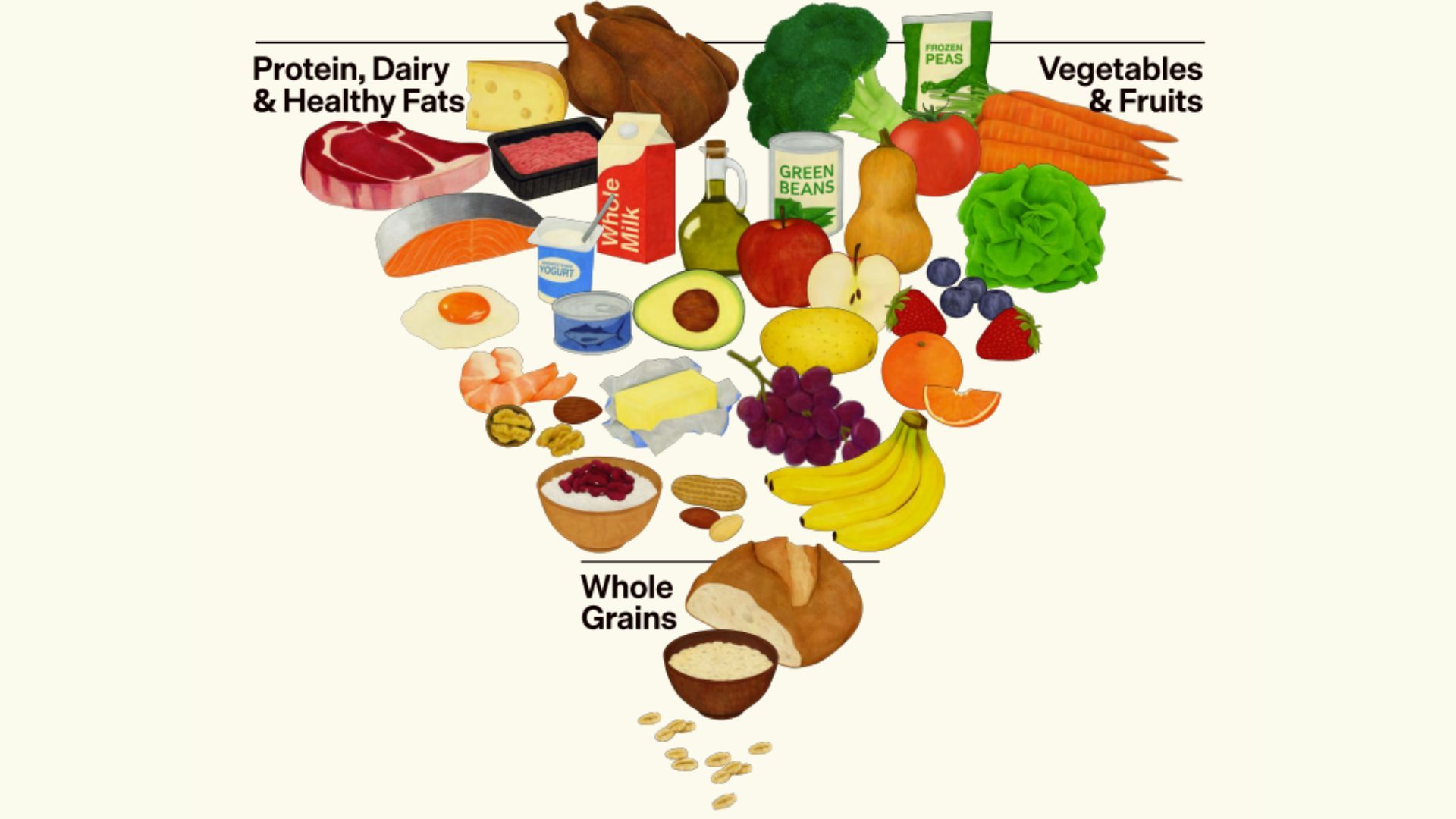
The U.S. government has officially resurrected the food pyramid — and flipped it on its head.
The new food chart emphasizes meats, dairy and what it calls “healthy fats,” as well as fruits and vegetables. It accompanies new nutrition guidance that upholds some well-established diet recommendations while breaking with others.
The brief guidelines accompanying the New Pyramid place a heavy emphasis on avoiding highly processed foods, refined carbohydrates and added sugars, noting that the unrefined sugars found in foods like fruit and milk are not considered “added.”
The guidelines also specify that healthy fats include those found in meats, poultry, eggs, omega-3–rich seafood, nuts, seeds, full-fat dairy, olives and avocados. Olive oil (mostly unsaturated fat) and butter and beef tallow (mostly saturated fat) are listed as good options for cooking oils. That said, the guidelines don’t change the long-standing guidance about limiting one’s consumption of saturated fats, stating that they should not exceed 10% of a person’s total daily calories.
The guidelines significantly increase recommended protein intake, NBC reported. Established guidelines say that 0.8 grams of protein per 2.2 pounds (1 kilogram) of body weight would meet the daily nutrition requirements of the average, sedentary adult. Higher amounts are recommended for physically active adults (about 1.1 to 1.5 grams per kg) and older adults (about 1 to 1.2 grams per kg).
The new guidelines recommend a baseline daily protein intake of 1.2 to 1.6 grams per kilogram of body weight. So for a 150-pound (68 kg) person, that’s a jump from 54.4 grams of protein a day to about 81.6 to 108.8 grams.
Health Secretary Robert F. Kennedy Jr. had delayed releasing new dietary guidelines for months after rejecting the work of a 20-person scientific advisory committee assembled under President Joe Biden, STAT reported. The committee was poised to recommend plant-forward diets, rather than meat-centric ones, and had concluded that the existing research on ultraprocessed foods was inadequate to develop clear recommendations.
(The definition of “ultraprocessed” can be difficult to pin down, and while many experts agree ultraprocessed foods are unhealthy to eat in excess, it’s hard to know if every food under the ultraprocessed umbrella carries the same health risks.)
The new guidelines, meanwhile, put a notable emphasis on meat and dairy and say to avoid highly processed foods, without clearly defining what “highly processed” means. They do say to avoid packaged, prepared and ready-to-eat meals; foods that are salty or sweet; sugar-sweetened beverages; and foods containing artificial flavors, or preservatives, or low-calorie, non-nutritive sweeteners.
Some experts worry that the guidelines’ emphasis on meat and dairy — including the notable inclusion of steak, ground beef and a carton of full-fat milk on the illustration of the inverted pyramid — may promote high intakes of red meat and dairy products. This “will not lead to optimally healthy diets or a healthy planet,” Dr. Walter Willett, a professor of epidemiology and nutrition at Harvard T.H. Chan School of Public Health, told CNN in an email.
“These guidelines recommend heavily meat-based diets — protein is a euphemism for meat,” Marion Nestle, a nutritionist and professor emeritus at New York University, told STAT via email.
MyPlate previously sorted foods into five categories — fruits, vegetables, grains, protein, and dairy and fortified soy alternatives — and provided general recommendations for how much food a person should eat from each category based on their age and sex. As a rule of thumb, fruit and vegetables made up half the plate, and proteins and grains comprised the other half, with a small amount of dairy featured on the side. Healthy oils were defined as vegetable oils and those found in seafood and nuts.
MyPlate also emphasized that additional factors beyond age and sex — such as height, weight, physical activity levels, and whether you are pregnant or breastfeeding — may affect daily nutrition needs. About 150 pages of guidelines detailed those nuances, and also set specific intake limits on added sugars, saturated fats, sodium and alcohol.
The new guidelines also acknowledge that a person’s nutrition needs may vary depending on various factors, and they provide some brief guidance for specific populations, such as infants, pregnant and lactating women, and older adults.
They don’t note a specific limit for daily alcohol intake, instead saying that people should generally “consume less” for better overall health. They also specified groups, such as pregnant women, who should avoid it altogether.
They added that those with a “family history of alcoholism [should be] be mindful of alcohol consumption and associated addictive behaviors.” (While genetics do play a role in who is vulnerable to alcohol use disorder, genes are not the only factor at play, and people without a family history can also develop the addiction.)
These national dietary guidelines influence what’s included in school lunches and military meals, as well as federal food assistance programs such as the Supplemental Nutrition Assistance Program (SNAP), NBC reported. A White House spokesperson said the new guidance will be phased into schools and federal food programs over the next two years.
This article is for informational purposes only and is not meant to offer medical or dietary advice.