

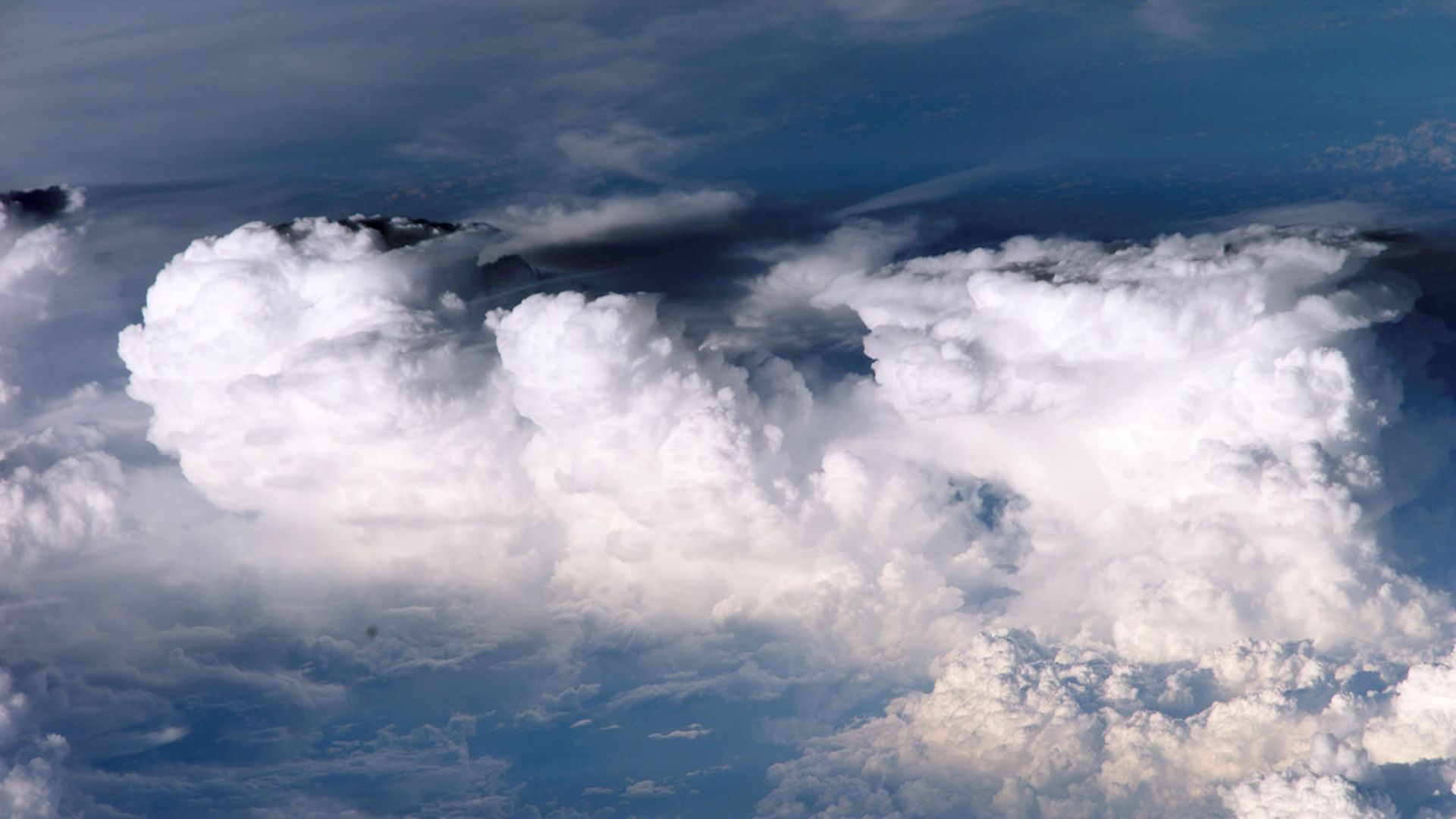
Caroline Muller looks at clouds differently than most people. Where others may see puffy marshmallows, wispy cotton candy or thunderous gray objects storming overhead, Muller sees fluids flowing through the sky. She visualizes how air rises and falls, warms and cools, and spirals and swirls to form clouds and create storms.
But the urgency with which Muller, a climate scientist at the Institute of Science and Technology Austria in Klosterneuburg, considers such atmospheric puzzles has surged in recent years. As our planet swelters with global warming, storms are becoming more intense, sometimes dumping two or even three times more rain than expected. Such was the case in Bahía Blanca, Argentina, in March 2025: Almost half the city’s yearly average rainfall fell in less than 12 hours, causing deadly floods.
Atmospheric scientists have long used computer simulations to track how the dynamics of air and moisture might produce varieties of storms. But existing models hadn’t fully explained the emergence of these fiercer storms. A roughly 200-year-old theory describes how warmer air holds more moisture than cooler air: an extra 7 percent for every degree Celsius of warming. But in models and weather observations, climate scientists have seen rainfall events far exceeding this expected increase. And those storms can lead to severe flooding when heavy rain falls on already saturated soils or follows humid heatwaves.
Clouds, and the way that they cluster, could help explain what’s going on.
A growing body of research, set in motion by Muller over a decade ago, is revealing several small-scale processes that climate models had previously overlooked. These processes influence how clouds form, congregate and persist in ways that may amplify heavy downpours and fuel larger, long-lasting storms. Clouds have an “internal life,” Muller says, “that can strengthen them or may help them stay alive longer.”
Other scientists need more convincing, because the computer simulations researchers use to study clouds reduce planet Earth to its simplest and smoothest form, retaining its essential physics but otherwise barely resembling the real world.
Now, though, a deeper understanding beckons. Higher-resolution global climate models can finally simulate clouds and the destructive storms they form on a planetary scale — giving scientists a more realistic picture. By better understanding clouds, researchers hope to improve their predictions of extreme rainfall, especially in the tropics where some of the most ferocious thunderstorms hit and where future rainfall projections are the most uncertain.
First clues to clumping clouds
All clouds form in moist, rising air. A mountain can propel air upwards; so, too, can a cold front. Clouds can also form through a process known as convection: the overturning of air in the atmosphere that starts when sunlight, warm land or balmy water heats air from below. As warm air rises, it cools, condensing the water vapor it carried upwards into raindrops. This condensation process also releases heat, which fuels churning storms.
But clouds remain one of the weakest links in climate models. That’s because the global climate models scientists use to simulate scenarios of future warming are far too coarse to capture the updrafts that give rise to clouds or to describe how they swirl in a storm — let alone to explain the microphysical processes controlling how much rain falls from them to Earth.
To try to resolve this problem, Muller and other like-minded scientists turned to simpler simulations of Earth’s climate that are able to model convection. In these artificial worlds, each the shape of a shallow box typically a few hundred kilometers across and tens of kilometers deep, the researchers tinkered with replica atmospheres to see if they could figure out how clouds behaved under different conditions.
Intriguingly, when researchers ran these models, the clouds spontaneously clumped together, even though the models had none of the features that usually push clouds together — no mountains, no wind, no Earthly spin or seasonal variations in sunlight. “Nobody knew why this was happening,” says Daniel Hernández Deckers, an atmospheric scientist at the National University of Colombia in Bogotá.
In 2012, Muller discovered a first clue: a process known as radiative cooling. The Sun’s heat that bounces off Earth’s surface radiates back into space, and where there are few clouds, more of that radiation escapes — cooling the air. The cool spots set up atmospheric flows that drive air toward cloudier regions — trapping more heat and forming more clouds. A follow-up study in 2018 showed that in these simulations, radiative cooling accelerated the formation of tropical cyclones. “That made us realize that to understand clouds, you have to look at the neighborhood as well — outside clouds,” Muller says.
Once scientists started looking not just outside clouds, but also underneath them and at their edges, they found other small-scale processes that help to explain why clouds flock together. The various processes, described by Muller and colleagues in the Annual Review of Fluid Mechanics, all bring or hold together pockets of warm, moist air so more clouds form in already-cloudy regions. These small-scale processes hadn’t been understood much before because they are often obscured by larger weather patterns.
Hernández Deckers has been studying one of the processes, called entrainment — the turbulent mixing of air at the edges of clouds. Most climate models represent clouds as a steady plume of rising air, but in reality “clouds are like a cauliflower,” he says. “You have a lot of turbulence, and you have these bubbles [of air] inside the clouds.” This mixing at the edges affects how clouds evolve and thunderstorms develop; it can weaken or strengthen storms in various ways, but, like radiative cooling, it encourages more clouds to form as a clump in regions that are already moist.
Such processes are likely to be most important in storms in Earth’s tropical regions, where there’s the most uncertainty about future rainfall. (That’s why Hernández Deckers, Muller and others tend to focus their studies there.) The tropics lack the cold fronts, jet streams and spiraling high- and low-pressure systems that dominate air flows at higher latitudes.
Supercharging heavy rains
There are other microscopic processes happening inside clouds that affect extreme rainfall, especially on shorter timescales. Moisture matters: Condensed droplets falling through moist, cloudy air don’t evaporate as much on their descent, so more water falls to the ground. Temperature matters too: When clouds form in warmer atmospheres, they produce less snow and more rain. Since raindrops fall faster than snowflakes, they evaporate less on their descent — producing, once again, more rain.
These factors also help explain why more rain can get squeezed from a cloud than the 7 percent rise per degree of warming predicted by the 200-year-old theory. “Essentially you get an extra kick … in our simulations, it was almost a doubling,” says Martin Singh, a climate scientist at Monash University in Melbourne, Australia.
Cloud clustering adds to this effect by holding warm, moist air together, so more rain droplets fall. One study by Muller and her collaborators found that clumping clouds intensify short-duration rainfall extremes by 30 to 70 percent, largely because raindrops evaporate less inside sodden clouds.
Other research, including a study led by Jiawei Bao, a postdoctoral researcher in Muller’s group, has likewise found that the microphysical processes going on inside clouds have a strong influence over fast, heavy downpours. These sudden downpours are intensifying much faster with climate change than protracted deluges, and often cause flash flooding.
The future of extreme rainfall
Scientists who study the clumping of clouds want to know how that behavior will change as the planet heats up — and what that will mean for incidences of heavy rainfall and flooding.
Some models suggest that clouds (and the convection that gives rise to them) will clump together more with global warming — and produce more rainfall extremes that often far exceed what theory predicts. But other simulations suggest that clouds will congregate less. “There seems to be still possibly a range of answers,” says Allison Wing, a climate scientist at Florida State University in Tallahassee who has compared various models.

Scientists are beginning to try to reconcile some of these inconsistencies using powerful types of computer simulations called global storm-resolving models. These can capture the fine structures of clouds, thunderstorms and cyclones while also simulating the global climate. They bring a 50-fold leap in realism beyond the global climate models scientists generally use — but demand 30,000 times more computational power.
Using one such model in a paper published in 2024, Bao, Muller and their collaborators found that clouds in the tropics congregated more as temperatures increased — leading to less frequent storms but ones that were larger, lasted longer and, over the course of a day, dumped more rain than expected from theory.
But that work relied on just one model and simulated conditions from around one future timepoint — the year 2070. Scientists need to run longer simulations using more storm-resolving models, Bao says, but very few research teams can afford to run them. They are so computationally intensive that they are typically run at large centralized hubs, and scientists occasionally host “hackathons” to crunch through and share data.
Researchers also need more real-world observations to get at some of the biggest unknowns about clouds. Although a flurry of recent studies using satellite data linked the clustering of clouds to heavier rainfall in the tropics, there are large data gaps in many tropical regions. This weakens climate projections and leaves many countries ill-prepared. In June of 2025, floods and landslides in Venezuela and Colombia swept away buildings and killed at least a dozen people, but scientists don’t know what factors worsened these storms because the data are so paltry. “Nobody really knows, still, what triggered this,” Hernández Deckers says.
New, granular data are on their way. Wing is analyzing rainfall measurements from a German research vessel that traversed the tropical Atlantic Ocean for six weeks in 2024. The ship’s radar mapped clusters of convection associated with the storms it passed through, so the work should help researchers see how clouds organize over vast tracts of the ocean.
And an even more global view is on the horizon. The European Space Agency plans to launch two satellites in 2029 that will measure, among other things, near-surface winds that ruffle Earth’s oceans and skim mountaintops. Perhaps, scientists hope, the data these satellites beam back will finally provide a better grasp of clumping clouds and the heaviest rains that fall from them.
Research and interviews for this article were partly supported through a journalism residency funded by the Institute of Science & Technology Austria (ISTA). ISTA had no input into the story.
This article originally appeared in Knowable Magazine, a nonprofit publication dedicated to making scientific knowledge accessible to all. Sign up for Knowable Magazine’s newsletter.