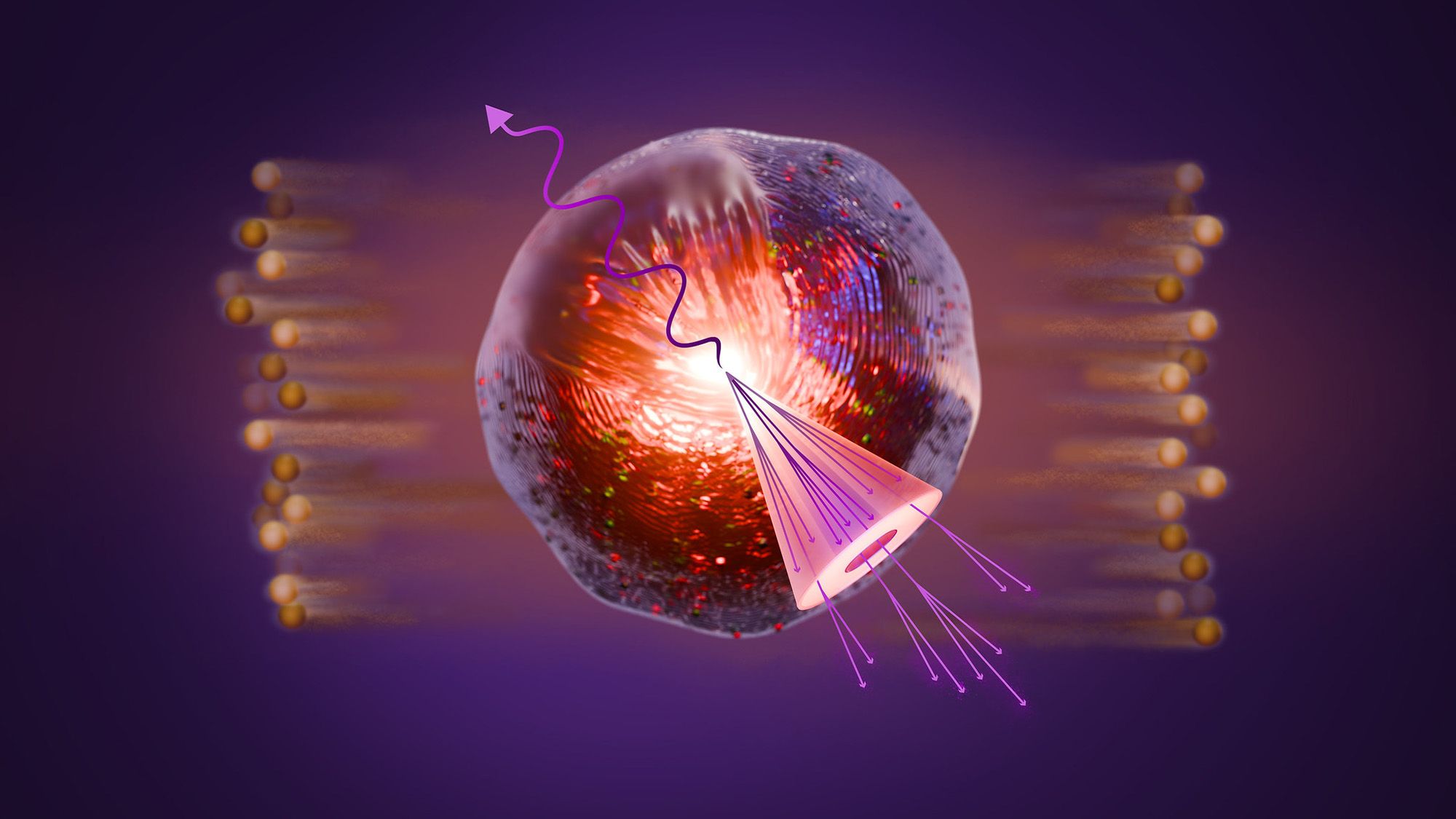




Physicists smashed gold nuclei together at nearly the speed of light and found an unexpected pattern in the particles these collisions sprayed out. If confirmed, that pattern could help reveal how the hot soup of quarks and gluons that filled the universe in the first few microseconds after the Big Bang cooled and condensed into the protons and neutrons that make up ordinary matter today.
In every collision, particles are flung out sideways; how hard they are flung, on average, varies slightly from one collision to the next. Physicists expected the size of these variations to change smoothly as they adjusted the collision energy. Instead, the variations dipped, shrinking and then growing again. This dip could be a sign of a long-sought “critical point,” a special set of conditions at which nuclear matter changes the way it transforms from one form to another.
The signal, detected by the STAR experiment at the Relativistic Heavy Ion Collider (RHIC) at Brookhaven National Laboratory in New York, is strong enough that it is very unlikely to be a statistical accident. However, the researchers cautioned that the dip is a tantalizing hint, not proof of the long-sought transition. They published their findings Sept. 22 in the journal Physical Review Letters.
Latest Videos FromLive Science
A rulebook for extreme matter
Protons and neutrons are made of smaller particles called quarks, which are held together by the “strong force” carried by particles called gluons. When heated or squeezed enough, protons and neutrons melt into a hot soup of free quarks and gluons known as a quark-gluon plasma. It’s thought that this primordial soup of particles filled the universe in the first milliseconds after the Big Bang.
Physicists want to pin down how this soup-ification happened, by measuring the so-called equation of state of nuclear matter. “For water, it tells you how pressure, temperature and density are linked, and therefore when it freezes, boils or expands,” study co-author Rutik Manikandhan, a postdoctoral physics scholar at The Ohio State University, told Live Science in an email. For nuclear matter, “it is the basic rulebook for matter under the most extreme conditions in nature, such as the cores of neutron stars,” Manikandhan added.
The “critical point” is a key landmark in that rulebook “For water, it is the point where the boundary between liquid and steam disappears,” Manikandhan said, and theorists have long suspected that nuclear matter has a similar point. At extremely high temperatures, matter melts smoothly and gradually into quark-gluon plasma, but at higher densities, the change may become abrupt.
The critical point would mark where one kind of transition turns into the other. Some recent calculations place this point within reach of RHIC’s lower-energy collisions. “But all of this is still conjectured and there is nothing concrete yet, either from the experimentalists or theorists,” Manikandhan said.
Get the world’s most fascinating discoveries delivered straight to your inbox.
The work also matters for cosmology. “Because the matter we create in these collisions resembles the matter that filled the universe a few microseconds after the Big Bang, mapping how it behaves helps us understand how the universe evolved from a hot soup of quarks and gluons into the protons and neutrons that make up everything today,” Manikandhan said.
The central part of the three-story STAR detector at the Relativistic Heavy Ion Collider (RHIC). Scientists recently used the detector to study the conditions of the early universe, just milliseconds after the Big Bang.
(Image credit: Brookhaven National Laboratory)
A dip where a smooth trend was expected
To explore this territory, the researchers ran RHIC at a range of collision energies. The lower the energy, the more tightly the colliding matter was squeezed. For its lowest-energy runs, STAR used a “fixed-target” setup, in which a beam of gold nuclei strikes “a thin gold foil placed inside the detector,” Manikandhan said, instead of a second, oncoming beam. This produces the densest matter RHIC can make.
Collision energies are measured in electron volts (the energy an electron gains when accelerated across 1 volt). That is a minuscule amount, so particle physicists usually work in billions of electron volts, or giga electron volts (GeV). One GeV is roughly the energy locked up in the mass of a single proton, according to Einstein’s famous equation E = mc2. The team analyzed roughly 1 billion collisions at energies between 3 and 7.7 GeV per pair of colliding protons or neutrons. That is the bottom of RHIC’s range, which reaches 200 GeV.
In each collision, the team measured how hard charged particles were flung sideways out of the fireball — a quantity known as transverse momentum. The researchers then looked for correlations between the particles. A correlation measures whether two things tend to change together. Here, the team checked whether pairs of particles from the same collision tended to both be flung harder than average, or both more gently. That reveals something about the fireball as a whole. If a fireball is slightly hotter, or expands more forcefully, all of its particles get an extra sideways kick together.
“Those correlations reflect how much the temperature and the flow of the fireball fluctuate,” Manikandhan said.
Close to a critical point, the matter’s heat capacity — the amount of energy needed to raise its temperature — is expected to shoot up. That makes the fireball’s temperature harder to budge, so the correlations should weaken. “If the matter approaches a critical point or a phase change, we would expect to see those correlations change in an unusual, non-smooth way as we vary the collision energy,” Manikandhan said.
That is what the team saw in the most head-on collisions. “Instead of changing smoothly with energy, the correlations show a dip,” Manikandhan said. The researchers compared the data with a smooth trend anchored by earlier STAR measurements at higher energies. The dip departs from that trend with a statistical significance of 5 sigma, the standard physicists usually demand before treating a signal as real. It means that if the true trend were smooth, random scatter in the data would produce such a pronounced dip only about once in 3.5 million tries.
“A smooth trend is what you’d expect from ordinary nuclear matter, so a dip suggests something more interesting is happening at those conditions,” Manikandhan said.
By contrast, a widely used computer simulation of the collisions, which contains no critical point, reproduced the overall trend but not the dip. Off-center collisions showed only a faint hint of the same feature, which is too weak to count as evidence on its own.
Not the final word yet
“The result is suggestive, not proof of a critical point,” Manikandhan said. Effects unrelated to a critical point can also shape these fluctuations, and how much of the dip they could explain remains unclear, the researchers noted.
Still, the dip “does point to a set of conditions where the behavior of nuclear matter changes, and it gives theorists a new, precise measurement to test their calculations against,” Manikandhan said.
Next, the team plans to use the correlations to “extract the specific heat of the hot matter,” Manikandhan said. They will then compare it with supercomputer simulations that calculate the behavior of quarks and gluons from first principles.
The researchers also plan to test the dip against more theoretical models and combine it with other measurements, such as fluctuations in the number of protons produced in the collisions. “Only when different measurements agree can we say confidently whether a critical point exists,” Manikandhan said.
Aboona, B. E., Adam, J., Adamczyk, L., Aggarwal, I., Aggarwal, M. M., Ahammed, Z., Alshammri, A. K., Aschenauer, E. C., Aslam, S., Atchison, J., et al. (2026). Nonmonotonicity of transverse momentum correlations in Au+Au collisions at RHIC. Physical Review Letters, 137(13), 132301. https://doi.org/10.1103/2xsn-rgx3