Planting trees along coastlines with human-made shore defenses, such as dikes, could protect more than 140,000 people from flooding and save up to $800 million from flood damage globally each year, a new study finds.
Places that have mangroves, such as parts of Florida, are better able to withstand the ravages of storms and their powerful waves. But although there is a push to restore mangroves around the world, there are several challenges.
But places in Florida with mangroves saw 30% less damage than areas without mangroves, saving about $13 billion. “Mangroves act as a sponge to incoming waves,” Daniel Friess, an environmental scientist at Tulane University, told Live Science. “Their dense tangle of aboveground roots are great at soaking up incoming wave energy.”
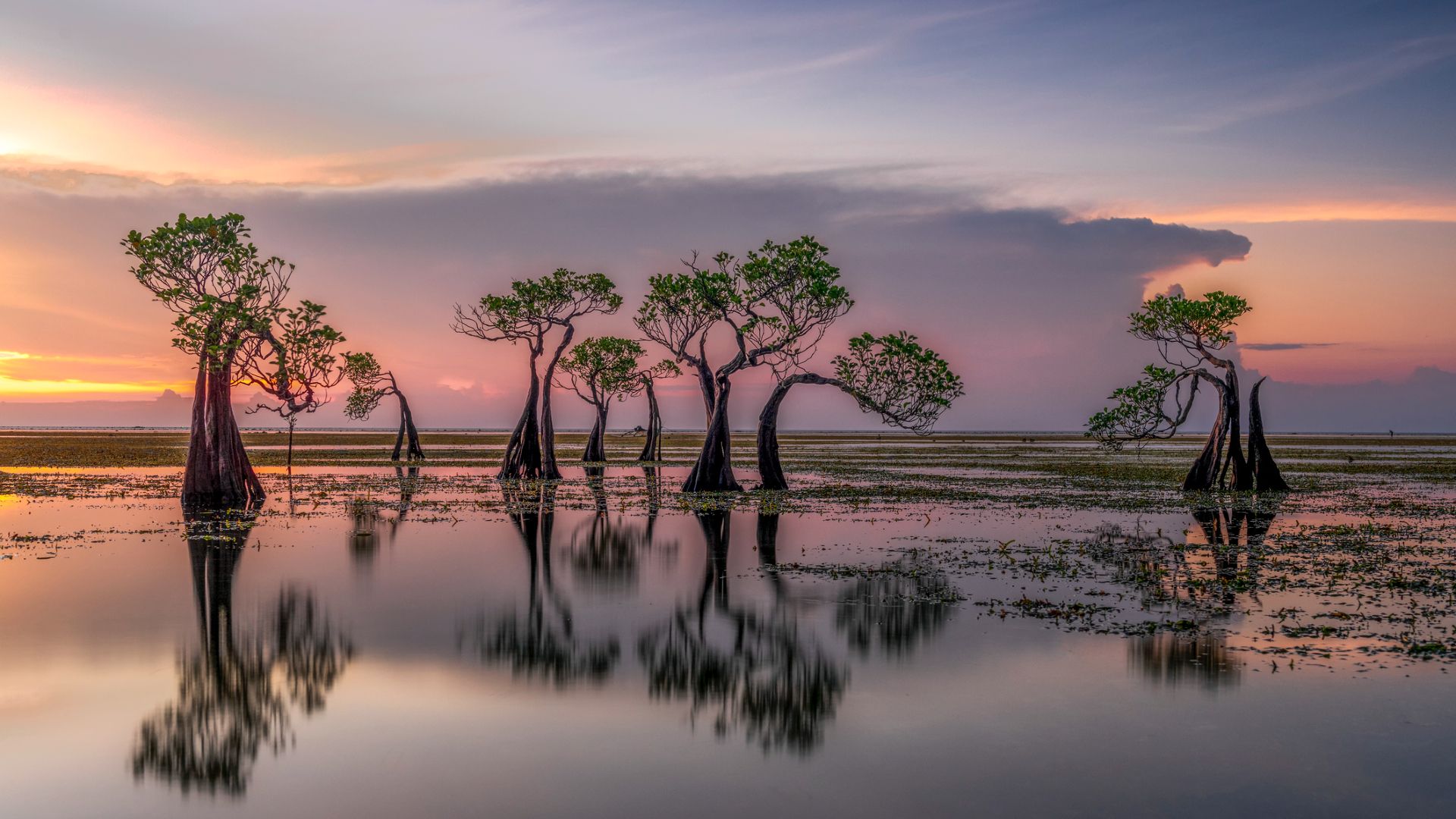
Mangroves are forests that exist in the intertidal zone between the ocean and land. Their trees can live in the salty water, and they are found in tropical and subtropical coastal zones.
Climate change is expected to make hurricanes more frequent, and rising sea levels will drive higher storm surges. Mangroves protect communities and infrastructure from these surges.
They could also help to combat climate change. A 2025 study found that restoring 1.1 million hectares (2.7 million acres) of mangroves globally would remove about 0.93 gigatons of carbon dioxide from the atmosphere. That’s almost triple the emissions from cars in the U.S. It would cost about $10.73 billion to restore those mangroves, according to the study.
Despite their importance, the world’s mangroves are in danger. More than half of Earth’s mangrove ecosystems are at risk of collapse by 2050, according to a 2024 assessment by the International Union for Conservation of Nature. They are being replaced by agriculture and aquaculture.
Balancing costs and benefits
Researchers wanted to see how mangrove restoration around the world could protect people and prevent costly damage from floods, as well as determine where these measures might have the greatest impact.
In the study, published Jan. 20 in the journal PNAS, they modeled the effects of mangroves when the forests were combined with flood defenses, such as dikes or seawalls. Dikes are human-made structures that run alongside the ocean or rivers to stop water from overflowing onto land.
“We used a published mangrove restoration tool, which looks into where the mangroves have been lost based on satellite data, the hydrological conditions of those areas now” to determine whether those mangroves could be restored, study lead author Timothy Tiggeloven, a climate adaptation specialist at Vrije Universiteit Amsterdam, told Live Science. Then, the team combined that information with flood risk, future climate scenarios, changes in GDP and population, and sea-level rise.
They found that mangrove-dike systems could save a total of $800 million globally and protect 140,000 people from flooding each year. These numbers increased under different climate scenarios linked to human carbon emissions.
Their cost-benefit analysis suggests that in a high-emissions scenario, in which Earth’s climate changes dramatically, every dollar spent on mangrove dike systems globally could ultimately generate — or save — $6. That could translate to as much as $125 billion by 2100.
The benefits were not the same everywhere, though. Countries in Southeast Asia would see the greatest benefits — about $270 million a year and 70,000 people shielded from flooding. West Africa was a close second, saving about $221 million and protecting 38,000 people. Nationally, Nigeria, India and Indonesia would benefit the most from restoring mangroves in front of human-made coastal defenses.

In the U.S., Florida would see significant benefits from restoring its mangroves, but Louisiana would get even greater returns, the study found.
Jonah Busch, an environmental economist and a former senior research fellow at the Center for Global Development who was not involved in the research, welcomed the study. “It combines the biophysical analysis of mangrove restoration with the engineering of dikes, and then economics,” he said.
However, he would have liked to see a breakdown of the financial benefits of mangroves on their own. “They’re assuming that places already have dikes and then you can add mangroves on top of that,” he said.
The authors flagged this as a limitation of the study. The analysis relies on a flood-protection database, which lists existing infrastructure, and cannot say whether the dikes are strong enough or even still standing.
Gray-green strategies
Adaptation strategies that combine nature-based solutions and engineered infrastructure are sometimes called gray-green infrastructure. This area is “a new, open and important topic,” Busch said.
Other examples include combining forest management with home hardening (which involves retrofitting or building houses with flame-retardant materials) to lower fire risk, and marrying dam maintenance with upstream watershed restoration.
“There is no doubt that a hybrid approach can be a pragmatic and effective approach” to coastal management, Thomas Westhoff, a nature-based solutions officer at the conservation nonprofit Wetlands International, told Live Science. That was especially the case along heavily urbanized, subsiding coastlines that have lost much of their mangrove cover, he added.
Westoff cautioned that there is no one-size-fits-all solution. “Whether this is a feasible solution is very context specific,” he said, adding that dikes may not exist in many areas.
However, “in many regions, healthy mangrove belts can still provide enough of a buffer for coasts and communities as the climate changes,” Westhoff said.
Challenges of restoring mangroves
There is a global push to restore mangroves, but a majority of these projects — up to 80% — fail.
“Restoring mangroves is a good idea, but these projects are difficult to implement,” Tiggeloven said. Mangroves are sometimes planted in unsuitable places, or the wrong types of trees are planted.
Successful projects require community buy-in, Westhoff said. “When communities benefit directly from restored ecosystems — whether through sustainable harvesting or ecotourism — they are more likely to protect them for the future.”
Plus, when restoring or preserving a mangrove, people may want to develop the land in other, more profitable ways, Busch noted.
“Mangroves have to compete with that from an economic perspective,” he said. The new paper “is a key part of that, because it shows the economic value of mangroves’ storm protection.”