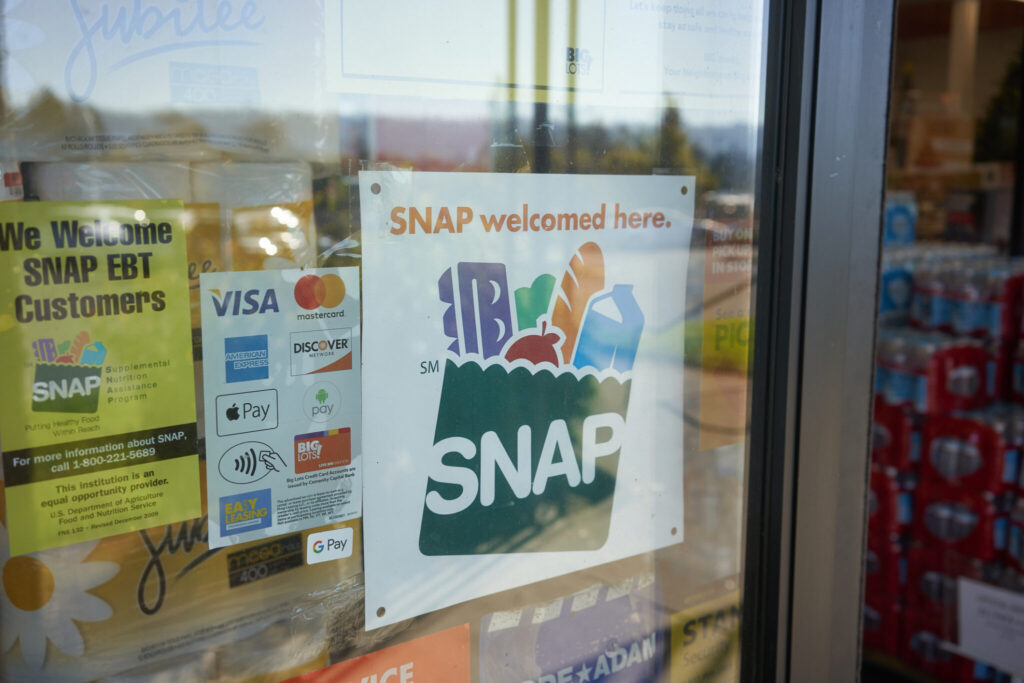
A “SNAP welcomed here” sign is seen at the entrance to a Big Lots store in Portland, Oregon. (Courtesy of Getty Images)
LINCOLN — Nebraska food pantries and anti-hunger advocates were somewhat relieved but racked with questions and concerns this week after learning that, despite the federal government shutdown, about half of November public grocery benefits are expected to flow to the state’s SNAP recipients.
One sticking point: For some states, November benefits could take months to arrive. Tuesday, as many tried to grasp the new developments, President Donald Trump added further confusion on social media, backtracking on the pledge by his administration to partially fund the Supplemental Nutrition Assistance Program (SNAP) in November.
Meanwhile, a group of progressive Nebraska state lawmakers is still pursuing a special emergency legislative session to “protect Nebraska families” from any suspension of SNAP and to give the state financial flexibility to meet “urgent” needs.
“We have to be prepared to step in,” said State Sen. Machaela Cavanaugh of Omaha, who led the call by 15 state senators, 14 Democrats and one progressive nonpartisan, to convene an off-season session Nov. 12.
State Sen. Machaela Cavanaugh of Omaha works at her desk on the floor of the Legislature in 2023. (Zach Wendling/Nebraska Examiner)
The group delivered a letter late Friday to Nebraska Secretary of State Bob Evnen to begin the process. Buy-in is required from 33 of 49 lawmakers to consider the emergency session that would explore legislation to preserve programs such as SNAP and Nebraska’s Head Start.
Cavanaugh called the proposed session a proactive step and option that could be canceled if the federal shutdown ends. In Nebraska, about 150,000 low-income and eligible participants, including children, participate in SNAP, formerly known as food stamps. The public grocery benefits amount to about $30 million each month, she said.
Shutdown, day 35
Federally funded SNAP has been in a state of uncertainty as the government shutdown drags on since Oct. 1, when Congress failed to appropriate money for federal programs or pass a stopgap spending bill.
Leading into November, the Trump administration had warned it could not pay SNAP benefits for this month, saying it was legally prohibited from using a contingency fund it said was for emergencies and natural disasters.
Two federal judges on Oct 31 ruled otherwise. One judge in a written order Saturday, Nov. 1, said there is “no question” that the contingency fund (which currently contains about $4.65 billion) must be used to provide the public food benefits. Monthly SNAP benefits for about 42 million Americans, nearly 40% of them children, reportedly cost more than $8 billion a month.
U.S. District Chief Judge John J. McConnell Jr. of Rhode Island offered the Trump administration a choice: pay for a full month of benefits by tapping other reserve sources such as the child nutrition program by the end of Monday, or pay for partial benefits by the end of Wednesday through the contingency fund.
The U.S. Department of Agriculture opted to use the contingency fund. A USDA official pointed out that calculating half-month amounts would involve delay, and said in some states the changes and delivery will take anywhere from a few weeks to up to several months. The department believed it was complying with the judge’s order by starting the process of resuming payments Monday, according to a States Newsroom report reviewing a status report signed by Justice Department officials. The department did not address what might happen beyond November.
‘Not the solution’
News that part of November’s benefits will come to Nebraskans “is a little help — but not the solution,” said Stephanie Sullivan, a spokesperson for the Food Bank for the Heartland, which has about 500 network partners in 93 counties of Nebraska and Iowa.

Volunteers and staff at the Together food pantry in downtown Omaha help people in need pack up their free grocery items during 2024 holiday season. (Cindy Gonzalez/Nebraska Examiner)
She said the organization was seeking clarification on what partial payment means, and on when Nebraskans should expect to see the grocery benefits loaded onto debit-like cards used by the state’s SNAP recipients to buy food at retailers.
“All those answers are still up in the air,” she said, urging an end to the shutdown.
Nebraska Appleseed, a statewide advocacy organization that has been monitoring SNAP and other program changes, also is awaiting details from the state on how recent developments will impact Nebraskans, said Eric Savaiano, Appleseed’s food and nutrition access manager.
Sullivan said there was no way that food bank partners could make up for the loss of SNAP benefits. For every meal the food bank provides, she said, SNAP provides nine.
“Food banks are meant to supplement,” said Sullivan.
Asked when Nebraskans could expect November benefits, a spokesman for the Nebraska Department of Health and Human Services told the Nebraska Examiner the state was awaiting guidance from USDA.

A sign in front of the Nebraska Department of Health and Human Services’ Lincoln Public Assistance Office. (Juan Salinas II/Nebraska Examiner)
“Once received, the department will work as quickly as possible to distribute funds to Nebraska families,” Jeff Powell said late Monday in a statement for both DHHS and the Governor’s Office.
The state DHHS web site on Tuesday still displayed an earlier quote by Pillen, which has spawned a lawsuit, blaming Democrats in the U.S Senate for a government shutdown and for SNAP benefits being “unavailable in November.”
Community responds
Despite the uncertainty, advocates who are stepping in to help fill gaps said they have been inspired by the response from Nebraskans.
It’s been an overwhelming response … We believe this is a humanitarian issue not a political issue.
– Omaha Mayor John Ewing Jr., of community response to fill SNAP gap
“It’s been an overwhelming response,” said Omaha Mayor John Ewing Jr., whose office launched and organized a citywide food drive. “We are going to continue to go forward until the people of this country are able to get their full SNAP benefits. We believe this is a humanitarian issue not a political issue.”

Omaha Mayor John Ewing Jr. (Courtesy of City of Omaha)
Omaha’s effort to collect nonperishables began last Wednesday and by Friday morning, several community centers acting as drop off points had run short of room. Staffers from the Mayor’s Office transported 5,500 pounds of nonperishable items that day from four centers to the food bank, which will distribute the goods. Monday yielded another nearly 12,000 pounds from five other centers, said Ewing.
The City of Omaha plans to allocate $45,000 more in keno revenue to the food bank. The Douglas County Board today approved allocation of $200,000 among eight eight nonprofit and community partners to strengthen food assistance efforts.
The City of Lincoln has reminded residents of free lunches for youths at its F Street Community Center and of expanded food service starting Wednesday at an Aging Partners program at Victory Park. Mayor Leirion Gaylor Baird was scheduled to speak Tuesday afternoon at the Food Bank of Lincoln to discuss other support of those affected by the SNAP pause.
CHI Health made a $100,000 donation for Nebraska food banks. United Way of the Midlands and Omaha Community Foundation have launched fundraisers too.
Sullivan said retailers, manufacturers and businesses have started various outreach efforts to increase donations and volunteers. Some restaurants are offering free meals. She said all donated food has to be sorted for distribution, and that she has been both amazed and inspired at the outpouring of help over the last week.
Diminished SNAP benefits come at a time when demand already was up for pantry food, she said, and that is exacerbated by federal workers without a paycheck. On top of that, the coming holiday season is the busiest for food bank partners, and concern mounts as the shutdown continues.
“It’s heartbreaking, it’s maddening as we approach the holiday season,” Sullivan said, to think that families might not be able to assemble a holiday meal.
Seeking special legislative session
State Sen. Machaela Cavanaugh of Omaha said she is speaking also to Republican lawmakers to urge support for a special legislative session, and believes some agree.
She sees the emergency session as an option to allow Nebraska legislators to adjust funding streams that can protect certain federally-funded programs if the federal government shutdown continues.
So far endorsing the call: State Sens. Ashlei Spivey, Terrell McKinney, Margo Juarez, John Cavanaugh, John Fredrickson, Dunixi Guereca, Wendy DeBoer, of Omaha; George Dungan, Danielle Conrad, Jane Raybould, Jason Prokop, of Lincoln; Victor Rountree of Bellevue, Dan Quick of Grand Island and Megan Hunt, a nonpartisan of Omaha.