QUICK FACTS
Where is it? Boykin, Alabama [32.10219570, -87.28911406]
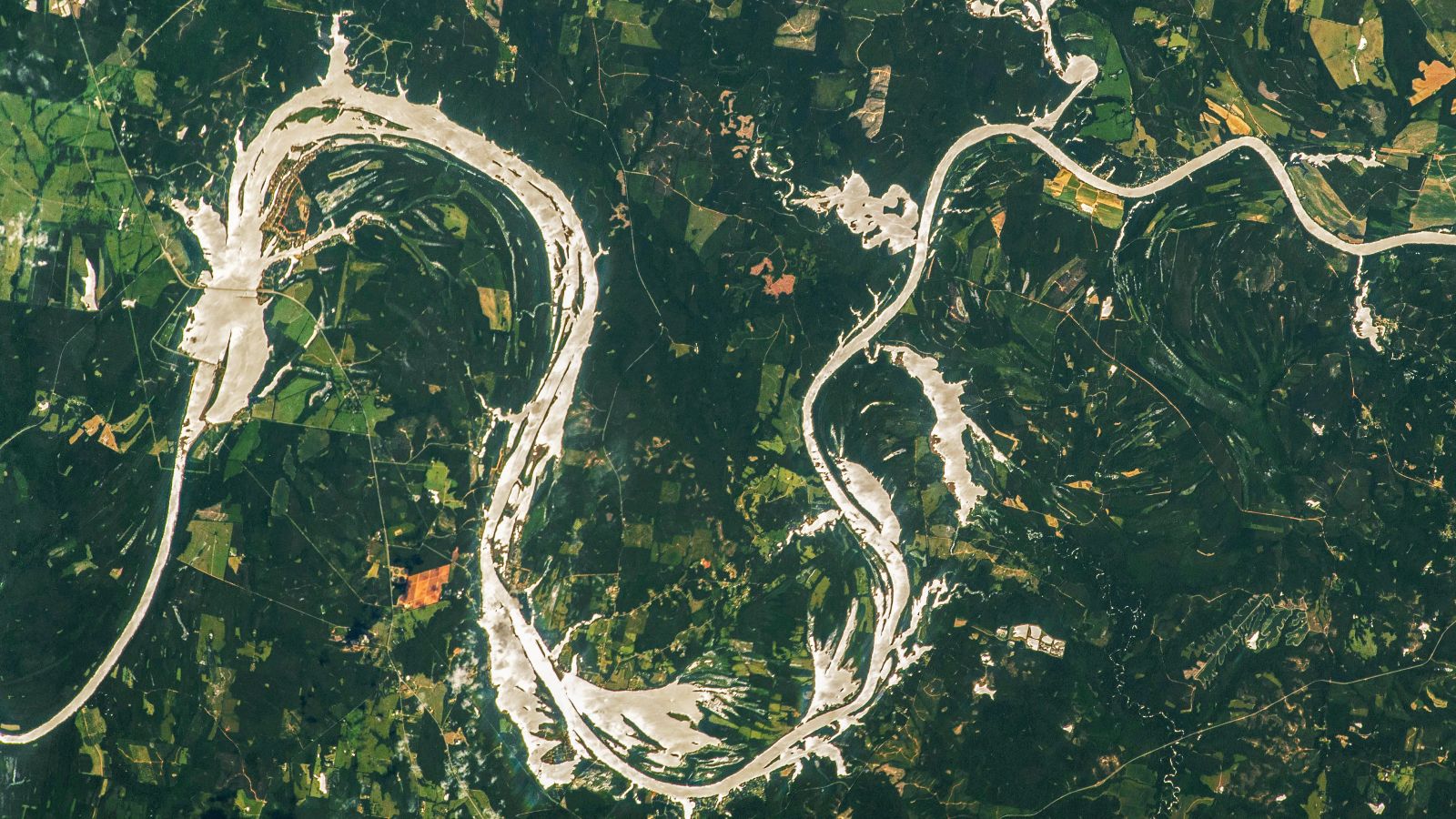
What’s in the photo? A “sunglint” making the Alabama River look like a golden Chinese dragon
Who took the photo? An unnamed astronaut on board the International Space Station (ISS)
When was it taken? June 26, 2023
This incredible astronaut photo captured a unique glimpse of Alabama’s eponymous river cosplaying as a golden Chinese dragon. The metallic hue of the serpentine waterway is the result of a rare optical phenomenon that is only visible from space.
The section of the river in the photo features a large U-shaped bend, known as Gee’s Bend, that surrounds the small town of Boykin, which is renowned for its “vibrant folk art” that is displayed across the country, according to NASA’s Earth Observatory.
The river’s unusual glow is the result of a rare phenomenon, known as a sunglint, which occurs when sunlight perfectly reflects off a still body of water toward an observer in space, like a massive liquid mirror. This is similar to how the surface of an ocean or lake sparkles when light bounces off it during a sunset — except the only people who can see it are astronauts.
The golden color of the sunglint helps provide greater contrast between water and land, highlighting a series of flooded zones. When combined with the river’s larger bends, this makes the waterway look surprisingly like a dragon from Chinese mythology, netizens pointed out at the time.
The head of the dragon (located on the left of the image) is represented by the flooded zones of the artificial William “Bill” Dannelly Reservoir, which was created in the 1960s by partially damming the river. This 27-square-mile (70 square kilometers) reservoir generates hydroelectric power via a dam and has also become a popular fishing spot for people looking to catch crappie, bass and catfish.
The river’s water levels rose higher than initially expected following the dam’s construction, causing the waterway to permanently spill over into surrounding floodplains, such as at Chilatchee Creek (towards the bend in the dragon’s tail) and around Gee’s Bend, according to Earth Observatory.
Most bodies of water usually take on a silvery, mirror-like appearance when illuminated by sunglints, making the Alabama River’s golden glow particularly noteworthy.
The unusual golden color is likely the result of atmospheric scattering of the reflected light by aerosols, dust and haze. This scatters blue wavelengths of light, giving the remaining light a more yellow hue.
Astronauts are always on the lookout for sunglints, especially over the ocean, because they can reveal hidden natural phenomena, such as gyres and internal waves, as well as human activities, such as ship wakes and oil slicks, according to the National Environmental Satellite, Data, and Information Service.
For more incredible satellite photos and astronaut images, check out our Earth from space archives.