




This week’s science news was all about the good, the bad and the ugly of technological progress, with a study warning of next-generation AI ‘swarms’ that could soon invade social media.
Signs of bots on social media are already evident, with over half of the written text online being churned out by large language models as of 2025. What scientists warn about with this next generation of bots is different — trained to impersonate real humans and flock en masse as if they belonged to an organic movement, they will adaptively target human users, spread false narratives and influence opinion.
Mysterious ‘Cloud People’ tomb is Mexico’s ‘most significant archaeological discovery’ in a decade
The discovery of a 1,400-year-old Zapotec tomb in Oaxaca, southern Mexico, was hailed this week by Mexico’s president, Claudia Sheinbaum Pardo, as the country’s most important archaeological find in a decade.
Built by the Zapotec culture, who believed that their ancestors descended from the clouds and their spirits returned to the heavens after death, the ancient tomb is adorned with complex carvings that include a sculpture of an owl with a man’s head in its beak — owls being symbols of death and the afterlife in Zapotec culture.
Authorities first learned of the tomb’s presence in response to an anonymous report of looting at the site. And while some information about this centuries-old civilization has been lost to robbers, the tomb now joins a dozen other Zapotec tombs discovered in Oaxaca in the past decade.
Discover more archaeology news
—160,000-year-old sophisticated stone tools discovered in China may not have been made by Homo sapiens
—430,000-year-old wooden handheld tools from Greece are the oldest on record — and they predate modern humans
—5,000-year-old rock art from ancient Egypt depicts ‘terrifying’ conquest of the Sinai Peninsula
Life’s Little Mysteries
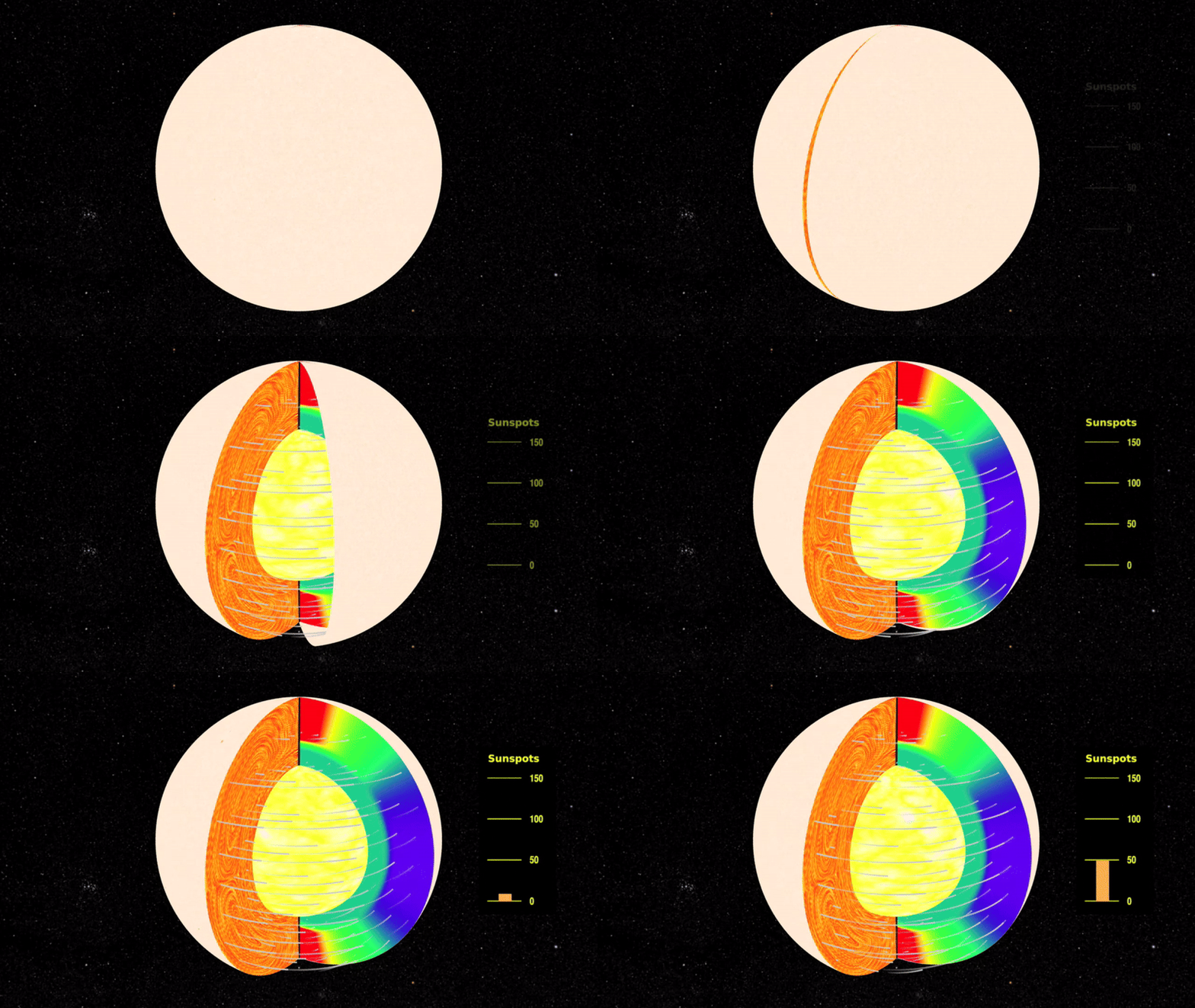
The fact of the Earth’s axial rotation is as sure as day following night, but what about the sun’s? It turns out that yes, our star rotates, although measurements of its spin are complicated by several factors, including its different layers and its rotation in the same direction as our planet’s orbit.
—If you enjoyed this, sign up for our Life’s Little Mysteries newsletter
Pancreatic cancer breakthrough in mice

In a major breakthrough study announced this week, scientists at the Spanish National Cancer Research Center in Madrid announced a triple combination therapy that proved remarkably effective at eliminating pancreatic cancer in mice.
The announcement is a big deal for many reasons: Pancreatic cancer is one of the deadliest common forms of the disease, its aggressive and stealthily-growing tumors quickly becoming resistant to chemotherapy.
To investigate a more effective form of treatment, the researchers behind the new study inhibited a mutated gene responsible for 90% of diagnosed pancreatic cancers in humans using three drugs, two of which already have regulatory approval in the U.S. The results were long-lasting tumor regression without significant side effects in all of the mice in the study, opening a path forward for the therapy’s development for humans.
Discover more health news
—South Carolina’s measles outbreak nears 790 cases — making it the biggest in decades
—IVF hormones could be delivered with painless ‘microneedle’ patch someday, early study hints
—The UK has lost its measles elimination status — again
Also in science news this week
—Shark attacks in Hawaii spike in October, and scientists think they know why
—50-year-old NASA jet crashes in flames on Texas runway — taking it out of the Artemis II mission
—‘Doomsday Clock’ ticks 4 seconds closer to midnight as unregulated AI and ‘mirror life’ threaten humanity
—More than 43,000 years ago, Neanderthals spent centuries collecting animal skulls in a cave; but archaeologists aren’t sure why
—‘Previously unimaginable’: James Webb telescope breaks own record again, discovering farthest known galaxy in the universe
Science long read

Thousands of dams in the United States may be at risk of failure, and they could have major public health and economic impacts.
That’s according to new satellite images revealing dozens of faults emerging from shifting ground beneath the structures — including the biggest dam in Texas. But how does climate change play into this phenomenon? What are the potential consequences? And can anything be done to stop it? Live Science investigated in this news analysis.
Something for the weekend
If you’re looking for something a little longer to read over the weekend, here are some of the best opinion pieces, crosswords and skywatching guides published this week.
—Giving AI the ability to monitor its own thought process could help it think like humans [Opinion]
—Live Science crossword puzzle #27: The explosion that created the universe — 5 down [Crossword]
—The Snow Moon will ‘swallow’ one of the brightest stars in the sky this weekend: Where and when to look [Skywatching]
Science in motion

It may not look like much, but this blurry smudge could be a harbinger of an impending revolution in cosmology.
Picked up by the James Webb Space Telescope (JWST), the light seen here comes from the ancient galaxy MoM-z14 just 280 million years after the Big Bang, making it the most distant galaxy confirmed to date.
And the detection isn’t just exciting because it’s broken the JWST’s own record, but because MoM-z14 appears to be far brighter and more developed than its extremely young age should permit it to be. That means that studying it, and others like it, promises to spark a fundamental rewrite of how the universe evolved.
Follow Live Science on social media
Want more science news? Follow our Live Science WhatsApp Channel for the latest discoveries as they happen. It’s the best way to get our expert reporting on the go, but if you don’t use WhatsApp we’re also on Facebook, X (formerly Twitter), Flipboard, Instagram, TikTok, Bluesky and LinkedIn.