


Cephalopod evolution has long had a missing chapter in its story: how did squid-like ancestors give rise to today’s octopuses? The answer, it turns out, was floating in the deep sea all along.
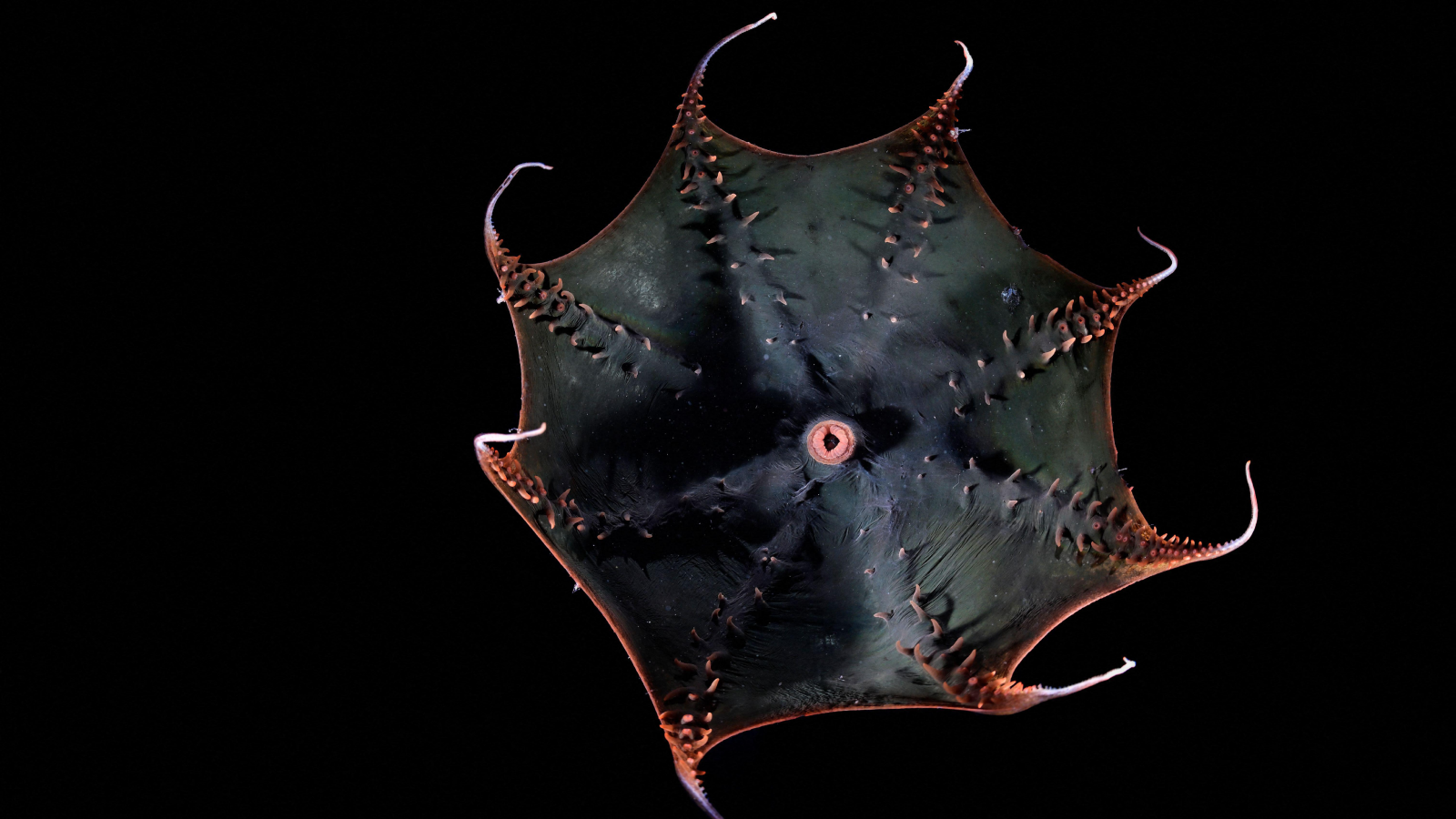
With its glowing ghostly eyes, eight arms like its octopus cousins and a dark ruby coloring to match, the elusive vampire squid (Vampyroteuthis infernalis) has finally revealed its genetic secrets.
In a study published Nov. 27 in the journal iScience, researchers sequenced the genome of Vampyrotheuthis and discovered its chromosomes still resemble those of squids and cuttlefish — despite belonging to the octopus order. This discovery hints at what the common ancestor of modern squids and octopuses may have looked like at the genetic level 300 million years ago when octopus and squid evolutionarily diverged. The researchers described the vampire squid as a “living fossil.”
On the cephalopod evolutionary tree, the vampire squid belongs to the group that includes octopuses, but underwent a “very ancient split” from the rest of the clade, study lead author Oleg Simakov, a researcher at the Department of Neuroscience and Developmental Biology in the University of Vienna, Austria, told Live Science in an email.
After acquiring a tissue sample from a vampire squid collected as bycatch in the West Pacific Ocean from a research cruise, the researchers used a genetic analysis platform called PacBio to sequence the DNA of the sample. Unfortunately, there were no other vampire squid samples to compare it to, due to their rarity. Using PacBio, the researchers compared the vampire squid’s genome to that of other cephalopods like the Argonaut (Argonauta hians), the common octopus (Octopus vulgaris) and the curled octopus (Eledone cirrhosa).
The findings revealed the vampire squid has an 11 billion-base-pair-long genome, almost four times the size of the human genome — and the largest cephalopod genome sequenced to date.
While modern octopuses have DNA that consistently gets reshuffled, resulting in some chromosomal mixing, the researchers found that the vampire squid’s genome kept much of its ancestral, squid-like chromosomal arrangement. Essentially, it’s an octopod that genetically looks like an ancient squid.
The vampire squid has had a long history of being misunderstood. When it was initially discovered in 1903, it was thought to be a cirrate octopus due to its unique webbing between its arms. In the 1950s however, scientists reclassified it as its own group, belonging to neither octopus nor squid but in the order Vampyromorphida, so named because it looks like it’s wearing a vampire-like cloak.
The finding is welcome news for cephalopod scientists as it is “nice to have resolved” why vampire squids retain much of their ancestral, squid-like traits, said Bruce Robison, senior scientist at the Monterey Bay Aquarium Research Institute (MBARI) who was not involved in the research.
Part of what makes the fully sequenced genome so valuable is how hard it is to study vampire squids, mainly “because they live in a habitat that is difficult to access, they are solitary, rare, and do not survive well in captivity,” Robison said. “Some people think that we can just dive into deep water, and find one whenever we like, which is definitely not the case.”
He added that the findings “reinforce the notion held by some of us that vamps would be the key to the puzzle. They are interesting to study because they are such cool animals, and because they just look like they are hiding secrets.”