

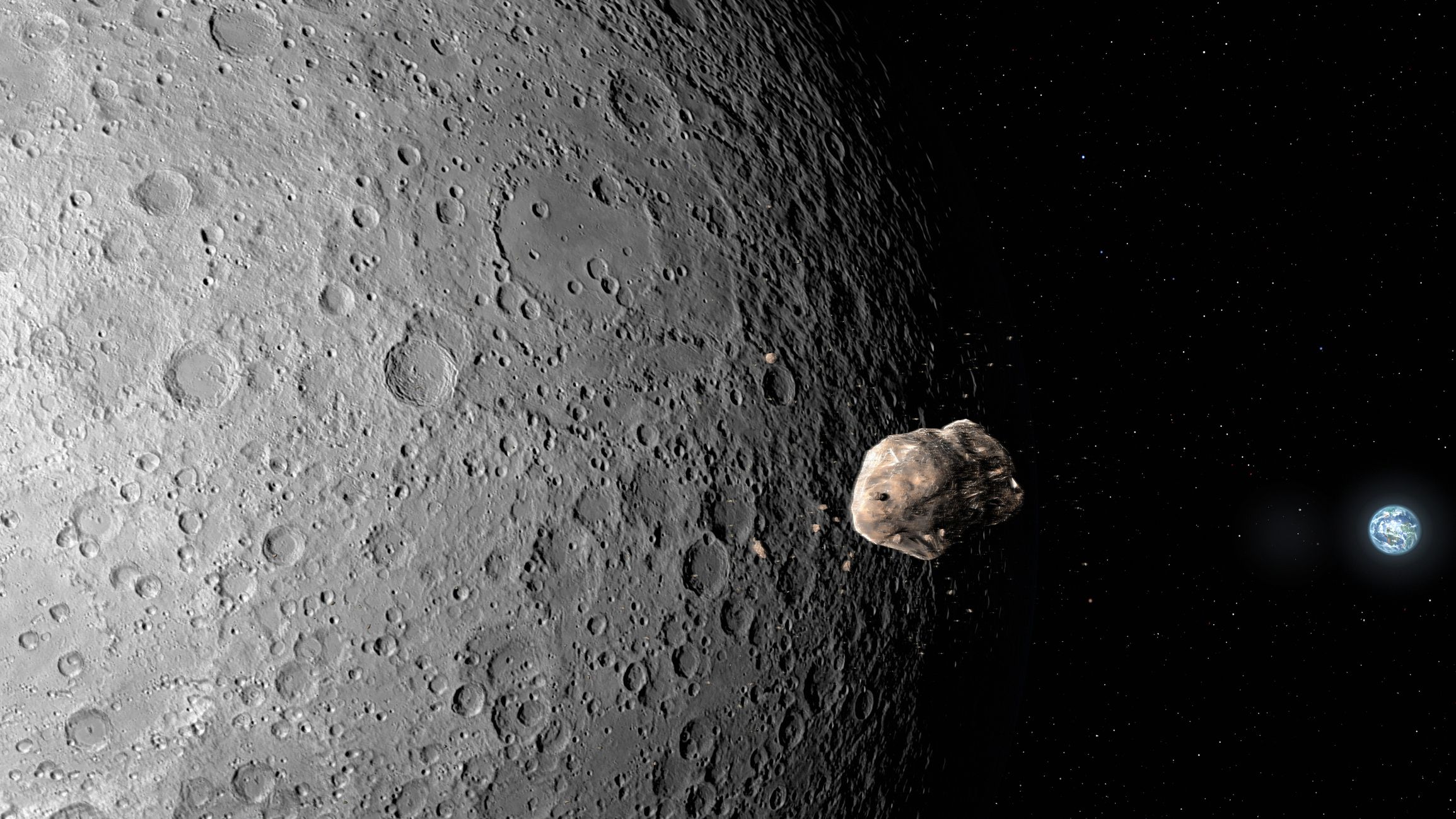
The building-size asteroid 2024 YR4 has a small chance of striking the moon in 2032 — and a new study predicts it could also put on a spectacular show for skywatchers by creating thousands of impact flashes as well as extreme meteor storms.
The space rock — which is about 200 feet (60 meters) wide, or about as big as a 15-story building — was discovered on Dec. 27, 2024. It briefly gained notoriety in February 2025, when astronomers calculated that it had the highest-ever probability of colliding with Earth of asteroids that size or larger. Although this likelihood reached as high as 3.1%, more detailed estimates of the asteroid’s trajectory negated any chances that the rock would collide with Earth during its near pass on Dec. 22, 2032.
The possibility of this impact intrigued Yifei Jiao, a postdoctoral researcher at the University of California, Santa Cruz. He and his colleagues realized that this was “a rare ‘natural experiment’: a forecastable small-body impact whose signatures could be scientifically rich and operationally relevant,” he told Live Science by email. As a result, the researchers wanted to assess all plausible outcomes, he said.
10,000 collisions
To do this, the scientists created computer models of the solar system that included the asteroid, all of the planets, Earth’s moon and the sun — and simulated 2024 YR4’s path as it whizzed through the inner solar system.
By tweaking the space rock’s trajectory, the team created 10,000 such simulations, with which they charted the likeliest collision areas on the moon. Drawing on a different set of finer-scale simulations, the researchers also simulated the actual impact process over a 500-second time interval. The team modeled the range of possible scenarios for the impact debris, tracking the paths of the objects that escaped the moon’s gravity.
The results of their simulations, which are available on the arXiv preprint server and haven’t been peer-reviewed yet, suggest that the asteroid will likely impact the moon somewhere along a roughly 1,900-mile-long (3,000 kilometers) stretch. The predicted impact corridor lies just north of the moon’s Tycho crater. That would be along the moon’s lower half if you were observing from Earth’s Northern Hemisphere (and the opposite from the Southern Hemisphere), according to The Planetary Society.
A blast bright as Venus
More spectacularly, the impact would produce a starlike flash between magnitudes -2.5 and -3 — about as bright as Venus in the night sky. The flash would last between 200 and 300 seconds (three to five minutes), although it would definitely be visible for at least 10 seconds “when the flash is bright enough above background conditions to be reliably noticed,” first author Yifan He, a researcher at Tsinghua University in China, told Live Science in an email.
If the collision were to occur, the predicted impact time would be 10:19 a.m. EST (15:19 UTC) — so the flash would be visible in parts of the world where the moon had risen. This would make East Asia, Oceania, Hawaii and western North America great places for viewing it.
But there’s a catch: On the predicted day of impact, 70% of the moon will be illuminated. The impact flash would be visible to naked-eye observers only if the asteroid were to strike in the moon’s unlit region. He and Yixuan Wu, a researcher at Tsinghua University and the study’s second author, estimate that the chance of that happening — if asteroid 2024 YR4 collides with the moon — is merely 2.85%.
Still, regardless of the impact location, the flash would be detectable by amateur telescopes. Other spectacles would be likely — an impact would lift many lunar rocks that would then rain back onto the moon’s surface, causing potentially several thousand flashes. However, the flashes from these secondary impacts would not be as bright as the main one, and will probably be more difficult to see without any instruments.
Additionally, the study predicts that the impact would fling up to 220 million pounds (100 million kilograms) of lunar rocks toward Earth. These would create what Wu calls “super meteor storms”, extreme meteor showers that would be prominent between two and 100 days after the impact. 2024 YR4’s lunar impact is still fairly uncertain, but Wu is excited about the future. “If this scenario plays out, it will be a milestone for planetary science, turning the Earth-Moon system into a grand stage for validating our understanding of asteroid impacts,” she told Live Science in an email.

Brandon Specktor
While Earth is safe from 2024 YR4, studying the asteroid offers some of the best planetary defense practice we’ve had. When the asteroid was first discovered and deemed a potential risk, telescopes around the world turned to watch it, with even the James Webb Space Telescope dipping into its limited discretionary time to observe it.
These quick and thorough observations narrowed down the size and trajectory of the asteroid, and confirmed it would not hit Earth. We may not always be so lucky — but the more practice we have at tracking near-Earth asteroids, the more prepared we will be if a true threat from space emerges.
He, Y., Wu, Y., Jiao, Y., Dai, W., Liu, X., Cheng, B., & Baoyin, H. (2026). Observation timelines for the potential lunar impact of asteroid 2024 YR4. arXiv (Cornell University). https://doi.org/10.48550/arxiv.2601.10666