Starship has made it to orbit for the first time ever. But the loss of an engine during its nail-biting ascent meant SpaceX’s mission ended earlier than planned — with an explosion to boot.
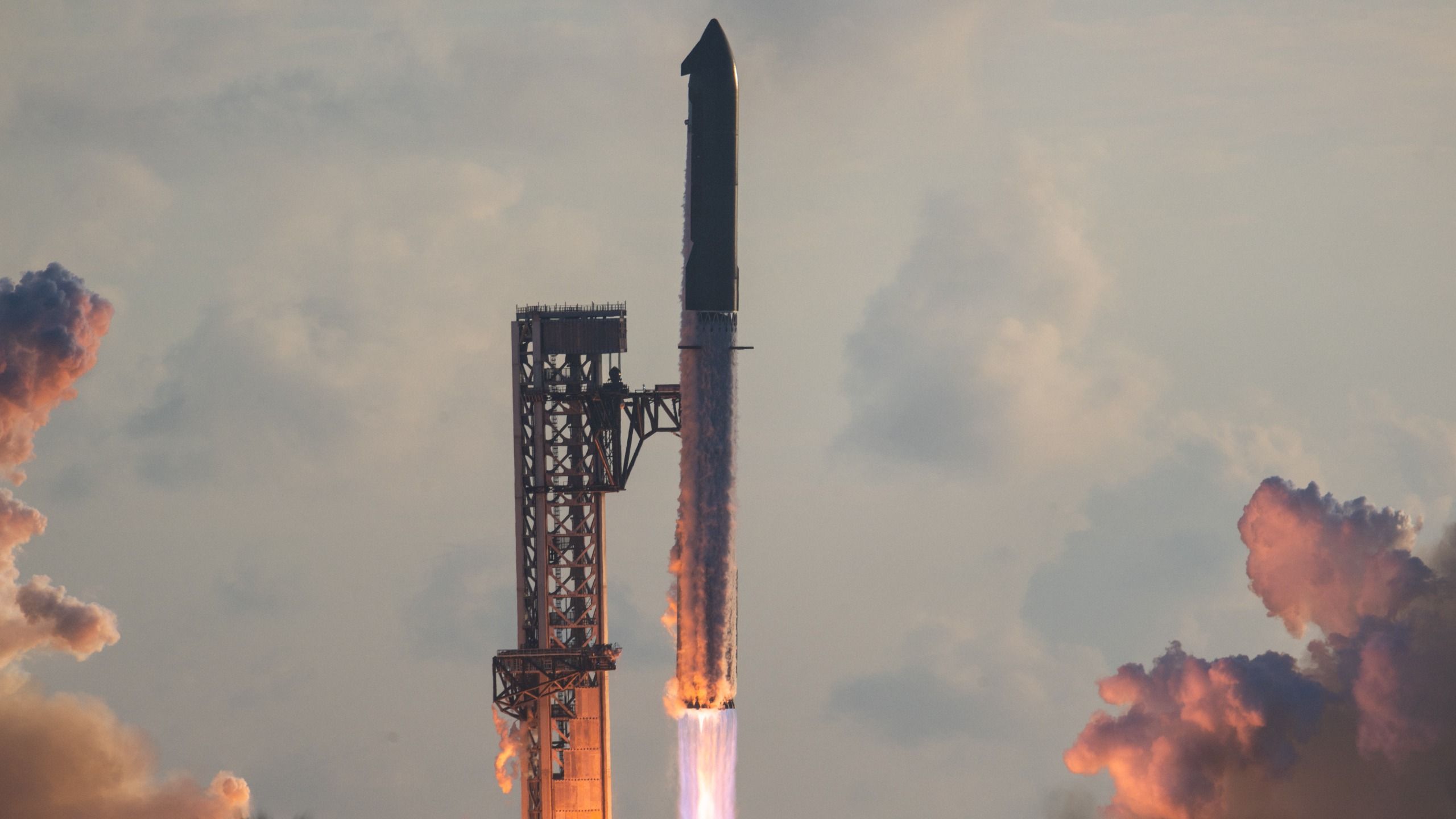
The tallest and most powerful rocket ever built blasted off from SpaceX’s Starbase in Boca Chica, Texas on Monday (Sept. 28) at 8.49 a.m. ET (7.49 a.m. local time).
Soon after launch, one of Starship’s 33 engines failed. A tense few minutes followed while the mission team deliberated over whether the mission should continue to orbit. Eventually, the call came through: “Go for orbit.”
A short fire of Starship’s boosters nudged the rocket into orbit, where it zoomed around Earth at a highest point of 170 miles (275 kilometers) above the planet’s surface.
However, after successfully deploying 26 Starlink V3 satellites, SpaceX decided not to leave Starship up in space for the remainder of the mission, which was originally expected to last 10 hours.
The rocket splashed down in the Pacific Ocean after 3 hours and 8 minutes, and then promptly exploded with a fiery bang. An explosive landing was always expected for Starship, and there were audible cheers during that part of the SpaceX livestream of the mission, but SpaceX would have probably preferred to have kept its rocket intact — like it did on Flight 13.
SpaceX called this mission, Starship’s Flight 14, the company’s “most ambitious launch to date” during its livestream. Prior to this launch, Starship had only flown suborbitally, and this was SpaceX’s first attempt to send its flagship rocket into orbit. The company said reaching orbit represents the “next phase” for Starship toward becoming a fully reusable rocket.
Get the world’s most fascinating discoveries delivered straight to your inbox.
Starship flight 14
The day started with promise for SpaceX: Engineers weren’t tracking any holds in the lead-up to launch; tanking and launch progressed smoothly; and Starship served up some spectacular images of Earth as it raced into space.
Shortly after launch, Starship’s booster separated and safely splashed down in the Gulf of Mexico. Then the problems started. Starship had lost one of its engines. Initially, commentary on SpaceX’s livestream suggested that officials planned to abandon the push for orbit, but after several tense minutes, they confirmed the attempt was a go.
The latest mission had a few objectives. In addition to making it to orbit, SpaceX deployed Starlink V3 satellites, designed to boost the speeds and reliability of the internet services provided by its satellite megaconstellation.
The mission also tested the Starship’s booster, which had experienced some hardware and software modifications after Flight 13.
SpaceX has experienced multiple setbacks with Starship. The seventh and eighth Starship test flights exploded and rained fiery debris from the sky. The ninth flight fell short of its target, and a Starship exploded on the launchpad during a routine test leading up to the 10th mission. However, Starship did end up having a successful 10th flight in August 2025, despite taking some damage, and its 11th run, in October, was clean.
The last two flights, in March and July 2026, saw successful launches and controlled landings but experienced booster problems.
Starship exploded after splashing down in the Pacific.
(Image credit: SpaceX)
To the moon?
The stakes are high for the rocket: Starship’s success could be essential for NASA’s plans to return humans to the moon in early 2028. The U.S. space agency needs a commercial lunar lander to ferry astronauts to the lunar surface during the upcoming Artemis IV mission. (Artemis III, a practice attempt above Earth, is slated for 2027.)
NASA wants to take astronauts to the moon in its Orion spacecraft, as tested in the Artemis II mission. Once in lunar orbit, the crew is then supposed to rendezvous with a commercial lander, which will take the astronauts to the surface and launch them back up to Orion for the trip home.
SpaceX has been developing a moon-landing variant of its Starship for that job. With rival Blue Origin (whose New Glenn rocket dramatically exploded in May) lagging behind, the Artemis program’s success could be tied to Starship’s.
During Artemis III next summer, NASA will test docking Orion with one or both of its commercial lander options in low Earth orbit. The space agency has made clear that lander readiness will determine which commercial provider gets to take astronauts to the lunar surface as soon as 2028.
There are some doubts about whether NASA will be ready by then. But today’s Starship issues also leave key questions about whether SpaceX can meet the tight deadline.