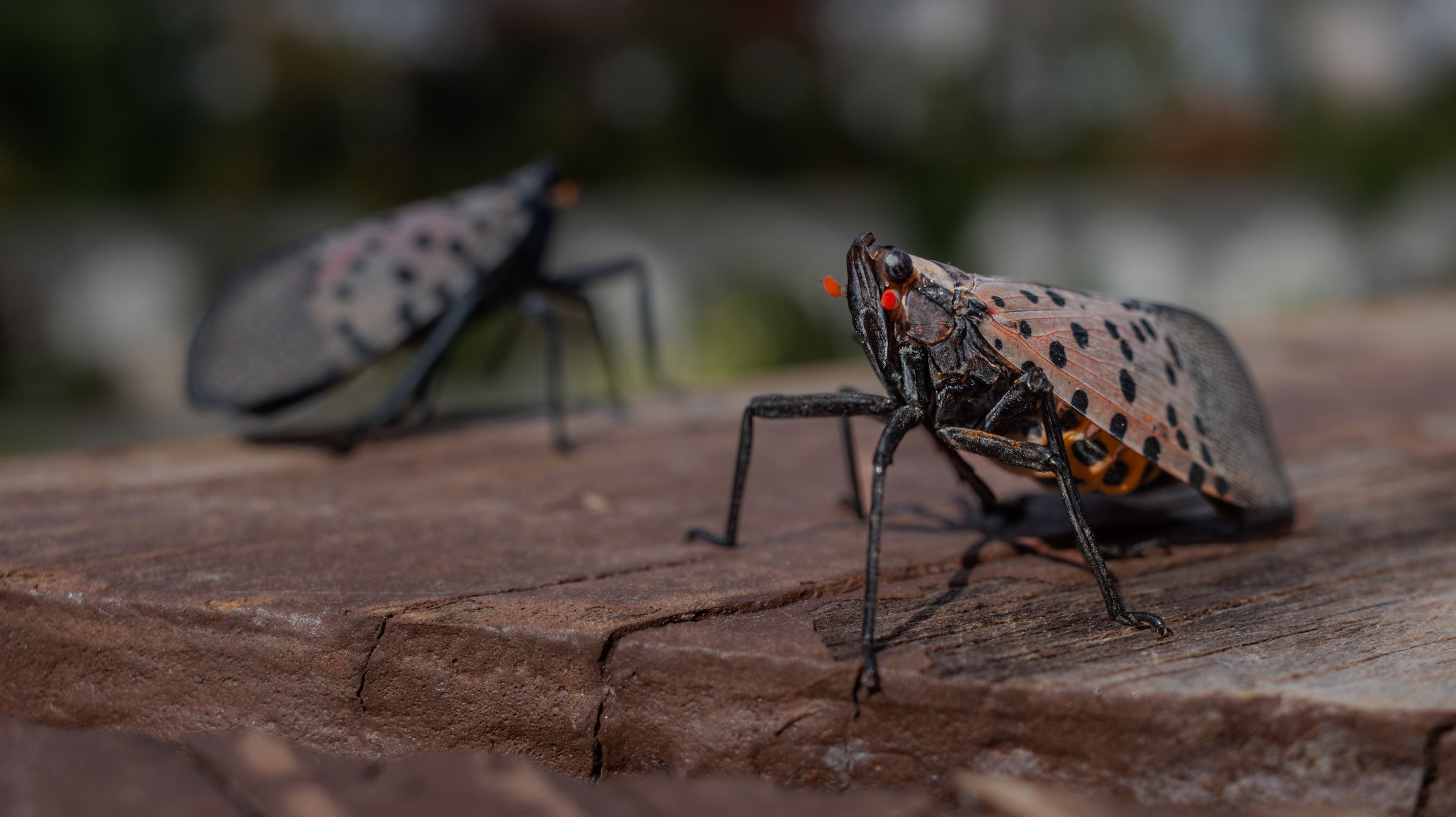
The spotted lanternfly has spread across the United States with unrelenting speed — and now we have a clue as to why: living in cities seems to have helped these invasive insects evolve to be more resistant to stresses.
“Cities may act as evolutionary incubators that help an invasive species to better deal with pressures like heat and pesticides, which then helps them to better adapt to new environments,” lead author Fallon (Fang) Meng, a biologist at New York University, told Live Science.
Its preferred host plant is the tree of heaven (Ailanthus altissima), which is also an invasive species — but it is able to sup on a wide range of plants, including economically valuable ones like grapevines, hops, maples, fruit trees and hardwood trees.
Spotted lanternflies can weaken plants, and as they feed, they also excrete a sticky, sugary fluid that promotes the growth of sooty mold. What’s more, when bees decide to forage on this sugary waste rather than visiting flowers it gives the honey they produce a smoky aroma and a lingering aftertaste, although this honey is still safe to eat.
All this adds up to a potentially huge financial impact. For example, a 2019 study estimated that in Pennsylvania alone, if uncontrolled, the insect’s effects could cost $324 million annually.
Lanternfly genetics
To get a better handle on how the lanternflies have adapted so well to life in the United States, researchers sequenced the genomes of lanternflies from urban and rural areas in Shanghai, China, and from New York City, Connecticut and New Jersey. The study was published Wednesday (Feb. 4) in the journal Proceedings of the Royal Society B: Biological Sciences.
In the lanternfly populations in China, they found clear genetic differences between those in the urban and rural areas. “Even though they’re just 30 kilometers [19 miles] away, they have very strong population differentiation,” Meng said.
This is probably because although lanternflies can fly, they need to feed continuously, so they stick close to the host trees on which they depend. This means it is easy for populations to stay separate, Meng added.
This separation means the urban lanternflies in Shanghai evolved genetic tolerance to stresses that the rural ones didn’t, adapting them to the hotter conditions of cities, and boosting their ability to detoxify and metabolize toxins and pesticides.
In the U.S., however, the lanternflies were genetically similar across all locations, even though some were sourced from locations 124 miles (200 kilometers) apart. The same genes that evolved for city living were further adapted in U.S. populations, according to the study.
Using demographic modeling on the genomic data to reconstruct the recent history of the lanternflies, researchers revealed three genetic bottlenecks, when populations were established from a limited pool of insects. One was more than 170 years ago, when Shanghai underwent rapid urbanization. The second aligned with when lanternflies moved from China to South Korea in 2004, and the third was in 2014 when the insects arrived in Pennsylvania — probably hitchhiking on goods shipped from overseas.
Adapting to China’s cities may have primed the lanternfly to tolerate other hot, polluted environments, Meng said. “We should study invasive species and urbanization as interconnected parts of a whole. Those two major aspects are too often studied in isolation, but their effects actually can compound in synergistic and surprising ways.”
The ability to handle a wider range of toxins might be helping spotted lanternflies spread in the U.S., said Zach Ladin, an ecologist at the University of Delaware, who wasn’t involved in the study.
The relatively high densities of tree of heaven give spotted lanternflies a foothold in many cities, he told Live Science, “but some of those genes that they found that are related to overcoming toxic chemical exposure could really help them switch hosts and take advantage of other plants.”
Ladin added that the new genetic information could help people slow or contain the spread of spotted lanternflies. “From a chemical control perspective, now we have some genes to target which could be important in making sure we’re not just driving resistance to certain chemicals,” he said.