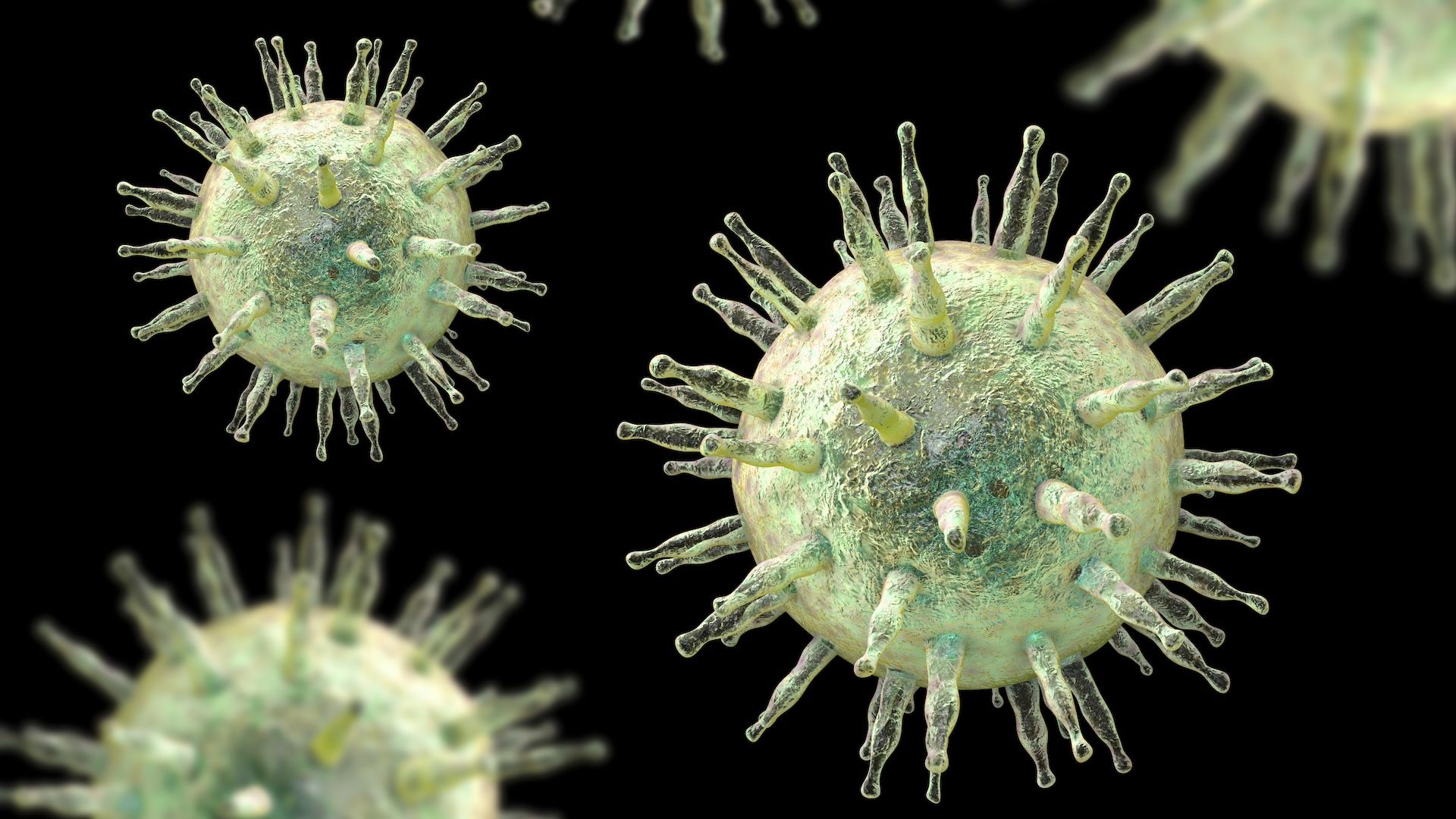
Around 90% of people are infected with Epstein-Barr virus at some point in their lifetimes. For most of them, the virus causes a mild, transient illness or no symptoms at all. But for a subset of people, Epstein-Barr can eventually contribute to chronic illnesses, such as lupus and multiple sclerosis, or to the development of cancer.
Now, new research uncovers 22 human genes that might make an Epstein-Barr infection more likely to turn into a chronic condition.
Nearly two dozen genes
Epstein-Barr virus can cause mononucleosis, better known as mono, a temporary illness notable for producing extreme fatigue. But even once the symptoms of mono disappear, the virus lies latent in the body, mostly in the immune system’s B cells, which remember and defend against specific germs.
For most people, this latent Epstein-Barr virus causes no problems. But in other people, the virus persists at a higher, more active level. In these cases, it can raise the risk of certain nasopharyngeal cancers and lymphomas, and may fuel autoimmune disorders such as multiple sclerosis. Chronic, active Epstein-Barr has also been linked to heart and lung disease.
To understand why only some people seem to experience these chronic effects, Ryan Dhindsa at the Baylor College of Medicine and colleagues turned to an underexplored source of information: human DNA biobanks. These biobanks collect full gene sequencing data and health records for hundreds of thousands of individuals. In sequencing the human genome, they also happen to scoop up the DNA of any viruses that happen to be in residence inside cells.
“Typically, when we’re analyzing human genome sequence data we ignore the reads that don’t map back to a human reference genome. We just kind of throw them away,” Dhindsa told Live Science. “Here, we decided maybe we could go through those reads that we normally throw away and see if we could recover viral DNA.”
By combing through tossed-aside Epstein-Barr sequences from 750,000 people in the UK Biobank and the U.S. National Institutes of Health’s All of Us biobank, the researchers were able to identify individuals — about 11% of the total — who had very high levels of Epstein-Barr DNA. They found that these high levels of viral DNA were associated with health conditions previously linked to Epstein-Barr, including diseases of the spleen and Hodgkin lymphoma.
The presence of viral DNA was also associated with conditions thought to be linked to Epstein-Barr, although less definitively: rheumatoid arthritis, chronic obstructive pulmonary disease (COPD), and lupus. Other associations in the data reinforce even less well-studied connections, including links between Epstein Barr and heart disease, kidney failure, stroke and depressive episodes.
In addition, the researchers found 22 genes tied to a higher likelihood that someone would be in the 11% of people with chronic Epstein-Barr. Many of these genes were in a region of the genome called the human leukocyte antigen (HLA) locus, which is known to code for the immune cells that present antigens — immune-response-triggering foreign molecules — to other immune cells.
“It seems like these variants changed the way an individual’s immune response actually presents Epstein-Barr virus to the immune system,” Dhindsa said, possibly making it harder for the body to suppress viral replication. That said, the data has only shown a link between these genes and persistent infection — more research is needed to prove cause-and-effect.
In people with high levels of Epstein-Barr, the researchers also saw variations in genes that regulate the immune system. One, the SLAMF7 gene, typically encodes for a cell-surface protein that helps the immune system’s natural killer cells attack tumors. Another, called CTLA4, encodes for a receptor on T cells that helps keep the immune system from attacking the body.
“They found some really interesting results,” Hollenbach said.
She and her team are now interested in looking deeper at the mechanisms that link the genetic variation to the immune response to Epstein-Barr. Meanwhile, Dhindsa and his colleagues are interested in using biobank data to search for other viruses that have long-term impacts on human health. Some examples are the cancer-causing viruses Merkel cell polyomavirus and human T-cell lymphotropic virus type 1.
The researchers are also eager to expand their methods to more diverse global datasets of human genes. While the All of Us dataset includes participants from a variety of backgrounds, the U.K. Biobank is predominantly made up of people of European ancestry.
“We need to be able to look at genetic differences across more representative samples in future work,” he said.
Nyeo, S. S., Cumming, E. M., Burren, O. S., Pagadala, M. S., Gutierrez, J. C., Ali, T. A., Kida, L. C., Chen, Y., Chu, H., Hu, F., Zou, X. Z., Hollis, B., Fabre, M. A., MacArthur, S., Wang, Q., Ludwig, L. S., Dey, K. K., Petrovski, S., Dhindsa, R. S., & Lareau, C. A. (2026). Population-scale sequencing resolves determinants of persistent EBV DNA. Nature. https://doi.org/10.1038/s41586-025-10020-2