


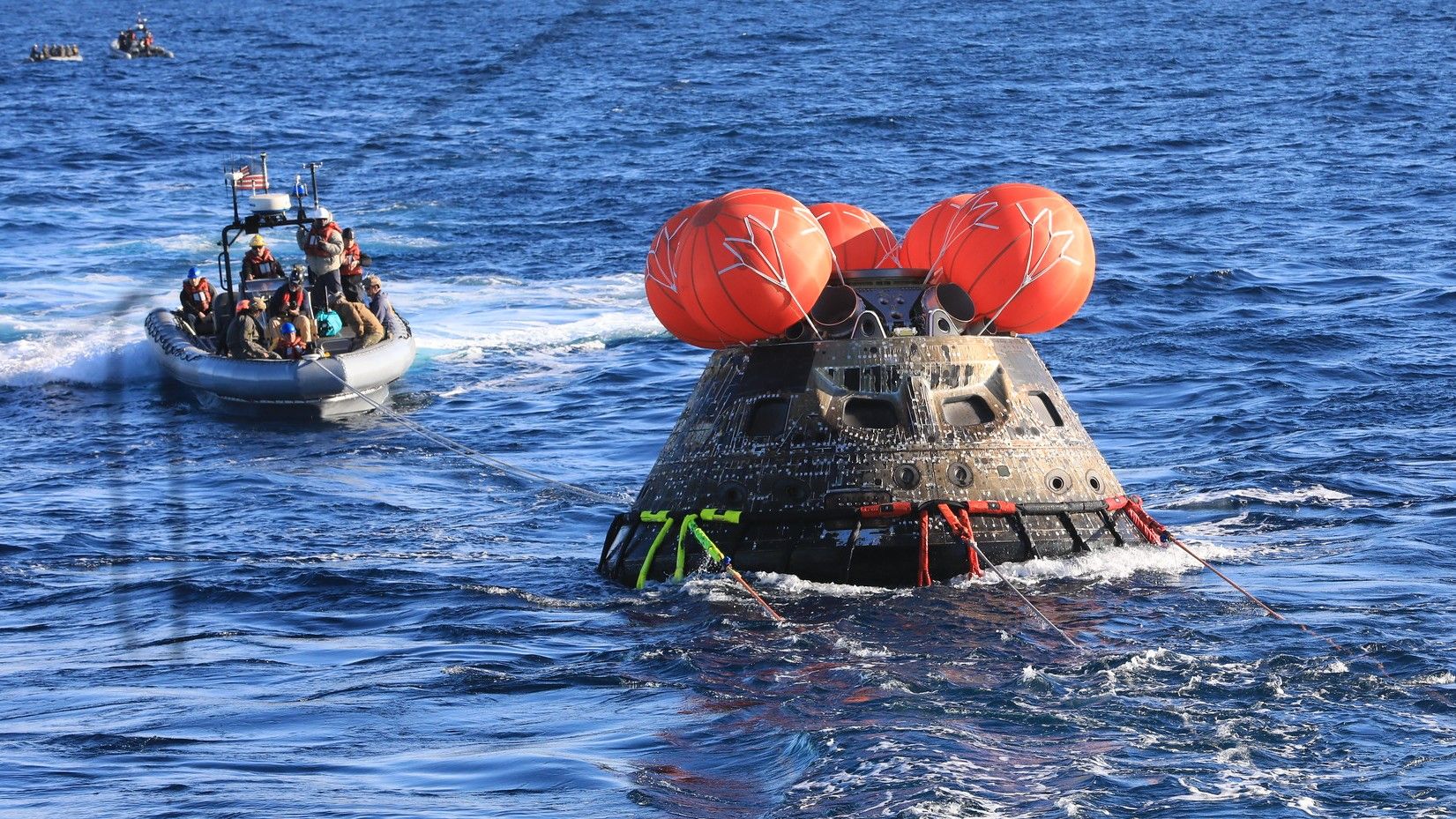
The Artemis II Orion spacecraft is expected to splash down later today (April 10) as the world waits to welcome back the mission’s record-setting crew. So far, the Artemis II moon mission has been a tremendous success, but this final leg of the journey has some experts concerned.
There’s an issue with the Artemis II heat shield, which is meant to protect the astronauts from the blistering heat of reentry. NASA is confident that a tweak to the reentry path is enough to mitigate the heat shield problems observed during the Artemis I test flight, and to keep the astronauts safe today.
Patrick Pester: What is Orion’s heat shield and why is it important?
Ed Macaulay: The heat shield is an absolutely essential part of the Orion spacecraft. When the Orion spacecraft comes back and reenters Earth, it’s going to be travelling at a speed of about 25,000 mph (40,000 km/h) — it’s just an unbelievably fast speed. For context, at that speed, it would cover the distance of the London Marathon [or the New York City Marathon] in about four seconds.
Because of that speed, the capsule is going to approach temperatures on reentry of about half that of the surface of the sun [5,000 degrees Fahrenheit or 2,800 degrees Celsius]. The heat shield is essential to protect the capsule from this scorching heat of reentry. Without it, the capsule would just completely melt and burn up.
PP: Can you explain why some experts are concerned about the heat shield?
EM: There have been some concerns raised about the heat shield because Artemis II is a crewed version of the uncrewed Artemis I mission that flew a few years ago. This was designed to be exactly the same mission profile, but without any humans on board. When the Artemis I capsule returned to Earth, it did make it safely through the atmosphere, but the damage and effects to the heat shield were more severe than had been anticipated from the modelling.
The heat shield is designed to burn away due to the heat; it’s not designed to stay completely intact and completely pristine. You can almost think of it as a bit like the crumple zone of a car, but for heat. In a car, the crumple zone is designed to get compressed on impact so that the passengers are going to be safe. The heat shield is designed to burn away and fragment away, and carry away that heat.
What was surprising with the Artemis I heat shield is that parts of the heat shield had burnt away in large chunks. It wasn’t ablating [gradually eroding] away evenly. This seems to be caused by hot gases that are trapped in the heat shield. As they heat up, they expand, they break away chunks of the heat shield and cause that damage.
For Artemis II, NASA has decided to keep the heat shield the same as with Artemis I. Instead, what they’ve decided to do is to change the reentry profile to put less stress on the heat shield. So, hopefully we’re going to get even ablation through the heat shield and not have it burning away in these big chunks.
PP: Am I right in saying NASA is going to take a more direct approach rather than go for a skip reentry, which may have caused the problems the first time around?
EM: In a nutshell, that’s exactly what they’re doing. The skip reentry profile was designed in principle to make the reentry easier on the capsule and on the crew. Because you’re coming into the atmosphere at 25,000 mph and in the space of a few minutes, all of that speed has to get cooked off, has to get turned into heat.
The idea with the skip reentry profile is that before going directly back into the atmosphere, the capsule just grazes off the surface of the atmosphere, burns off a bit of that speed, and then comes back out, and then later comes back in for the full reentry. In principle, that’s going to put less stress on the capsule in terms of the temperature, in terms of g-loading [gravitational force].
What seems to happen in practice, though, is that because that whole process takes a longer amount of time, there’s more time for these trapped gases in the heat shield to heat up and expand and cause damage. That’s why, for Artemis II, the capsule is just going to go for a direct reentry profile; the same reentry profile used in the Apollo missions.
Hopefully, there’s going to be less time for gases to cause damage. The other advantage with the direct reentry is that it’s more straightforward to model. The team at NASA and all the related engineers have spent a huge amount of time doing computer simulations of these reentry profiles, trying to work out how much the heat shield is going to heat up, and what the damage is going to be.
With a skip reentry, the whole process is more complicated. You’re trying to model how something’s going to bounce and then come back in. With direct reentry, it’s more straightforward. I almost think of it as a bit like, it’s better the devil you know.
PP: So, maybe slightly more uncomfortable for the crew, but better for the heat shield?
EM: Yeah, I think that might be the trade-off. And the crew of Artemis II are all such complete pros when it comes to experiencing g-forces. So, if you’re talking about g-forces of 4 Gs or something like that, they’re not even going to bat an eyelid. They train for far higher g-loadings. Pulling a few Gs for a few minutes, that’s not going to be any drama at all for the crew of Artemis II.

PP: Would you be comfortable betting your life on that heat shield?
EM: The short answer, if you’re asking me, I wouldn’t. I think there are reasons to be confident about it because even with the Artemis I heat shield burning off in big chunks, the crew still would have been safe had there been humans in there. I think what that shows is that there is an element of safety margin in this heat shield. Even if things are slightly, as they say at NASA, “off nominal” — not entirely normal — there’s a kind of reasonable safety margin in what the heat shield is able to take. That’s not quite the same as asking me personally, would I be next in line to go on Artemis II?
The crew of Artemis II are clearly a very extraordinary bunch of astronauts. They all clearly have the right stuff. And what they are doing on this mission is really extraordinary. They’re going so much further than humanity has been in more than half a century.
I am sure that they will all have studied all of these details because nobody is more invested in this heat shield than they are. And I’m sure that they will all be confident in the work that all of the scientists and engineers involved with the heat shield have done.
With the Artemis II mission so far, it has been an extraordinary success from a technical point of view. I think that does give reasons to be confident about the reentry because it looks like there’s every reason to expect that the trajectory is going to be absolutely nominal, absolutely what it is designed for. And hopefully, that’s going to give them the best possible ride through reentry.
PP: But you wouldn’t personally want to assume the risk, or you wouldn’t want to be an astronaut in general?
EM: Personally, I’m a nervous flyer. And I think it’s easy to forget just how much risk is involved with human spaceflight and how much greater the risk is than anything we would normally experience day-to-day. Only a few hundred people have ever gone into space. We haven’t even had 1,000 people go into space. And, very sadly, even with just a few hundred human space missions, there have been some fatal missions.
PP: Is there anything else you’d like to add as we wrap up?
EM: My personal take is that this mission has just been an extraordinary success so far, for all kinds of reasons. From a technical point of view, the mission has been an incredible success; the Space Launch System [rocket], the boosters, going into that initial orbit, the translunar injection — the performance of the system has been incredible.
But more than that, these four astronauts have just been absolutely amazing. Not just performing their technical duties, but providing that human connection, that human perspective, and taking the rest of planet Earth along for the voyage.
Part of why I am so excited is that it’s not like this is all going to end when Artemis II comes back for reentry. This is just the start of a whole new chapter: NASA’s recently announced very ambitious plans for this continued human presence on the moon and exciting, concrete plans for the next Artemis missions. So, it really is just the start of a whole new chapter.
Editor’s note: This interview has been edited and condensed for clarity.