Roman silver coins ever found in that country from the reign of the Emperor Hadrian.
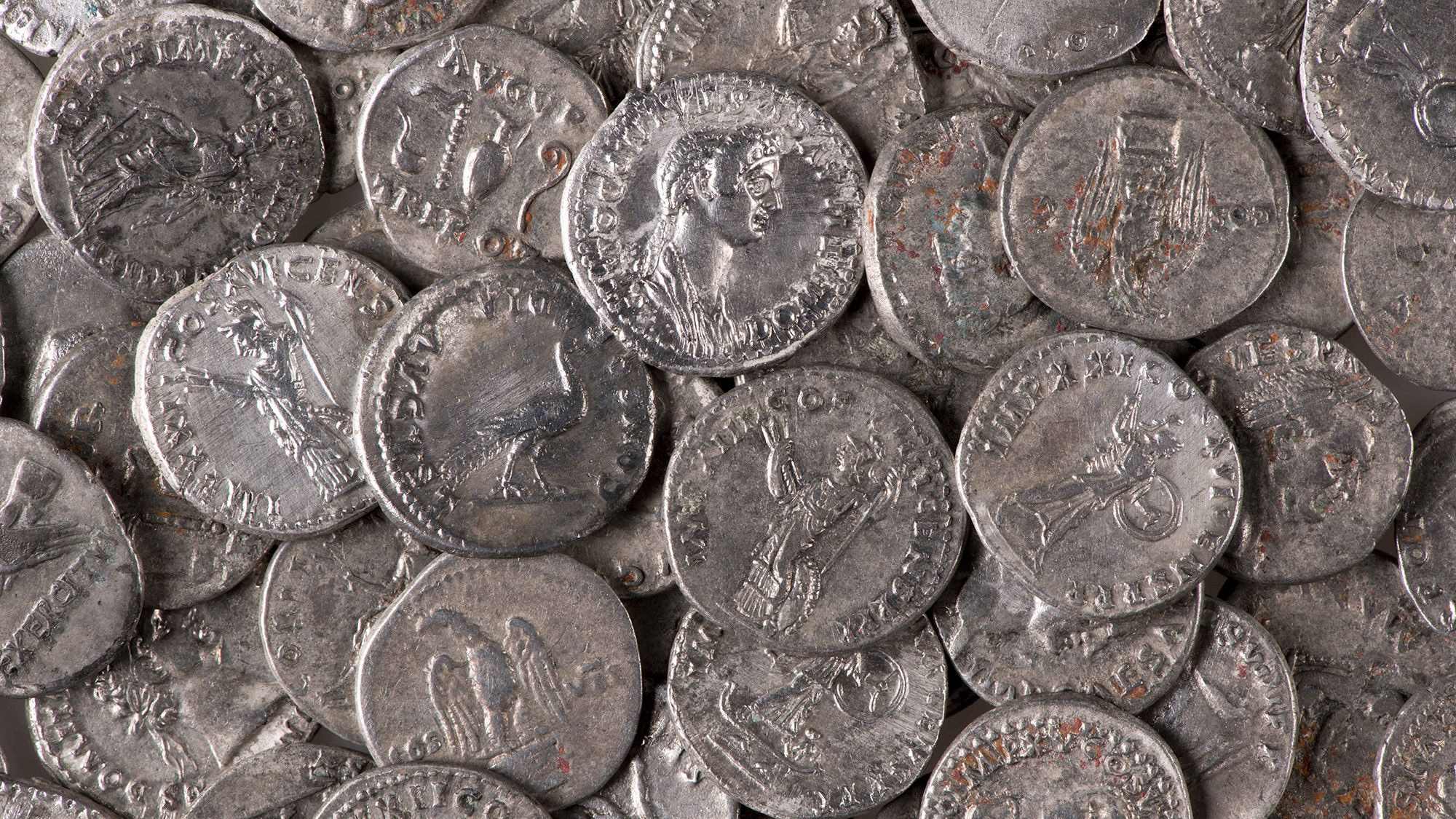
The pile includes more than 900 silver denarii — the denarius was the standard coin of the early Roman Empire — and weighs almost 7 pounds (3.1 kilograms).
The stash was discovered about a year ago in a field near the small city of Wesseling, a few miles south of Cologne, according to a translated statement from Germany’s Rhineland regional government. It’s now on display at the Rhineland Regional Museum in Bonn (LVR-Landesmuseum Bonn).
Latest Videos FromLive Science
Archaeologists think the hoard was buried at the time of the Emperor Hadrian, who ruled from A.D. 117 to 138, because the most recent coin was minted in 124 or 125.
But the coins span more than three centuries: the oldest was minted in 148 B.C., during the time of the Roman Republic; while most of them are from the time of the Flavian emperors — Vespasian and his sons, Titus and Domitian — from A.D. 69 to 96.
The coins span more than 300 years. The earliest were minted during the Roman Republic and the latest coin dates to the reign of the Emperor Hadrian.
(Image credit: Marcel Zanjani/LVR-Office for the Preservation of Archaeological Monuments in the Rhineland)
Silver signal
The statement praised the metal detectorist, Oliver Riedl, who found the hoard and stopped digging after unearthing 15 of the coins. At that point, his metal detector signaled that something much larger was hiding underground.
“It was clear to me that there was something bigger in the ground here,” Riedl said in the statement. “I therefore immediately informed the office.”
Get the world’s most fascinating discoveries delivered straight to your inbox.
Riedl is licensed by the state to use his metal detector and has been trained by regional archaeological authorities, the statement said. (Illegal metal detectorists also operate in Germany, but are known to often disrupt the archaeological value of their finds).
Archaeologists from the Rhineland regional government soon investigated the find and excavated the entire hoard of 934 Roman silver coins. The block of earth that contained the coin hoard was removed whole and X-rayed before it was opened, the statement noted.
Erich Claßen, the head of archaeology for the Rhineland regional government, said it seemed that the original owner collected most of the coins in about A.D. 100, but didn’t actually bury them until Hadrian’s time.

Most coins in the buried hoard date to the time of the Flavian emperors. This one is adorned with the likeness of Domitian, who ruled from A.D. 81 to 96.
(Image credit: Marcel Zanjani/LVR-Office for the Preservation of Archaeological Monuments in the Rhineland)
“We can only speculate about the motives, but very likely someone wanted to keep this money safe,” he said in the statement. “Banks did not exist at that time.”
But whoever buried it never came back. “It is possible that the owner died beforehand without being able to pass on the knowledge of the coins,” Claßen said.
Buried treasure
Marjanko Pilekić, a numismatist, or coin expert, at the German Historical Museum in Berlin who wasn’t involved in the find, said it was significant that the hoard was unearthed just inside the northern frontier of the Roman Empire demarcated by the Roman limes, which ran along the Rhine nearby.
He told Live Science in an email that the location suggested when the hoard had been purposefully buried: “In this case, we can cautiously assume that the hoard was buried not long after the most recent coin was minted,” Pilekić said.
Outside the Roman Empire, however, in the Barbaricum – the “barbarian” regions beyond, according to the Romans — such hoards of coins were often buried much later, he said.
While its historical value is priceless, the worth of such a hoard during the second century A.D. would have been considerable: 300 denarii was the yearly pay of a Roman legionary at the time of Hadrian, of which around half was deducted for food and equipment, regional archaeologist Rahel Otte, who led the excavation, said in the statement.
This means that a legionary “would have had to save all his available money for about six years to accumulate the Wesseling treasure find,” she said.
She added that it was unclear who had buried the hoard, but it may have been someone who lived on one of the Roman estates in the area.
From Augustus to Nero, see how much you know about ancient Rome’s famous leaders with our Roman emperor quiz!