QUICK FACTS
Where is it? Along the California-Nevada border [38.70029087, -119.44294268]
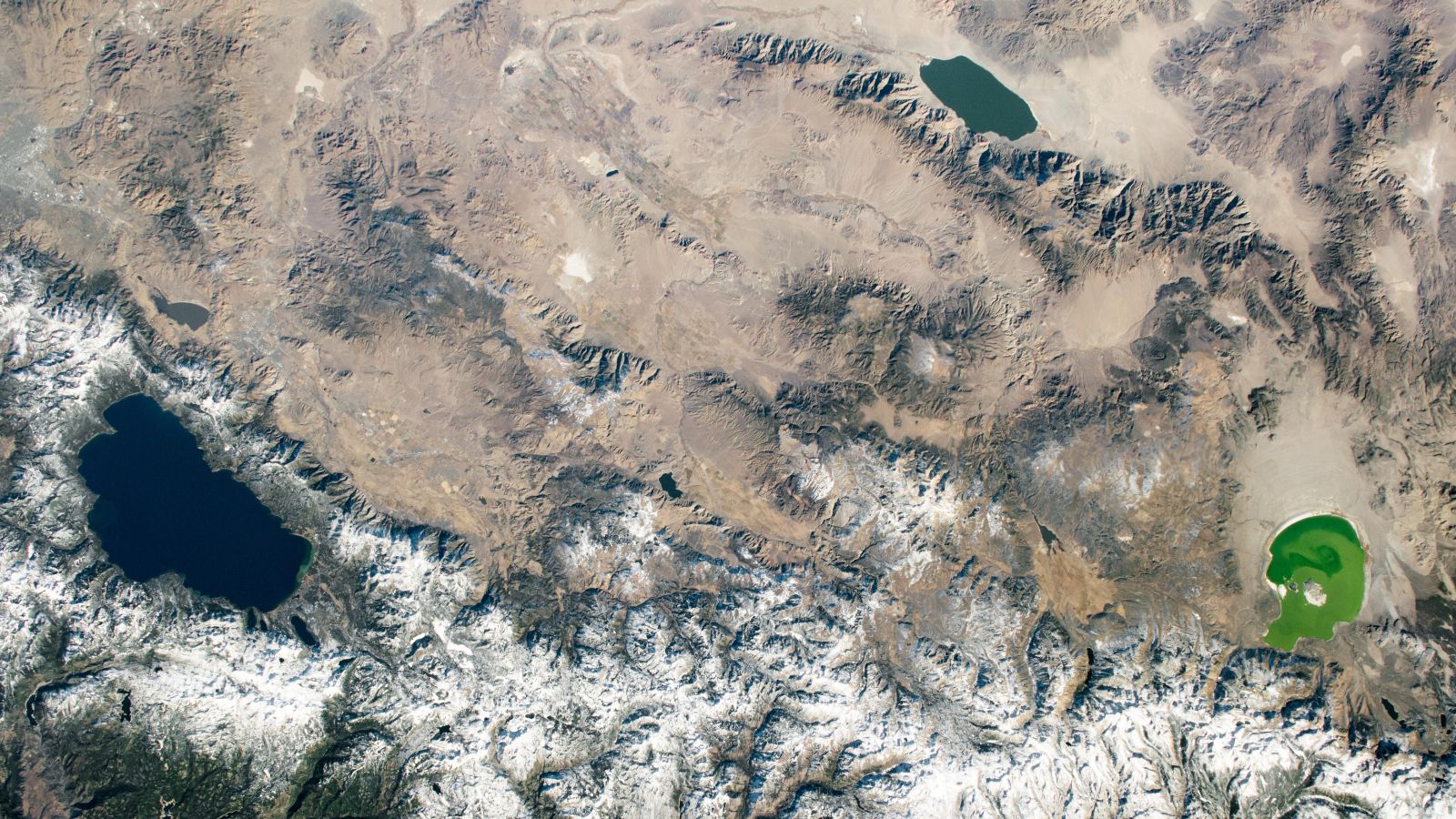
What’s in the photo? Lake Tahoe (left), Walker Lake (upper right), Mono Lake (lower right)
Who took the photo? An unnamed astronaut on board the International Space Station
When was it taken? Dec. 3, 2020
This dramatic astronaut photo shows a trio of colorful lakes straddling the border between Nevada and California. The three lakes — which vary in shape, size and salinity — also occupy very different biomes.
The most famous lake in the trio, Lake Tahoe (on the left), is the largest alpine lake in the U.S.. It covers an area of around 192 square miles (497 square kilometers) and sits at about 6,223 feet (1,897 meters) above sea level in the Sierra Nevada, which stretches across the bottom of the image and is covered in snow.
The other two bodies, Walker Lake (upper right) and Mono Lake (lower right), are positioned southeast of Lake Tahoe and each have have a maximum width of around 13 miles (21kilometers). (Another major body of water, Pyramid Lake, is located out of the shot to the northeast of Lake Tahoe, while two much smaller lakes sit between the three larger lakes.)
The border between California and Nevada runs directly through the middle of Lake Tahoe and continues to bisect the space between Walker Lake, which is in Nevada, and Mono Lake, which is in California.
While Tahoe is located in the lofty climbs of the Sierra Nevada and is subsequently exposed to very wet and cold conditions, Walker and Mono are situated within the Great Basin desert. This flatter region — which also covers parts of Utah, Idaho and Oregon — has a drastically different environment because it sits within the mountain range’s “rain shadow” and, therefore, receives very little precipitation, according to NASA’s Earth Observatory.
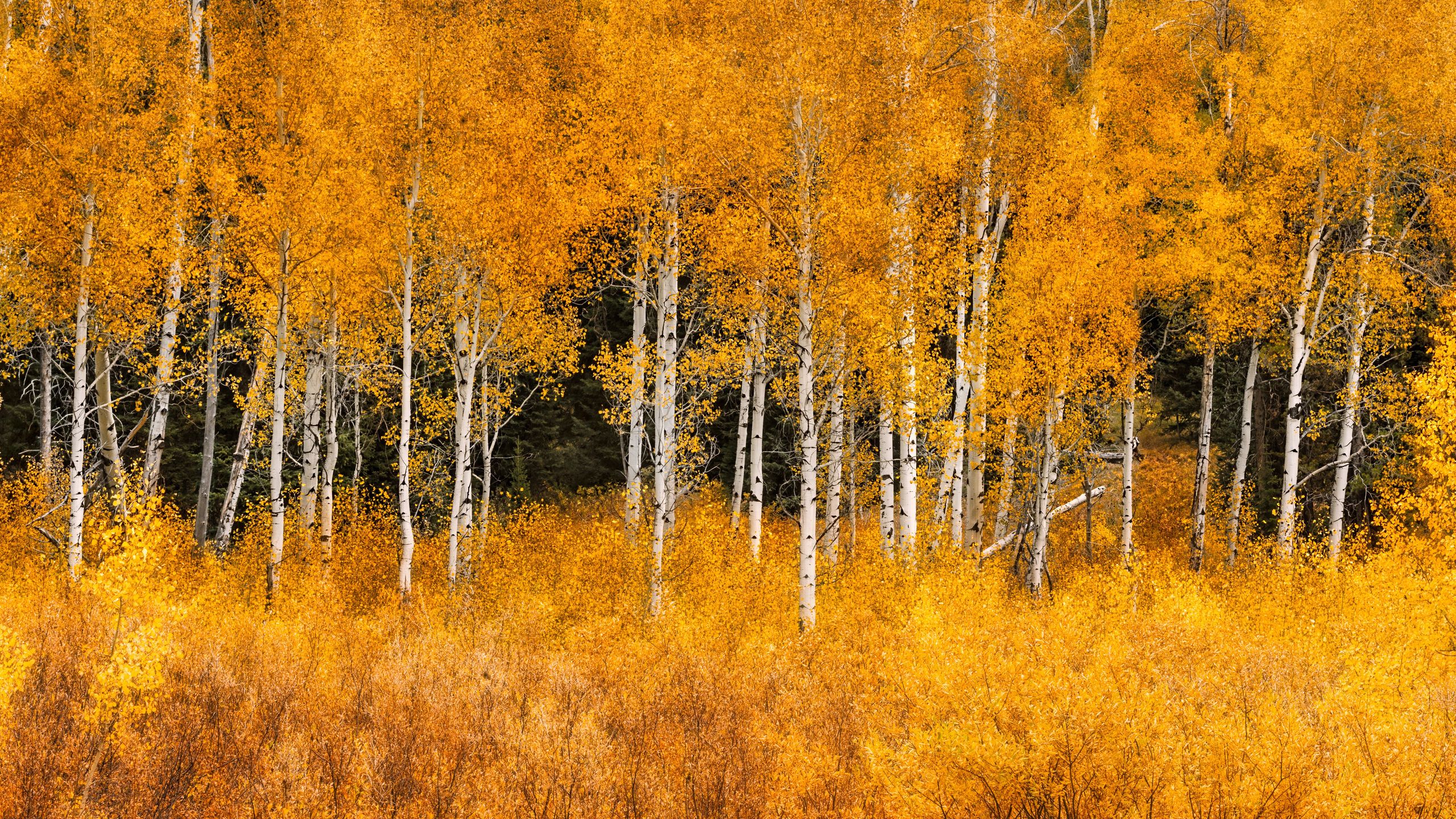
Despite sitting at an altitude of 6,223 feet (1,897 m), Lake Tahoe never freezes due to subsurface currents that keep its waters moving.
(Image credit: Michael Heiman via Getty Images)
The other stark difference between the lakes is their respective colors, which become even more apparent when viewed from above.
Lake Tahoe is the second-deepest lake in the U.S., with a maximum depth of 1,645 feet (501 m). As a result, it has a rich, bright-blue hue. It has constant subsurface currents that prevent it from freezing over in the winter, so it looks the same year-round.
Get the world’s most fascinating discoveries delivered straight to your inbox.
Walker Lake is endorheic, which means it does not have a proper inlet or outlet and instead rises and falls via rainfall and evaporation. Over the past few centuries, the rate of evaporation has outpaced precipitation, which has made the lake extremely salty, or hypersaline. This altered chemistry, combined with the lake’s shallower waters and the presence of various microbes, gives the lake a greener hue when viewed from above.
Mono Lake is also endorheic. It has seen an even sharper drop-off in recent years, as evidenced by a series of “bathtub rings” left over from when the lake had much higher water levels. It’s home to salt-tolerant photosynthetic algae, which are preyed upon by brine shrimp (Artemia). Drops in the shrimp population in the colder winter months allow the algae to bloom, causing Mono Lake to turn bright green. If you look closely at the image of the lake, you can see a large swirl that represents the blooming algae getting trapped within wind-driven surface currents.

During the winter, the drop off in brine shrimp numbers allows vibrant green algal blooms to take hold of Mono Lake.
(Image credit: Daniel Viñé Garcia via Getty Images)
Due to the sharp rises in their salinity, Walker and Mono lakes have almost no remaining fish populations. This has allowed algae to take a greater hold in both lakes, according to the Mono Lake Committee.
Mono Lake also made headlines in 2010 when NASA scientists found a species of bacteria living there that could feed on the high levels of arsenic in its waters — a first in microbe biology, which could “impact the search for evidence of extraterrestrial life,” researchers claimed. However, this paper was eventually retracted in 2025 after experts noticed flaws in its data.
Although it is rare to see many visually contrasting lakes in close proximity, similar scenes have been snapped from space. For example, in Africa’s Great Rift Valley, there is a striking trio of blue, green and yellow lakes. Colorful collections of lakes can also be found in Crimea’s “putrid sea” and around the Etosha Pan in Namibia.

A 2015 satellite photo shows a series of golden tendrils surrounding Ghana’s Lake Bosumtwi, which is considered sacred to the local Asante people. The lake and its surroundings were shaped by a massive meteor impact around 1 million years ago.

A 2017 astronaut photo shows two sets of solar evaporation ponds alongside the Colorado River. The stripy structures are used to refine potassium chloride, or “potash,” which is mined nearby.
TOPICS