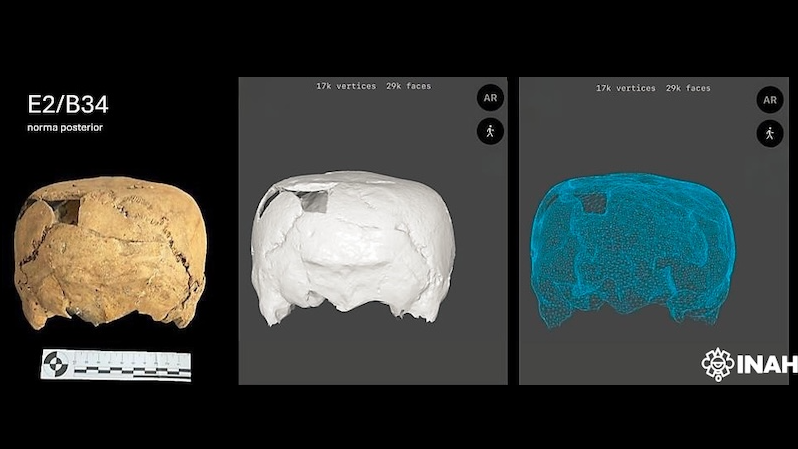
Archaeologists digging at a Mesoamerican site in Mexico have discovered an unusual, cube-shaped human skull. It is the first evidence that people in this area practiced a unique form of head-shaping, scientifically known as cranial modification, around 1,400 years ago.
The skull was unearthed near the archaeological site of Balcón de Montezuma (Balcony of Montezuma) in the east-central Mexican state of Tamaulipas. Various Mesoamerican ethnic groups lived in the area between 650 B.C. and A.D. 1200. Around A.D. 400, a village sprang up, eventually encompassing around 90 circular houses in two plazas, according to the Mexican National Institute of Anthropology and History (INAH).
In a recent review of artifacts and bones discovered at Balcón de Montezuma, researchers noticed that the skull of a middle-aged man was a shape they’d never seen before.
In a Nov. 25 translated INAH statement, biological anthropologist Jesús Ernesto Velasco González explained that, while artificially modified skulls have been discovered in the area before, the shape of this man’s skull is unique.
Many people are familiar with cultures that practiced cone-shaped cranial modification, as these skulls have an almost “alien” appearance. Those skull shapes were typically created by using lengths of fabric or soft padding to “bind” the heads of infants and encourage the skull to grow in an “oblique” direction, and they appear elongated.
Most of the modified skulls from Balcón de Montezuma, meanwhile, are shaped in an “erect” direction by placing soft padding on the back and/or front of the skull, causing the person to have a more upright or pointy head.
But the man from Balcón de Montezuma has a different form of “erect” modification in which the top of his head was flattened, giving his skull a cube-shaped appearance that some experts refer to as parallelepiped (shaped like a three-dimensional parallelogram or rhombus).
Since examples of this flat-topped skull shape had only been seen outside the area, including in Veracruz and in the Maya area, the researchers wanted to test whether the man was local or foreign. Analyzing the chemistry of the man’s bones and teeth, however, revealed that he was born in the area, likely lived there his entire life, and died there.
The researchers’ speculate that man’s uncommon head shape may have some sort of culturally-specific meaning that is still unknown. In many parts of Mesoamerica, slightly different head shapes are known to correlate with different cultural groups. Although this man himself was not from another geographic location, it is possible that the people who shaped his head were members of a different cultural group.
Research into the material recovered from past archaeological investigations at Balcón de Montezuma is ongoing, according to INAH Tamaulipas director Tonantzin Silva Cárdenas, and will help expand experts’ understanding of the site and its cultural and historical relationships with other pre-Hispanic groups in the area.