





Follow us
Add us as a preferred source on Google
Subscribe to our newsletter
Hold a strong magnet close to a candle flame, and the flame moves — bending, deflecting and splitting.
But the magnet isn’t touching anything, so how can it move the flame?
Experts told Live Science that the driving force comes from the oxygen in the air, and that a related effect has big implications for stopping fires in space.
Latest Videos FromLive Science
How magnets steer flames
Of all the common gases in air, only oxygen is strongly paramagnetic. That means its molecules are attracted to magnetic fields, while nitrogen, argon, and CO₂ are essentially invisible to them. While most molecules pair their electrons in ways that cancel out their magnetic properties, oxygen’s unusual molecular structure leaves two electrons unpaired.
“Their spins [the intrinsic quantum property of particles that causes them to act like tiny bar magnets] don’t cancel,” Gabriel Xu, an aerospace engineer at the University of Alabama in Huntsville, told Live Science in an email. “They respond to a magnetic field by aligning their spin with the field. That’s what produces the paramagnetic effect.”
Nitrogen makes up about 78% of the atmosphere, but its electrons are fully paired — so it doesn’t respond to a magnetic field at all. Carbon dioxide and argon, also present in air, behave the same way.
That leaves oxygen, which makes up about 21% of the air, as almost the only molecule that responds magnetically.
Curious about Life’s Little Mysteries?
Feed your curiosity with an exclusive mystery every week, solved with science and delivered direct to your inbox before it’s seen anywhere else.
A magnet brought near a candle flame therefore exerts a selective pull, drawing cooler, denser air toward the strongest part of the magnetic field and creating a pocket of higher pressure that physically shoves the hot flame gases out of the way.
The magnetic field lines of a bar magnet interact with the spins of oxygens molecules’ unpaired electrons, drawing them closer.
(Image credit: Wittayayut via Getty Images)
“The magnet will deflect the flame away from it,” Xu said. “The oxygen in the flame and post-flame region has been consumed, so the magnet pulls more on the cold air that still has oxygen. It acts like buoyancy, where the magnetic field gradient takes the role of gravity, and the flame ‘rises’ away from the magnet.”
Meanwhile, the combustion gases inside the flame are all diamagnetic, meaning they’re pushed away by a magnetic field rather than drawn toward it. The gases — carbon dioxide and water vapor — have no unpaired electrons. “Even paired electrons interact with the magnetic field and generate a tiny opposing field of their own,” said Xu. “It’s true for all atoms and molecules — it’s just really small so it doesn’t show up most of the time.”
Soot, the fine carbon particles also produced in combustion, is diamagnetic for a different reason. Its carbon atoms arrange into six-membered rings, and electrons circulate freely through those rings, amplifying the diamagnetic response.
But flames aren’t just hot gas. During combustion, chemical reactions knock electrons loose from molecules to create charged particles called ions.
A “flame is a low-ionization plasma,” Xu said, and plasma responds to fields, which curve the paths of moving charges. By applying a voltage between two electric plates placed on each side of a flame, scientists can use this ionic wind to steer the flame, shoving it away from a fuel supply or snuffing out a fire without water or chemicals.
“Think of a bunch of people trying to run through a crowded mall,” Xu said. “They just keep ricocheting off each other, but they keep running, and slowly push everything in one direction.”
Why fire behaves differently in space
In 2008, the U.S. Defense Advanced Research Projects Agency (DARPA) funded the Instant Fire Suppression program, which tested using the effect to extinguish fires on aircraft and spacecraft, where water-based suppressants can cause damage. The method showed promise, though it has not yet been adopted.
NASA has also run its own flame-corralling experiments aboard the International Space Station (ISS), where researchers applied up to 10,000 volts across small burner flames to study how electric fields affect combustion.
Without gravity to pull hot gas upward, flames spread in all directions, creating a nearly spherical blue glow. Because water also floats freely in space, ISS crews currently use carbon dioxide to dilute a flame’s fuel vapor below reaction concentrations, explained Ya-Ting Liao, a fire scientist at Case Western Reserve University.

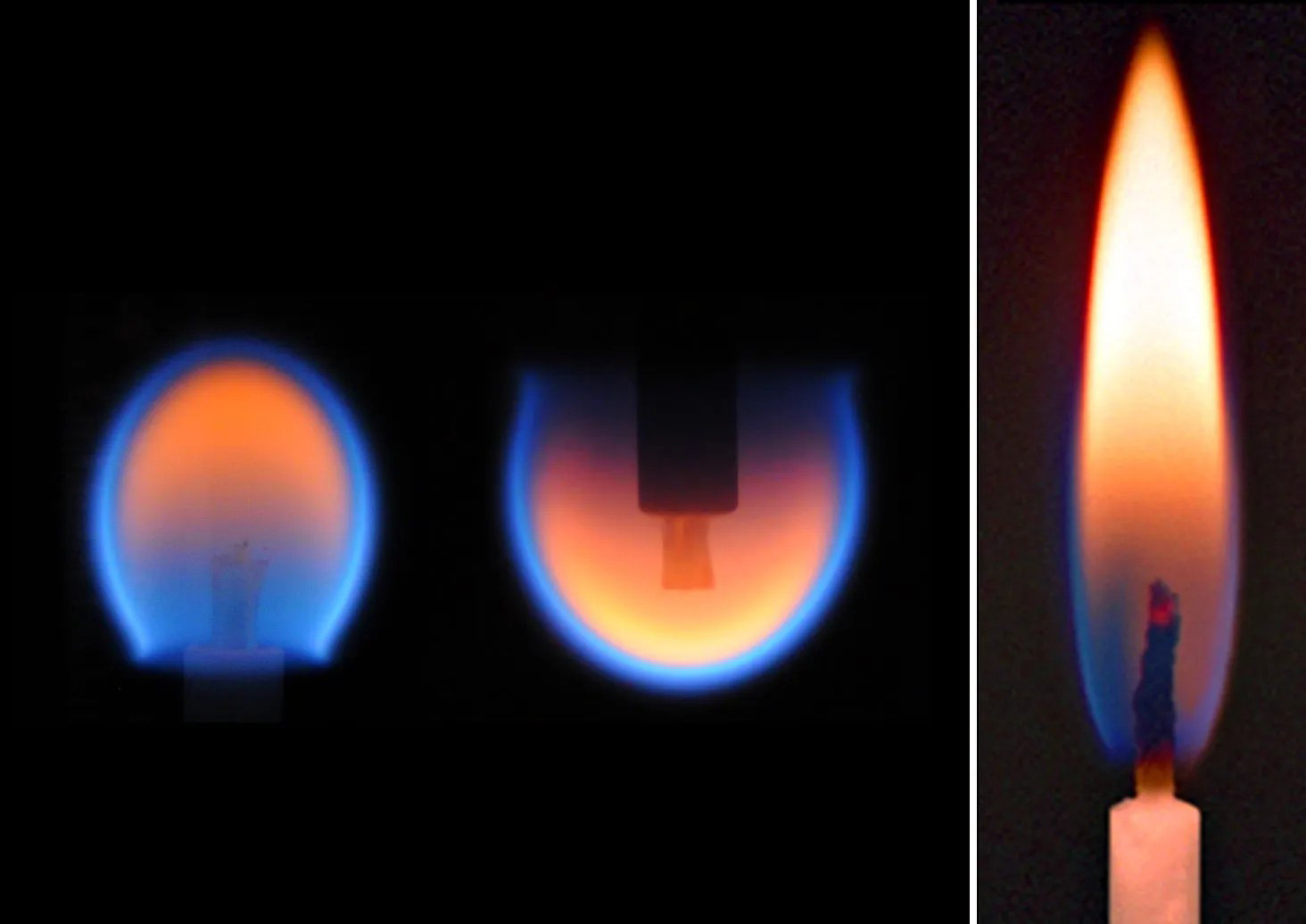
A spherical flame in space (left) next to a candle burning on Earth (right).
(Image credit: NASA)
Liao’s research now focuses on a scenario that may soon become urgent: fire on the moon, where gravity is one-sixth of Earth’s, causing some materials to burn more aggressively. “Something that you consider safe on Earth can become non-safe on the moon,” she told Live Science. As NASA moves toward permanent lunar habitats, that kind of knowledge could prove critical.
Researchers are also developing magnetically-confined plasma engines for space flight. With air rushing through them faster than the speed of sound, keeping a flame going inside these engines is “a hurricane blowing out a candle problem,” Xu said.
Of the four fundamental forces of the universe, the electromagnetic force is the one humans can control most practically. That gives fire scientists a tool no other branch of physics can offer.
“You can kind of reach into the fire,” Xu said, “and poke the particles.”
How many elements can you name in 10 minutes? Find out with our periodic table of elements quiz!
TOPICS